Aguilar Tone Hammer
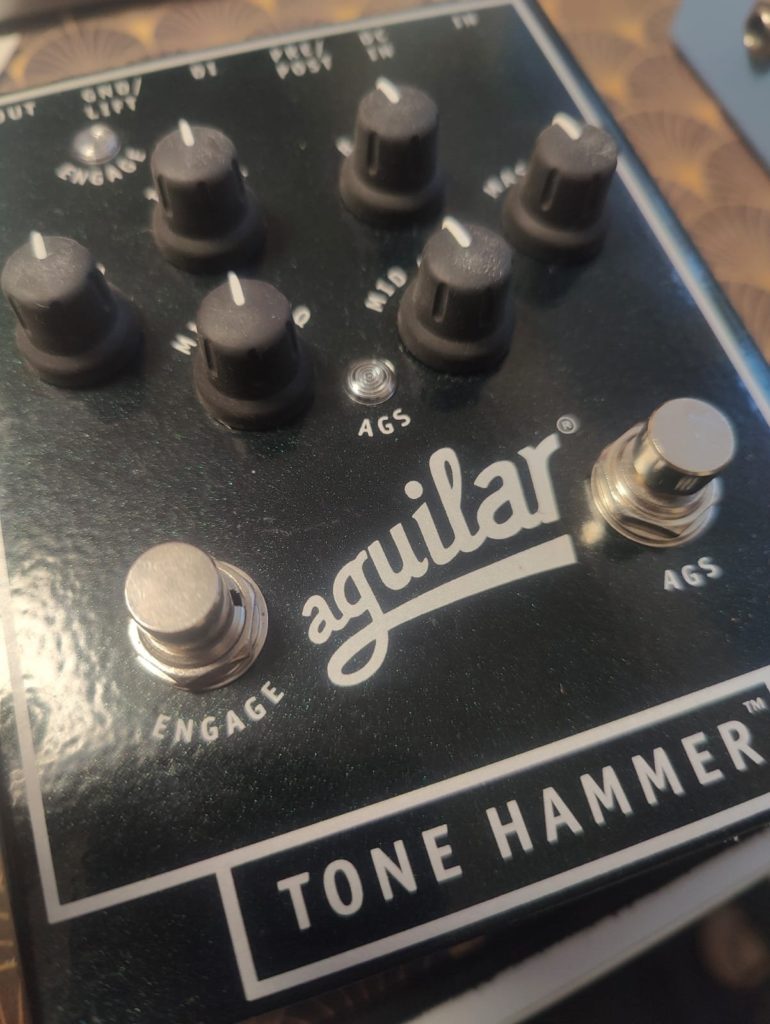
The Tone Hammer Preamp pedal was the first thing Aguilar released in the Tone Hammer product family, in early 2011. I always assumed they did the amp first and then made a pedal from the preamp section, but the pedal came out a few months before the amp – it seems like they planned to do both from the start. Since 2011, the Tone Hammer 350 and 500 came out, followed by the 700, and then everything got re-worked after Aguilar was sold to Korg, and if you ask my personal opinion, the V2 lines lost the Aguilar charm and look and feel much more generic. So when I decided to get a Tone Hammer pedal in 2025, I went for the old version. This one is a heavy pedal. It feels a lot more solid than it needs to, but in my book that’s a good thing.
It has taken me this long to acquire this pedal because I could not get over how Aguilar implemented the AGS circiuit. Had they taken it and let you toggle between on and off via a push button or by flicking a switch, I would have been fine with it. But they went and mapped it to a foot switch. Foot switches suggest, at least to me, that this function is meant to be accessed mid song where you can’t bend down and twiddle knobs because you’re playing. For those of you that do not know what AGS is and does, there will be more on it further down, but let me give you the crucial bit of information: When you hit that foot switch you get, among other things, a +16dB boost in your signal. That’s a bit much for nearly every scenario I can think of as a bassist. 16dB takes you from barely audible to way too loud in a mix.
I did not follow Aguilar or bass preamp pedals back in 2011, but got curious about the pedal when I noticed it first in 2013. So it took me 12 years to get over that issue. Nitpicking thickheaded stickler for principles that I am.
What do we have here, in terms of pedal? Apart from being on the large and heavy side, this is a solid preamp pedal. It runs on 18V, which can be supplied by your pedalboard power supply (provided you did not cheap out on the PSU and bought a Cioks or anything else that can supply 18V or you have a voltage doubler cable that runs off two outlets), by a pair of 9V batteries or through the XLR cable by the mysterious means of phantom power.
Beyond the aforementioned AGS footswitch, there is a three band EQ. Bass boosts and cuts at 40Hz, treble sits at 4kHz and the mids are parametric, 180Hz-1kHz. In front of the EQ, there is a gain knob and after the EQ, there is a master knob. Then, there is the bypass foot switch and that’s pretty much it. 1/4″ input, Balanced XLR out, which features a ground lift (on my unit that defeats phantom power – no idea if that’s a general rule or only in my test setup) and a pre/post switch, and of course there’s a 1/4″ out to run to the amp or other pedals.
The gain knob will pass signal at zero.
Aguilar has already released two pedals that are modeled after features of the Tone Hammer, the DB 316 which does essentially the same thing as the parametric mids on the Tone Hammer do and the Storm King, which is a copy of the AGS circuit in a standalone drive pedal (my opinion on this one is found here ). I have bought and tested both of these and they do their jobs well – this should be testament to how good of a package the Tonehammer really is.
Ignoring the AGS for a second, the Tonehammer is quite unspectacular. It’s a solid preamp with a good gain range and useful EQ. Especially the XLR out with Phantom Power option makes this your one-pedal-pedalboard when you don’t need to bring much, but want a solid sound that works in a band context. This could also be the plan B you bring, should your amp, pedalboard or whatever you thought would drive the gig fail on you. In those regards, it’s a bit like the Origin Bassrig Super Vintage or the Sansamp. A solid piece of gear you can rely on, sending a signal to FOH that will work.
However, this is not my test of the preamp capabilities of the Tone Hammer. This is about the capabilities of the Tone Hammer as a drive pedal. For the following impressions, I did place it early in the signal chain and ran it through my pedal board, as I would any other drive.
But before I did that, I hooked it up to my mixer and fed it some white noise, to see how the frequency response is when everything is set at noon.
Here’s the white noise I fed it:
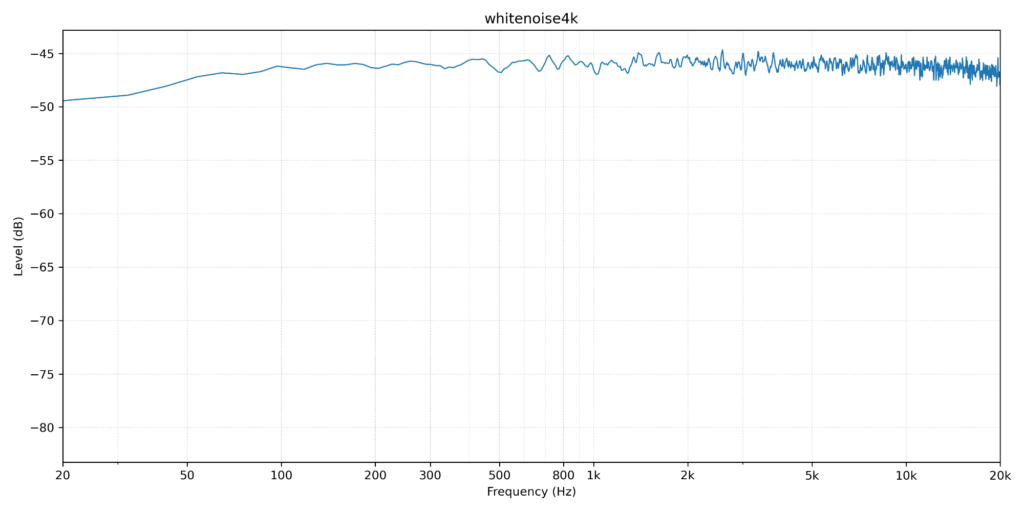
…I think in a super professional studio environment this line would be a lot less squiggly than it does when using my equipment, but as they say: “The best tool for the job is the one you have at hand”.
This is the Tone Hammer, being fed the above signal, with all controls at noon:
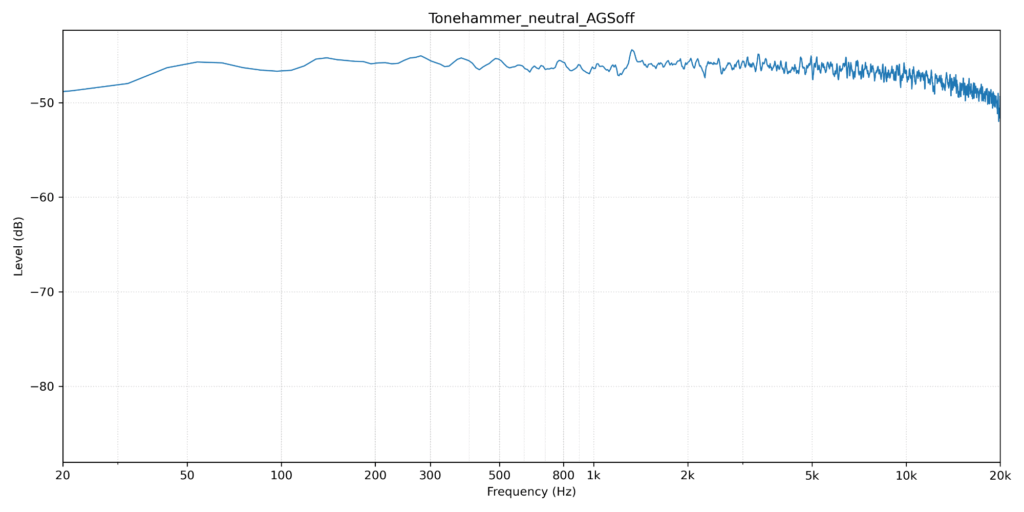
Which looks surprisingly similar. I can’t tell if the little budge around 50Hz is the pedal or inconsistency in the measurement process, so all that can be said is that the Tone Hammer has a mild drop towards 20kHz, but anyone who ever played one could have guessed that.
Now, let’s look at what happens when you switch on AGS:
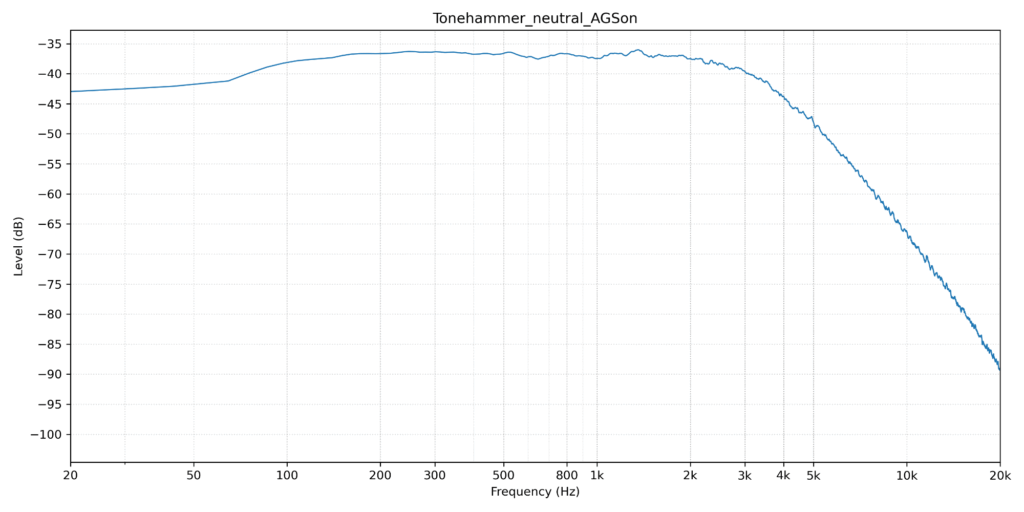
Aguilar writes about a tightening of the low end, which my humble measurements do not really show – but one thing that is not to be ignored is how the signal drops off in the top end. Starting at 3k, it goes downwards. At 10k we’re easily at -30dB compared to the 100Hz-2kHz range.
I did one last chart, where I dialed in a pleasant, mild drive tone by ear and when I was happy with what I was hearing, I hooked up the white noise again and measured once more:
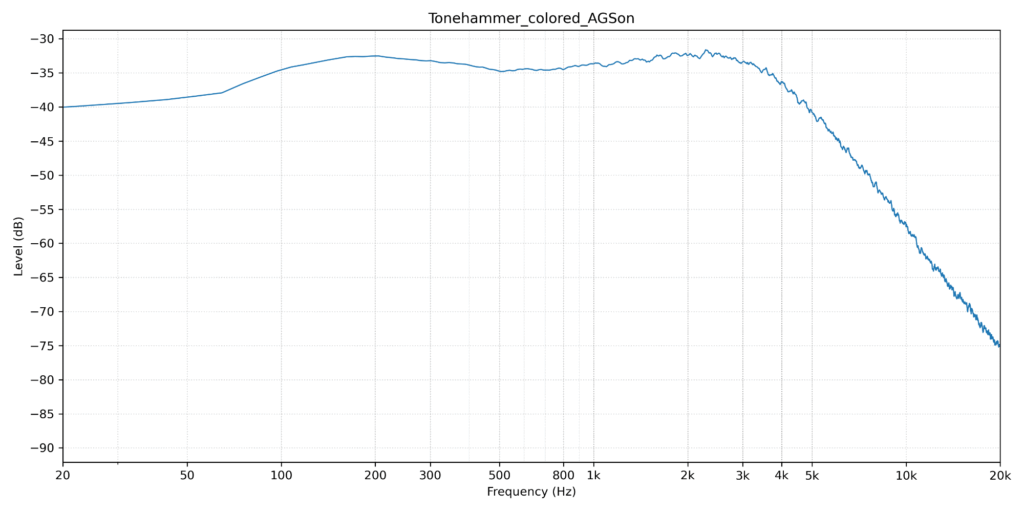
There’s not too much difference but one could say there’s a little boost around 100-200, a little cut at 500 and then a bit of boost again at around 2k.
What baffled me about these measurements, and the fact that my ears confirmed them, is how neutral the sound is when you have everything at noon and AGS off. I had the Tone Hammer marked down as a device with a a baked in sound that would always be present. The amp always felt like that whenever I played it and I used the TH500 a lot!
Now, let’s end this little excursion, plug back into the signal chain, leave the white noise off and play some bass.
Given that more or less the same circuit this pedal is rocking has become a popular bass amp when Aguilar added a power amp and put it in a slightly bigger (but not much heavier) box should suggest that the nature of the drive can be described as “amp like”, and you’ll find neither plot twist nor surprise in this paragraph: It totally is. I get a certain amount of push back when I push the dynamics to force it into overdrive. The tones get a harsh reaction that sits very close to the initial attack, so close that there’s hardly any difference between the initial attack of the note and the reaction of the drive, and the drive on these notes flares up short and bright, then quickly fades upon note decay. The organic qualities of the amp remain in this pedal. The amp does not have an AGS switch, but it comes with a drive knob, so you can, on the amp, blend in the AGS in a seamless way instead of the brutal on/off choice of the pedal.
Others did the measuring for that already, and determined that the amp’s drive knob set at 3 o’clock equals the AGS on state of the pedal. I already mentioned that there’s a solid jump in volume when you switch on AGS. You get roughly +16dB (the amount of boost you get varies with the setting of the gain knob) of gain on top of your previous setting, and you get the measured drop off from 3kHz onwards.
I am unable to tell if that’s all that happens, or if there’s more to it. The overall level jump makes a direct A/B comparison somewhat impossible for me.
With the Tone Hammer amp, I am able to get drive sounds with the gain knob past noon without ever touching drive and I use the interaction of gain and drive to shape a pleasant breakup (and while learning the ins and outs, I did swear a lot as the learning curve is more than you’d imagine). The pedal is a lot simpler in that regard. If you want driven sound, activate the AGS and set the amount of drive with the gain knob. There’s no intricate dance between knob positions, at least not between gain and drive.
The earlier described organic quality of the drive is warm and by no means harsh for the ear. There’s no metallic taste or aftertaste, and it’s really a bit mellow, especially when you go ahead and compare it to a Darkglass device. I do quite like the feeling and the taste of the pedal when used as a drive – or even a standalone. You might have guessed it already, but the AGS induced drop of the frequency curve makes a cab sim redundant, the Tone Hammer’s drive sound is fine through a PA system with no additional processing. Switch the AGS off for more top end – in that regard it really works.
Since I do have the Aguilar Strom King in my possession, and Aguilar claimed that it is based on the AGS circuit of the Tone Hammer (when they released the v2 version of the Tone Hammer that has a drive knob like the amp, they did rename the second foot switch to “Drive” and re-wrote the description of the Storm King accordingly), I gave those two a small A/B test in order to figure out if they can be made to sound similar.
That test revealed that when set to about the same level of drive the nature of the breakup is somewhat similar and also the response feels more or less the same with maybe a little more push back from the Tone Hammer, the Storm King sounds a little more open in the top end.
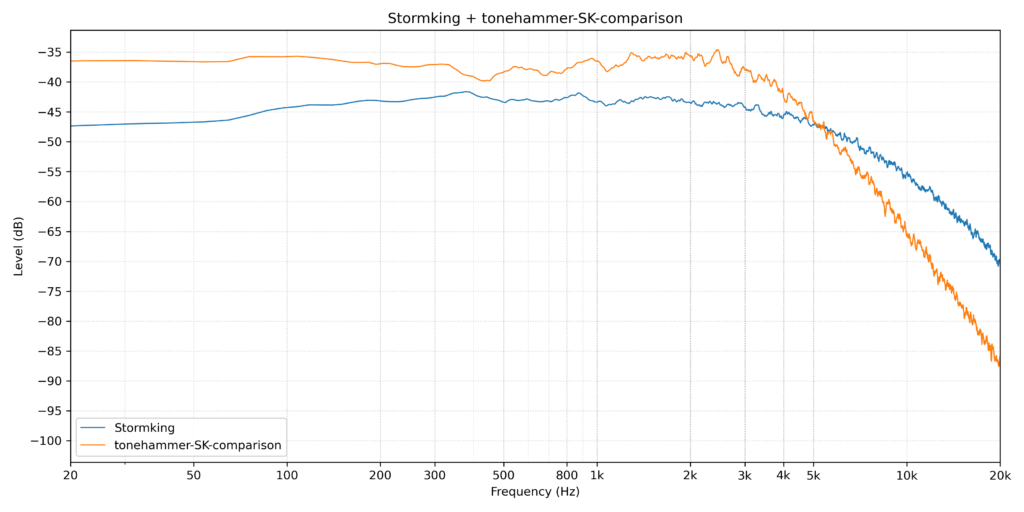
Double checking with white noise showed the graph of the Storm King to look familiar, but the drop off of the curve is less steep than it is on the Tone Hammer. While the Tone Hammer sounded fine when playing on its own, in direct comparison I do prefer the little plus in the top end, because it still works as a rudimentary cab sim, but makes the bass sound a bit crisper and gives it a bit more presence. This effect might be negated by the use of fresh roundwound strings where the Storm king might get a harsher edge where the Tone Hammer stays warm and round, and there are more options for the tone shaping process, but I must admit that for my personal preference and setup, the Storm King works right out of the box and I don’t feel the need to shape the low end or mids in any way – so when using either of those purely as a drive pedal, the Storm King would get my vote. It has a smaller foot print and better treble, while bringing the same general taste of dirt.
Nonetheless, I feel like I can easily recommend the Tone Hammer as a pedal, because it can do much more than just deliver the overdrive to your setup. You will get a variety of sounds from it, but you should prefer sounds that are generally described as warm, mellow, organic and fat, because it’s not the pedal that wants to bite through the mix, it prefers to sit cozily nestled in the sweet spot.