Broughton Evergreen Overdrive
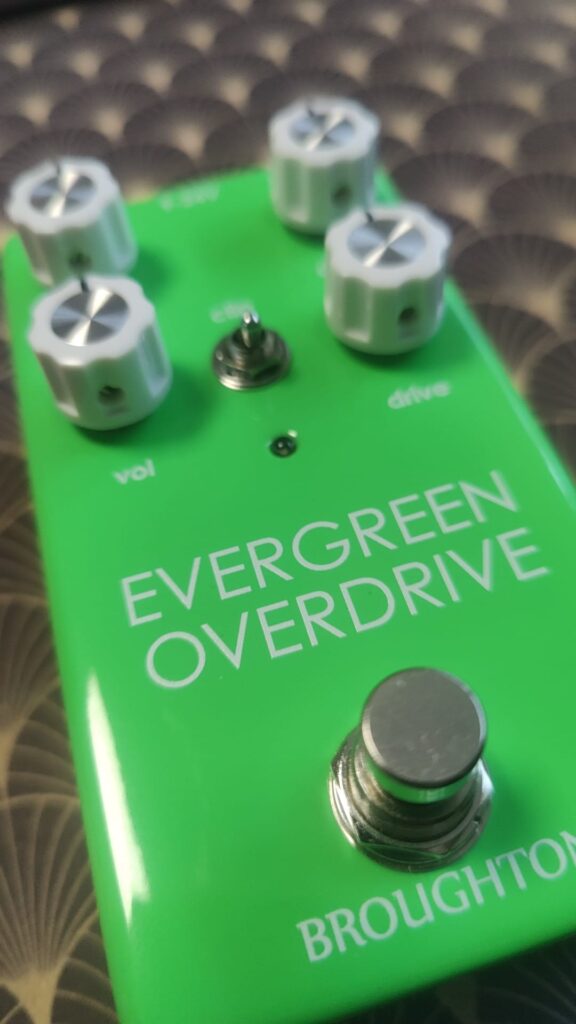
This is the Broughton Evergreen Overdrive. It is an overdrive and it is green, which gives a clear hint towards what kind of pedal we’re looking at. Here’s another hint: It’s not the Nobels ODR-1.
When I saw the drop of a new pedal on the Broughton website, I must admit that my first thought was
“Great! Just what the world needed. Another Tube Screamer” [read that in a voice that drips with sarcasm]. Then I read the description, because once my eyes had recovered from that shocking hue, I was able to make out details. The Tube Screamers come with three knobs. Volume, Overdrive and Tone.
This pedal has four knobs and a switch. So I read the description on the Broughton site to find out what they do. The switch is labeled clip and switches between your standard, Tube Screamer typical silicone diodes to LED, and not enough with that, those LEDs clip asymmetrical. I personally find the nature of LED clipping a bit chaotic and more often than not, don’t like LEDs as clipping diodes – combine that with asymmetrical clipping and it should be pure chaos. Interesting. Luckily, there are good old, reliable and symmetrical silicone diodes as an option, so there’s that. A Tube Screamer with a weird clipping option is not what sparks any kind of interest with me, though. The fourth knob, however. It is labeled depth. Depth is, of course, the elephant in the room when talking about Tube Screamers and bass. These pesky little green devices have that nasty little habit of squeezing your sound into a ball that has most of its mass in the high mids which works great on guitar. I mean, there’s a reason that you go “Tube Screamer” whenever you see a green drive pedal. They are everywhere and they work. But you rarely see them on bass boards because most bassists like low end and low end is not what the Tube Screamer does.
Broughton, being a company that completely focuses on bassists and their needs will of course have addressed that particular grey mammal, and somehow made sure there’s no balling up in the high mids without some counterweight in the lows. The Depth knob, however, reads a little bit different than “This is the bass EQ, it adds low frequencies”. No, it is a knob that decides how much low frequency content will be allowed to clip. I’m instantly reminded of two pedals. One would be the BJFe Blueberry that has a knob labeled “N” which is short for Nature, which decides how much low end is passed on to the clippers and the other is the Bogner Wessex, which has that weird bass control that feels like setting the crossover point between the clean bypass and the clippers. Add in that I did really like the Way Huge Green Rhino Mk V , which is also a pedal that is based on the Tube Screamer, and color me interested. Or color me green – which is the same thing in this context.
Concerning built quality and outward appearance, I say it’s a Broughton pedal. It’s well built, from high quality components. The color is strong, but also rich and deep, and the screen printing is sharp and clear.
It looks like a pedal done by the engineering department.
No people from finance “you know, when we switch to this other input jacks, we only loose a little quality, but save 32 cents per unit, that’s 64 if we use the same for the output”
but also no people from Design “You can’t just paint it green and write Evergreen Overdrive, in a sober font, on top. It’s got to have some panache”.
So let’s tackle the green beast.
Let’s start with some measurements. I tried to find out what the depth knob is doing.
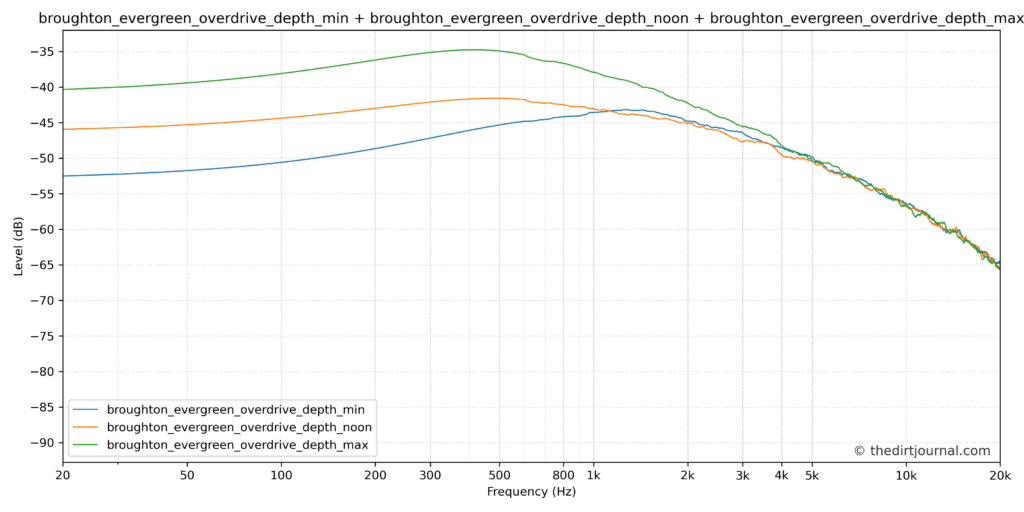
These measurements have been taken with all knobs at noon, except for the depth knob.
I repeated the same process for the Tone knob:
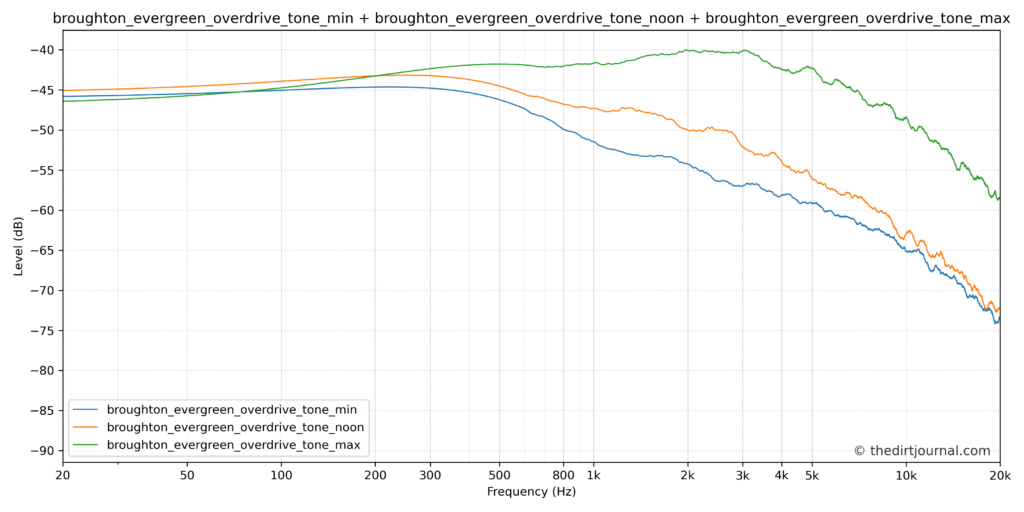
And since you can see the tone knob shows the slightest bit of a tendency to be a tilt EQ, with the fulcrum for the tilt anchored at 200Hz and the depth knob influencing frequency areas that sit well beyond that point, I repeated the depth-knob-measurements with both drive and tone dimed:
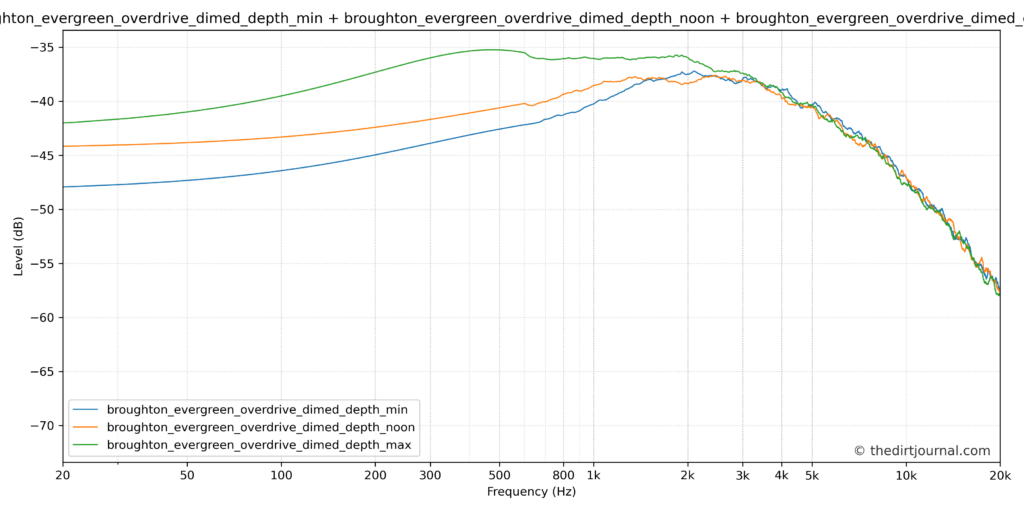
It does show certain traits of the Tube Screamer, especially when the depth knob is on the left side of noon, but the rather drastic high pass filtering of the original is thankfully absent. The depth knob seems to influence a lot more than just the lows, and it looks like it does its thing pre drive in the form of some sort of EQ. There are no clean lows siphoned off to be added post clipping as I would have assumed when reading the description of the knob.
But let’s get to the real question. How does it sound and how does it feel?
I do enjoy a well made Tube Screamer.
I am even able to enjoy a ‘bad’ one without bass optimization, at least for a moment up to the point where I realize how thin the low end is.
Why is that? Sound and feel. The Tube Screamer circuit always gives me the feeling of a drive pedal that has no inclination to influence the momentum in any way. A very amp like pedal pushes back, as if trying to stay clean. A very pedal like pedal pushes forward, as if to keep you with the drive tones.
The Tube Screamer is just stoic and chill, rolling with the punches, and in that regard, the Broughton Evergreen Overdrive feels like the original.
Another thing about the Tube Screamers that brings me enjoyment is that with the gain low, you have more or less a clean signal and with the gain dimed, you have overdrive, but on the milder side of things, giving you a large area of something of a sweet spot where it’s there but not overly so.
Plus, even though the pedal was intended to be used as a booster to push your amp into saturation, it sounds great on its own. The texture of the drive usually sounds like it’s done right, at least for my ears.
In my particular case I also enjoy when a pedal can give you a healthy boost in the 1k-2k area that will lead to more definition and sharper notes, something I don’t have an abundance of given my string choices, and the Broughton does that, too.
There is ample interplay between all knobs. Drive and Depth heavily influence each other, and while tone does not have as big of an impact as those two, it also joins the fray. Even though there are three knobs messing with your clipping results, the pedal is surprisingly easy to set, very forgiving and it’s easy to get a good drive tone out of it. You are absolutely allowed to turn a knob all the way, none of the extreme settings feel useless – and there is more than one sweet spot to be found. I did play, then change basses, then change pedalboards, then change the way I use the pedal, and it hung in there, stoic, chill, and rolled with the punches.
Checking it for its capability to do what the original was intended to do (making your amplifiers’ tubes scream), I quickly concluded that it totally does that, and does it well. Sending it either into the Meatsmoke or into the FPT, you get a solid overdriven grind with a texture the other device by itself is unable of delivering. Set to the edge of breakup, the Evergreen will deliver a slightly clipped signal into the clipping stage that will now be double clipped, and those two clipping instances stack extremely well for that blunted velcro sound.
The settings I seemed to gravitate to most were tone rather high, depth in the area between 10 o’clock and 2 o’clock and drive set high enough that normal playing emits audible grind, but barely so – so not on the edge of breakup, but just beyond that point.
While the pedal does compress somewhat with rising gain, there is still a fair amount of dynamics leaving the output jack, making it a good choice to send it into another gain sensitive clipping device to stack, but it also works just fine on its own.
The big surprise was the clip switch. I know that I favor silicon clipping to LED clipping, and I like the smoothness and predictability of symmetrical clipping.
I did anticipate the clip switch on the Evergreen to be for me what the bypass switch on the Klon KTR is for Bill Finnegan.
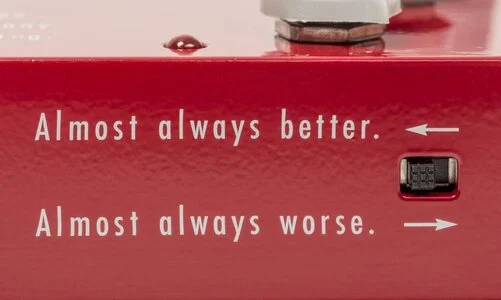
But in all honesty, it’s not. The nature of the clipping changes, but it felt a bit like the triode and pentode modes on the Singular Audio Tubedrve.
At first, you think this goes from a smooth and even sound to one that’s harsher, but then you realize that you need to adjust for the change and twist some knobs to accommodate the nature of the clipping. It gets a bit more edgy, but nowhere near a teenager with hair dyed so black it absorbs light, a makeup budget that rivals small governments and long sleeves on hot days that hide what they did to their arms. It’s really more like being a little bit too sarcastic for the occasion kind of edgy, and that can be dialed in with the knobs available, and before you know it, what felt like a drastic shift in character at first can easily be compensated with the means at hand and seamlessly integrated in your playing.
Since the gain reserves of the Evergreen Overdrive were not planned with modern metal in mind, the LED clipping does not reach levels of rabid fury, but also stops at solid overdrive. Since the grind of the LED clippers is a bit more on the rough and uneven sound, the sweet spots here are with higher gain settings, and riding the depth knob a lot higher than on the silicon side is fun.
Audio samples
Gain and Depth noon, Tone dimed:
Playing the Evergreen Overdrive into a slightly dirty Meatsmoke Tube Preamp (forgive the sloppy playing):
Tone maxed, Gain around 2 o’clock, Depth 11 o’clock