Disssid Dynamic Drive
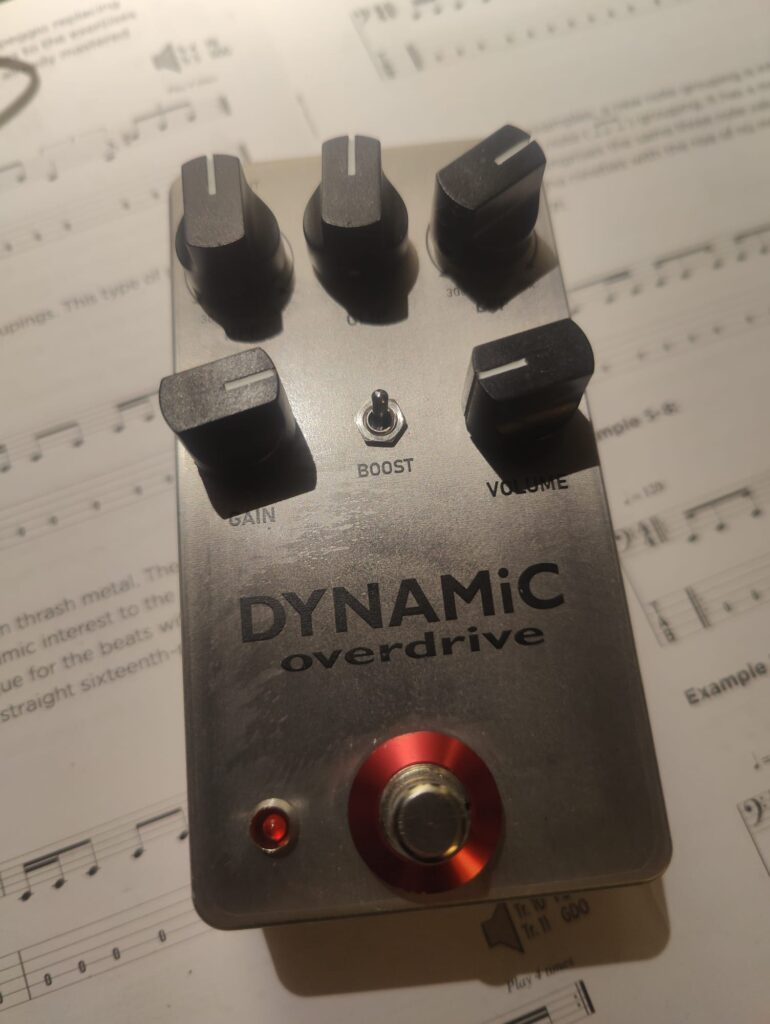
This is another clone made by Disssid, this time it’s a copy of the VFE Dragon Dynamic Overdrive.
Comparing the Disssid pedal with a pic of the original, I immediately realize on the Disssid, there is one more knob on the face plate, labeled “Clip”. Some research shows that this is not an addition. The original design has an internal trimpot for that job, Disssid merely deemed it important enough to put it on the outside for easy access.
The knob layout is as follows:
You get your typical gain and volume knobs that act as expected.
On top of that, you get a HPF and LPF knob, as well as the aforementioned Clip knob and a switch labeled boost.
The Clip knob is a bit weird. VFE claims that it fine tunes the amount of compression on the gain stage.
Disssid said the knob controls MOSFETs that clip, so he’s labeled it Clip.
I say when playing around with it, it feels like a BIAS knob. When you turn it low, you get more distortion in the signal and when you run it high, you also get more distortion – but both sound a bit off. I turned it up and down a lot, but always ended up around 1 o’clock and found that this sounds best.
Next, the “Boost” switch. I could not figure out what it does, so I measured it.
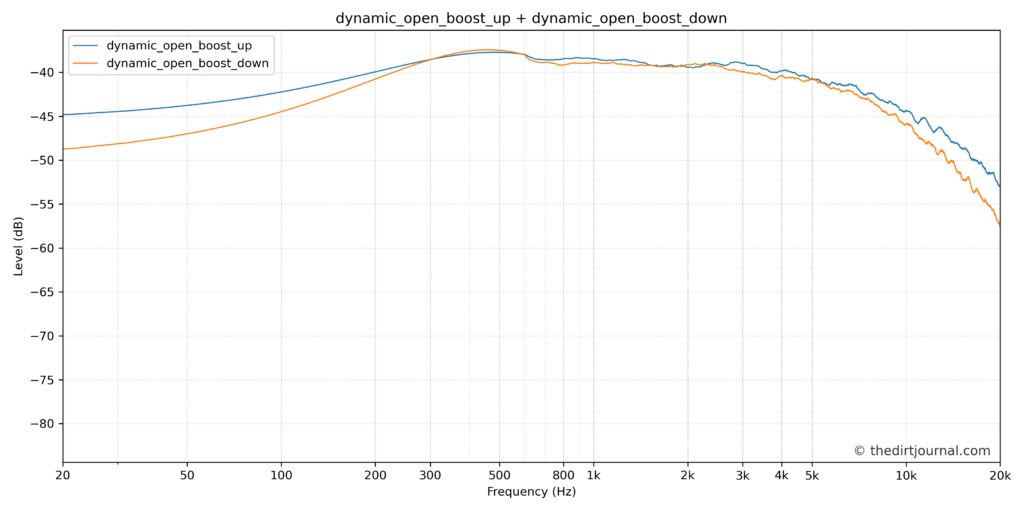
Apparently, this does influence the filters, and, after reading up on it, it does. In the down position they do 12dB/Oct and in the up position they do 6.
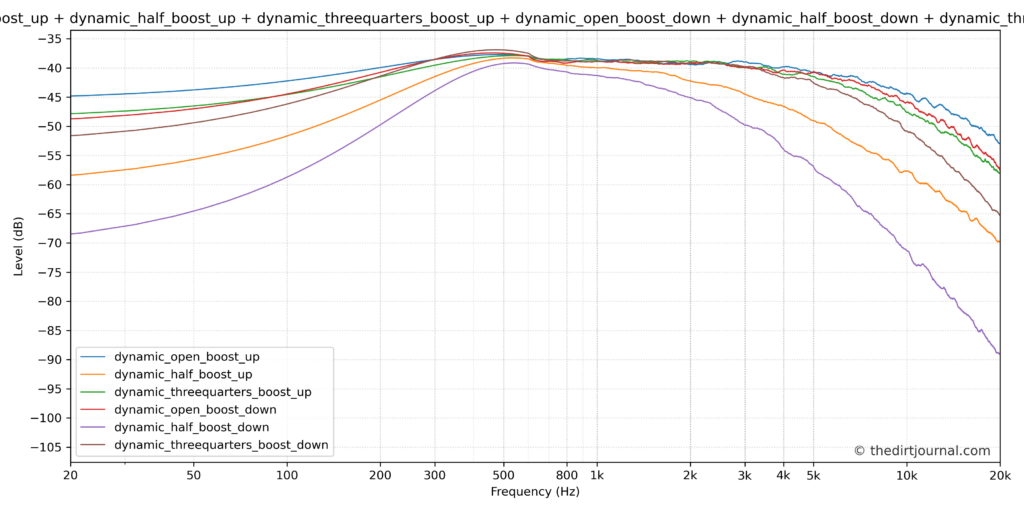
The filters. As I already said before, you might wonder where in the circuit they are located and what magic they do, and I say: These are regular high and low pass filters and there’s no side chain or dry/wet system of any kind. Close the filters all the way and the pedal output is zero, because they overlap.
Here’s the filters open, three quarters open, and half open, all other knob positions remaining the same, both with the switch in the up and down position :
So much for the nerdy stuff.
At first glance, that pedal looked absolutely boring to me and I did not know what to do with it.
I watched a video about a guitarist who loved the filter idea because he could make his humbuckers sound more like single coils or something like that, something guitarists can get happy about, but do not really create so much as ember in the ashes of my interest.
I did not watch any videos of bassists being happy with it because there were none.
Not a good sign. At least, there were no videos of bassists being unhappy, either. There simply were no videos of bassists using it at all.
Well, I started playing into the Dynamic Drive, with the filters wide open and the Bias control in the sweet spot, essentially treating the thing like a bog standard overdrive with just a gain knob and level control.
Surprise! This thing sounds really good! The dynamic range is remarkable. The organic timbre of the low gain sounds are commendable.
I found myself enjoying myself more than I ever hoped I would, merely playing a pedal in its simplest setting, completely ignoring the party tricks up its sleeve.
It feels like a rubber band that is incredibly stretchy. One that stretches so much, you don’t think you can easily break it because your arms are too short to get it into any kind of danger, and it’s super soft, not much force against you. There is a slight characteristic of an amp-like drive feeling, but the push back is so gentle, you can easily miss it and say the pedal has no direction of its own. The easy flow and the huge dynamic range let your fingers decide how little or how much breakup is going on, and the breakup itself has a texture that totally works for tone sweetening.
When I mentioned that to the builder, he replied that the clipping circuit is based on the same principles as the Zvex Super Hard On and the JPTR FX Jive – and in the moment that Info entered my brain, I suddenly heard it and I cannot unhear it now. It has that same quality, sitting there just on the brink of breakup where you are certain that it adds something to the signal, but it’s hard to put in words what exactly that is, because you don’t quite hear that breakup yet, yet there is more to the sound of your bass.
If I were do redesign that pedal, I would wish for the bias to be fixed to the point I chose, and the HPF can go, and the now vacant two knobs could become an active two band EQ, post drive. That might actually become something incredible!
The filters are a lot more useful than one would assume at first glance. The Low Pass Filter can act as a cab sim and you could run this pedal straight to a DI and your drive would still sound good through a PA system, no gnarly fizzle that needs to be filtered out. The High Pass needs to be treated with care, obviously. It can help getting rid of some low end rumble, but turn it up too far and your bass gets anemic. For bassists, an added low passed clean blend would make a lot of sense, so you could use the filters to shape your drive sound, but would be able to sprinkle in some intact low end.
But even as is, with the high pass set very low, the low pass set to taste and a medium amount of gain, I do have to admit that the descriptive part of “Dragon Dynamic Overdrive” is well chosen. Dynamic Overdrive is what it does. It’s neither over the top nor too subtle – unless you want it to – and can really step in as a stomp box for the parts where you want a little more just as well as an always on effect that sweetens up your dry signal.