Horrothia Teeth
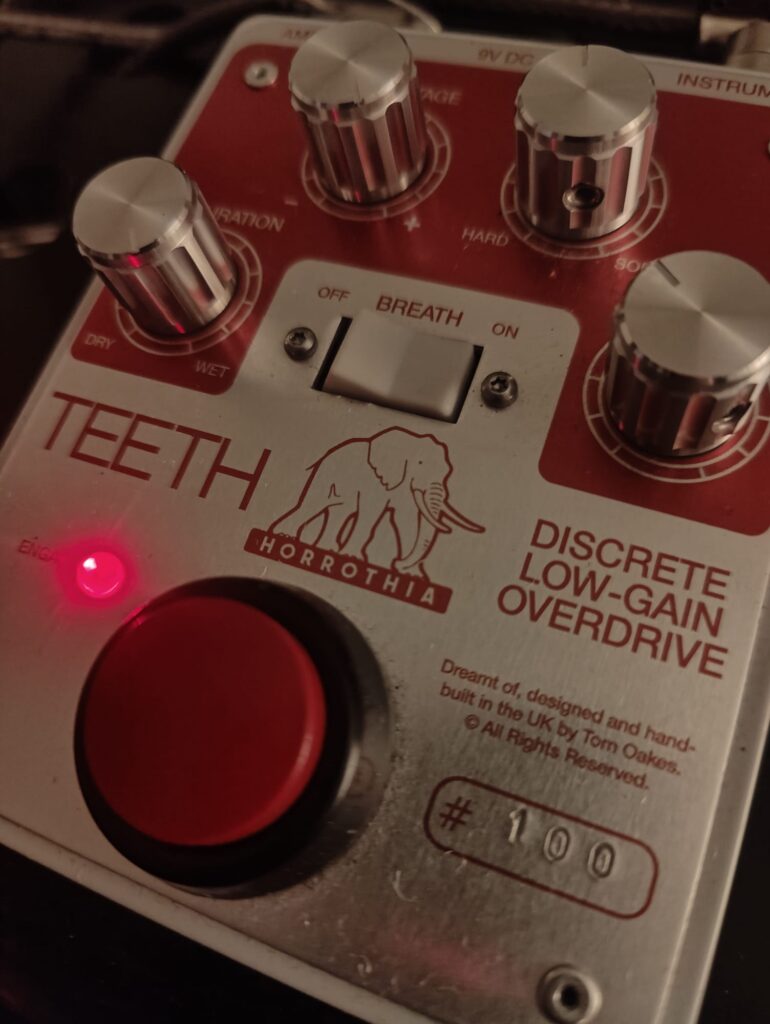
What a coincidence! The Horrothia Teeth will be the 100th pedal reviewed here, and the specimen I managed to get hold of is serial number #100.
I have been chasing this one for a while. Horrothia seems to do runs at times and their effects are available on their Reverb store, but as quick as they come, they disappear again.
The design of Horrothia pedals is something you’d immediately recognize on a pedalboard. That’s not only because of the elephant, or the fact that Horrothia uses standard Hammond enclosures, but rivets on a brushed aluminium face plate, it’s mainly due to the fact that the foot switch is a big plastic button. I thought these might be ripped from an arcade, but looking up the parts number reveals that this one was made in Bosnia by ITW Switches and apart from the somewhat sober name of “Pushbutton – 76-9420/439088R”, it is described as a “VANDAL RESISTANT PUSHBUTTON”. I guess for a plastic button that looks like it prefers to be operated by a thumb, putting it on the ground and stepping on it with your foot might count as vandalism, so it’s a good thing it resists that.
I really dig the design and build quality of Horrothia Effects. This is not my first, I already own their Type One chorus, which is, to my ears, one of the best chorus pedals there is. Everything feels, not only high quality, but also right. The friction on the pots is exactly where it needs to be, firm but not too firm.
The only design choice that is somewhat unlucky is that the knobs only have small cutouts as position markers and these are not easily seen in bad light.
Looking at the face plate, the description “Discrete Low-Gain Overdrive” gives a hint of what to expect.
There are four knobs and one switch to influence the pedal’s output.
Volume is volume.
Saturation is both gain and a dry/wet mix. By going over to the wet side, you also raise the gain.
Gain Stage is also gain – it sets the maximum amount of gain the Saturation knob can reach.
Clipping is a seamless blend between soft and hard clipping,
and the Breath switch can activate what Horrothia calls an upper mids/lower treble boost. That boost actually starts in the 500Hz area and looks like a shelving filter.
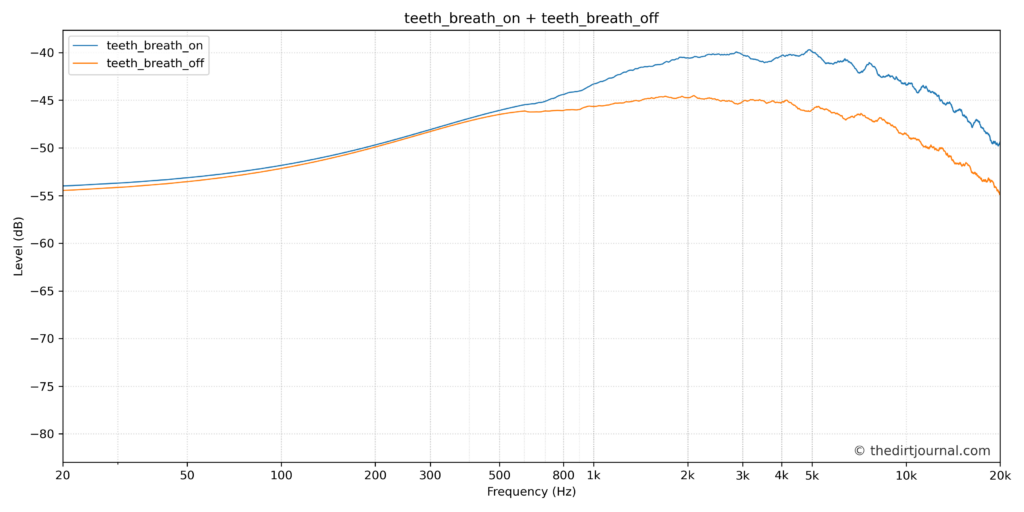
The two curves separate around 500Hz and drift further apart until somewhere around 2kHz, from where they run more or less parallel.
Horrothia describes the Teeth as a device that is aiming in the middle between overdrive and clean, and using it has a bit of a learning curve to it. Essentially, you get three knobs that influence the amount of breakup you get – what most pedals do with a single gain knob.
The Saturation knob feels like a standard dry/wet blend at first, but it also influences how much gain you get on the wet side. The Gain Stage knob can limit that – or rather add to it, because even with Gain Stage at zero, you can have audible dirt. The clipping knob feels like it’s built in facing the wrong way, because the harshest setting is all the way CCW and it gets tamer and mellows down when you turn it CW.
Now when you switch on the pedal in any given setting, and you want more dirt than what you’re currently getting, you can adjust Clipping towards hard. You can also raise Gain Stage or you can raise Saturation.
If one of them is already maxed, you can pick another. When you’re not totally satisfied with your tone but feel like you have the right amount of dirt, you can start toying around – dial one of the knobs back some and raise the other two a little to compensate. Slightly different flavor. Better? Keep going. Worse? Try the other direction. Or set it to where it was and try a different knob.
The amount of drive the Teeth is capable of is maxed out when I reach what I’d call solid overdrive.
With my low output passive bass, I get into the borderlands between light overdrive and overdrive.
There surely is no fuzz or distortion hidden at the end of the gain knob’s travel, waiting to be discovered, the writing on the face plate is nothing but the truth. The Horrothia Teeth is a discrete low gain overdrive.
Fun note: When I unplugged my bass after playing and was just about to switch everything off, I heard a noise through the headphones even though the instrument cable was touching nothing but air, and instinctively, I hit the switch on the Teeth, and the noise disappeared. Interestingly, the light came on. I switched a drive pedal on and the floor noise dropped. Weird.
With all those fine adjustment tools, there is an incredible range of nearly driven, not quite driven, are we there yet? and we’re barely there sounds. It feels like raising the gain by a small increment on a regular pedal is the same as raising both Saturation and Gain Stage while at the same time lowering Clipping by the same small increment. That allows for incredible fine tuning, since you can opt to raise all three, or any two of them, or just one – and you’ll land between the two settings a pedal with only a single gain knob would offer by bumping said knob by the smallest bit and back.
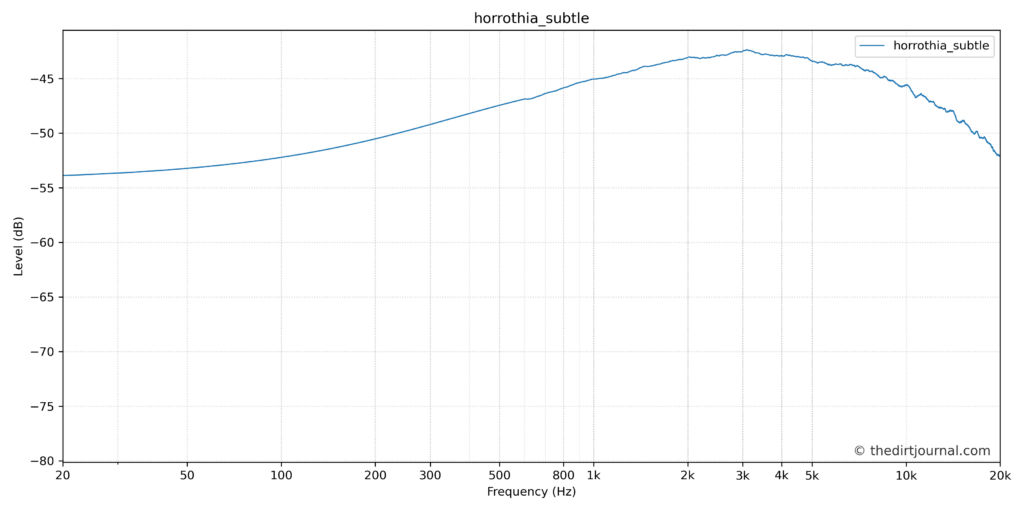
This is what the frequency response looks like when going for a very subtle drive sound, just enough that it’s audible but so subtle that it’s not commanding. The Breath switch is in the “On” position. There’s 10dB difference between 50Hz and 3kHz, and around 6dB between 50 and 500. Some would call that a rather big low cut, and the graph certainly looks like that, but I don’t hear it as lacking low end or anemic. It sounds just fine.
I already mentioned that there is a learning curve attached. Let me tell you how I used the Teeth when I hooked it up for the first time. After trying out all the knobs once, I decided to default to my preferred position on the dry blend, which is 100% wet. I also found that I like soft clipping more than hard clipping, so that knob went fully clockwise. I flicked Breath on and off a couple of times while playing and decided more treble is better, so it stayed in the on position. Now, with the Gain Stage all the way down, I was still getting audible drive which felt and sounded great when my hand was in the 12th fret position, but the low notes sounded a bit like a fizzy fart was attached to them; A sound that feels more like a speaker giving up or a console having the gain too high. To my ear, this sounded like unwanted distortion from a device that prefers to run clean.
Forced to leave the trodden path, I set out to explore more. Turning back the Saturation knob to noon with the Gain Stage at min and the Clipping at max (=soft), I reach the magic tone sweetening area where you’re not entirely sure whether or not there is dirt in the signal. That’s a good starting point if there’s any. By slowly increasing or decreasing Saturation, Gain Stage and Clipping, always listening for the sound and deciding whether the last adjustment made it better or worse, I homed in on the target.
Not like an AIM-120D AMRAAM missile that reaches Mach 4, but much rather like the snail that starts hunting you just after you accepted an internet bet and became a millionaire. Slow and steady, ever creeping forward in the right direction.
It turned out the target I reached was exactly what Horrothia describes on their website, a tone that is only very slightly driven, something that lets you bend forward towards the speaker, listening whether or not you can detect the drive sound – but switching it off certainly reveals that while it is subtle, it also is quite noticeable. Even though the tone curve looks like it might be of little use to bassists, I don’t really feel the low end drop out and the low gain adds a nice bit of growl
The Breath knob, at first, felt like an always-on thing for me, but then this happy little accident happened – I thought it was on when it was off, and I sat down and played a bit, somehow never checking that switches position, even when tweaking around on the other controls. I did find my favorite knob settings (see sound samples below), a very mild drive sound that, to my ear, enhances the dry sound in a tasteful way. But that’s not all. The Horrothia Teeth with these settings does a great job at stacking with other pedals in equally low settings. I did try it with the Audio Kitchen FPT and the Singular Audio Tubedrve, and with both, I could get a raw and raspy sound that is extremely dynamic in reaction to my playing.
The Teeth is, all in all a great pedal for a softly driven sound. If you’ve used the Way Huge Pork&Pickle (or Pork Loin) or the SolidGoldFX Beta as a drive but found yourself only getting nearly there, missing just the tiny little bit you can’t quite put your finger on, this is the pedal you should try next.
My favorite tone from the Horrothia Teeth. Breath off, Saturation about 1 o’clock, Gain Stage around 9 o’clock and Clipping all the way towards soft.
This is the absolute maximum of dirt I could coax from the device, using my Aria Pro II Fakenbacker with the bridge pickup soloed and playing hard. Breath on, Saturation max, Gain Stage max, Clipping all the way towards hard.