Singular Audio Tubedrve
Singular Audio was started by Berend van Eerden and is located in the Netherlands.
At the time I’m writing this, their total portfolio consists of 7 products, 4 of wich are different versions of the Tubedrve. Aside from an effect pedal, you can also get it as different rack modules for studio use.
As the name suggests, this pedal is a drive pedal that achieves its goal by overdriving a vacuum tube. The tube in question is a 6AS6, so not your standard choice of 12AX7. It is socketed, so should it ever run out, it can easily be replaced. It runs on 9V center negative, but requires 300mA – the voltage is stepped up internally to run on possibly lethal 240V , so don’t lick the inside while it’s running.
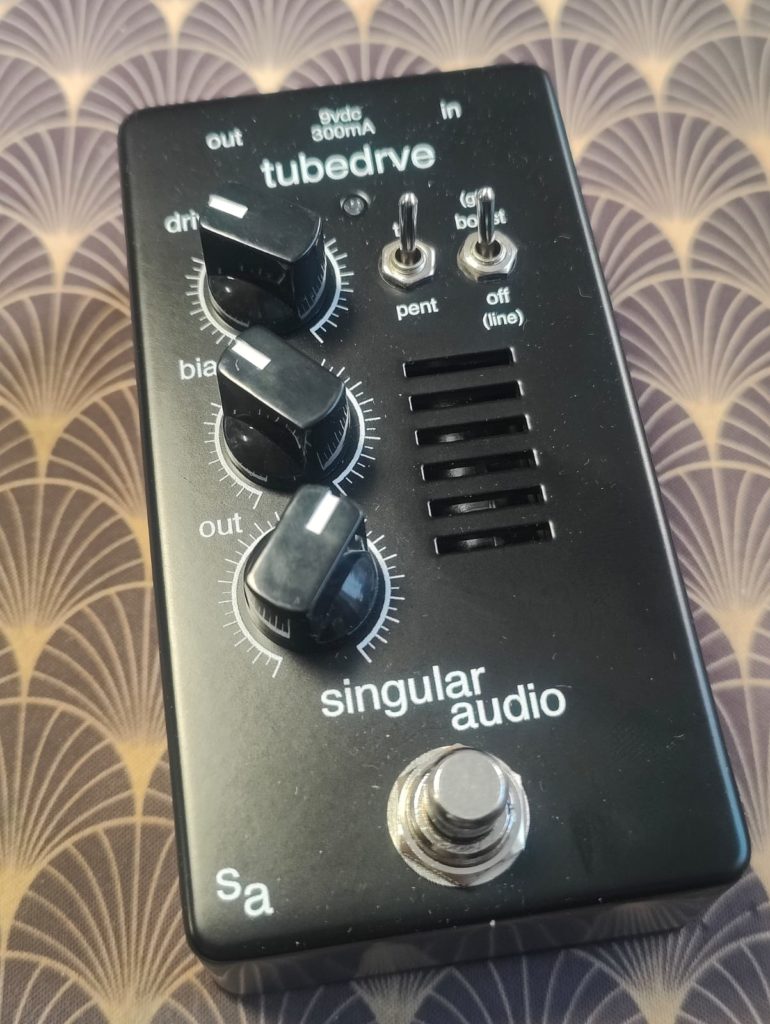
The layout of the Tubedrve is a little bit different from that of other pedals, but it’s simple enough.
It’s a true bypass pedal with a latching (no click) footswitch. First in line is the top right switch, labeled boost. Since the Tubedrve is a studio tool, it expects to see a line level signal. For those who want to run a bass or guitar into it, this switch adds 20dB to the input, so it works with instrument level. The other switch will control the operation of the tube – you can choose between triode and pentode. The three rotary controls will control the gain (drive), the bias of the tube (CCW is asymmetrical clipping, CW is symmetrical) and the output volume. As I said, not your average pedal, but nonetheless straightforward.
The build quality is decent, all controls feel good to operate and there is enough friction on the pots to make them a pleasure to turn. The screen printing is of high quality and the surface of the enclosure feels very smooth. I assume it’s powder coated, but can’t tell for sure. It is just between a matte and a glossy black, fingerprints do show on the surface. The enclosure looks like your standard Hammond 125B, but it feels a bit off to my pedal senses. When I looked inside, I inspected the lid for a maker’s mark and lo and behold, it’s not a Hammond, it’s a Tayda.
That’s all I can say about the Singular Audio Tubedrve without playing it. So let me show you a gut shot and then let’s move on to how it sounds.
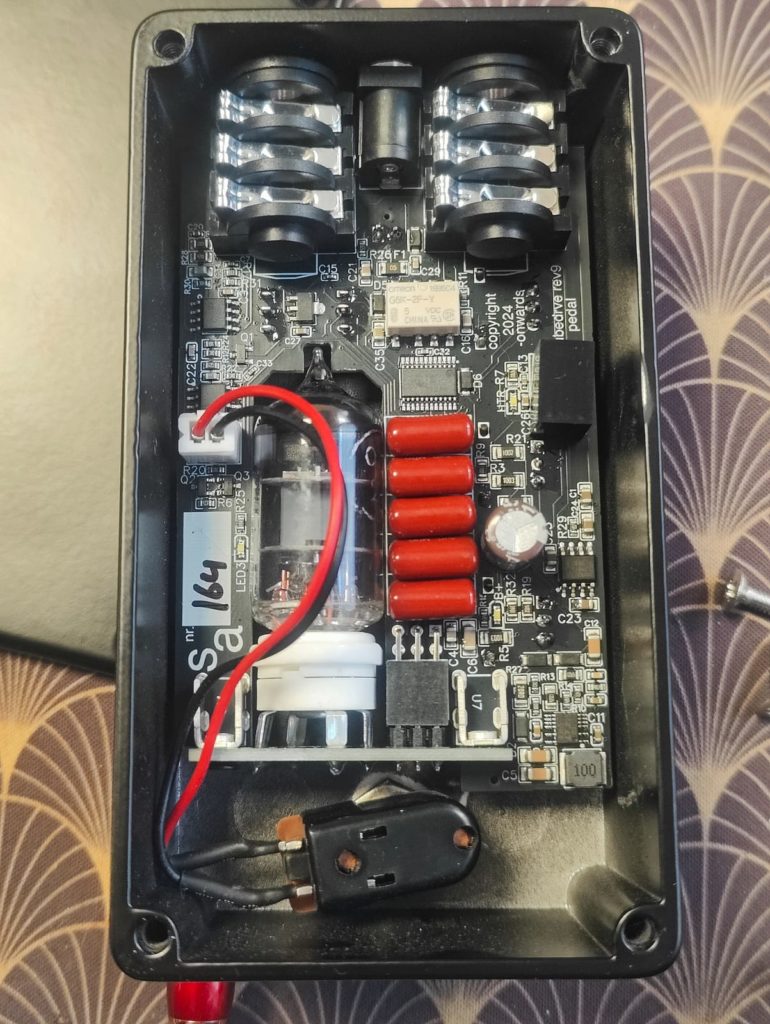
Well, one last comment on the looks of the pedal: Not only can you see the tube glow through the slits in the top, there’s also a LED right next to it that will light up once the signal gets strong enough for overdrive. That’s a nice piece of eye candy, if you ask me. I quite like when there’s a little more going on than static lighting.
Now let’s get to how it operates. The manual says that the bias turned all the way to the left yields asymmetrical clipping where the waveform clips more when the wave goes up and less when it goes down. This creates a more fuzzy, broken, spluttery sound. The manual further says that the opposite is true and turning it towards the right side yields symmetrical clipping and a smoother sound.
I personally say the smoothest experience is to be had in the area between 10 and 2 o’clock.
I did cruise aimlessly through the limited options the pedal holds in stock, trying out different combinations of gain and bias, then flipping the switch from triode to pentode and repeating the process.
The first sweet spot I discovered was not far off from the default “Everything at noon and the switches in up position”. Indeed, all I did was set the bias just a bit past noon and it was all there. My favored bass with its rather low output triggered the light inside the pedal only on harder hits, but what oozed out of the speaker system caressed my ears in a most seductive way. This is magic tone sweetening done right.
The pedal runs on a tube, but its operation is silent as a Ninja in the night, sneaking up on you from behind. Its tonal manipulation is oh so subtle, but noticeable nonetheless, and only in a good way. The dirt is also subtle. It’s not your default grit underlining everything, but it’s much rather the powdered sugar sprinkled on top, to accentuate the peaks in a luxurious manner that just made your kit sound twice as expensive. On the clean parts of the notes, there is some harmonic enrichment that I know from the Noble preamp – of course it’s not as pronounced here – but it’s there nonetheless and that’s impressive.
I’d say you can slap this pedal with those settings into any given signal chain that consists out of boring utility pedals and has zero magic tone sweetening going on and it’ll instantly sound better.
Given that the pedal has no tonal controls and that the rack versions of the Tubedrve are meant to be used on basically anything, it comes as not much of a surprise that the frequency response of the pedal is relatively flat.
Measured with all knobs at noon, it looks like this:
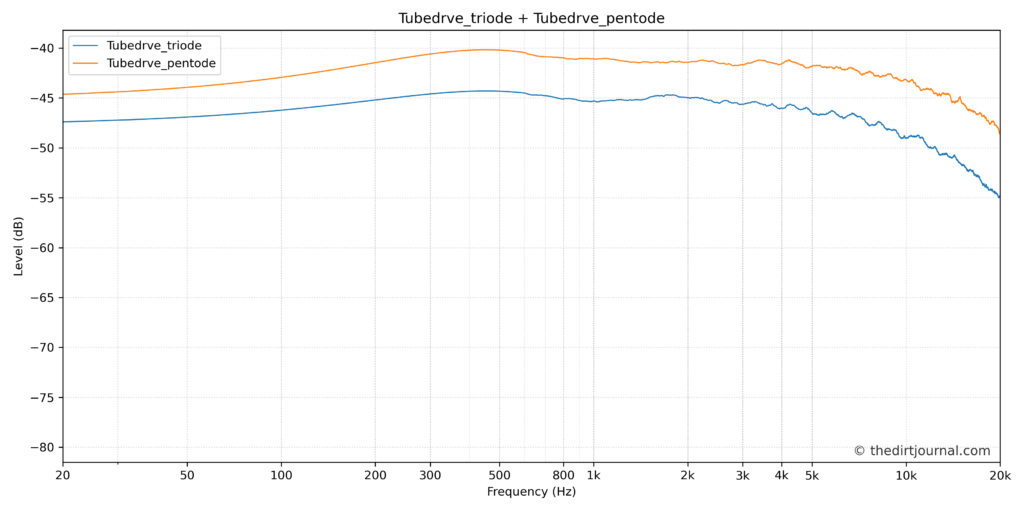
A gentle drop that starts around 5k and the slightest hump between 300 and 500Hz, plus a surprising similarity of the curves in triode and pentode modes.
The Tubedrve works well in my setup as a barely there drive that just adds a hint of drive, and those settings can easily be found both in the triode and the pentode setting, the pentode offers more grit and therefore I ran it with the gain slightly lower. I cannot really say which mode I prefer – it seems to depend on my mood, the bass I’m playing and the tone I’m after.
That pedal has an immense potential of keeping you adjusting the Drive and Bias knobs by the smallest increments to find the peak of the sweet spot – and I must admit that I sometimes listened through my headphones with my eyes closed, barely touching a knob to nudge it forth or back less than a hair’s breadth, to get it to the best possible spot – I was going for that tube enrichment, that third dimension, that barely there magic – for a solid 15 minutes until I was convinced this will not get any better, and then, when I tried to set the pedal to unity by repeatedly switching it on or off, I was unable to distinguish between the on and off sound by ear alone – and we’re not talking about the sound in a mix, but a pure bedroom sound.
That felt like a slap in the face, so I opted to change course. For the next trials, I alternated between double stops higher up the neck and low notes, both staccato lines and longer ones. My aim was to get as much of a beautiful light drive on the double stops that has this blooming character and blends the notes together with a rich singing voice, but on the low notes, I did not aim to get any farty feeling on the initial attack. When I imagine a (low) note as a three dimensional thing, I always picture it as something of a sideways raindrop, with the fat bit facing forward, of course. In that imaginary construct, I would want the low gain drive to start at the point with the biggest circumference. I want the initial impact of the note with all the heft intact and clean’ish, and the fizzle and hair on the back, when it starts decaying. That, in my opinion, leaves the heft and authority of the bass intact, which I judge important for a low gain drive sound or magic tone sweetening. I want every note to hit with full force when playing staccato – opposed to a heavy drive sound where the crunch and fizz already impacts the very beginning of the note, and there is a lack of sharpness to the outlines.
The Tubedrve can deliver those sideways raindrops, and it can do it both in pentode and triode mode. Pentode will have a little more of a percussive fizzle that reacts a little more nervous to playing dynamics, while triode is a bit more calm and feels more predictable, both in reaction and in sound.
There is a serious interplay between the Bias and the Drive knob. When you turn that knob clockwise, you will get more drive, less of a clearing up on note decay and you can set the drive knob lower.
When you turn it back from full, it feels like it’s acting mostly linear until you hit noon, and then you enter the asymmetrical clipping side which sounds more starved, reacts a bit more sluggish and gets a bit more gnarly sounding. When you’re purely after tone enrichment through low gain tube drive sounds, you want to stay closer to noon. Go up too high and you lose some of the definition of your clean sound. Go down too low and it sounds towards uneven and broken. Both effects can be used very well in a musical way, but you’re leaving the area of “Making your tone sound more expensive”.
Here’s the bit that I think is important: The sound and the feeling the Tubedrve provides is neither that of a tube amp, nor is it that of a drive pedal. The closest I can come to describing what happens is “An expensive piece of studio gear that adds some tube magic” I could be totally wrong since I have not had any conversation with anyone at Singular Audio, but I do Imagine the first iteration of the Tubedrve was not the pedal, but one of the rack mounted units. I do imagine that the intended workflow with these was that you have your track running through the unit while you make minimal adjustments to receive a track that sounds (slightly) better than before, because you ran it through an all analog device with tubes in. My guess would be that while you can run the Tubedrve on any of your audio tracks and that it will work with nearly every kind of instrument, someone also realized that it’s really great for guitar and/or bass guitar use, and from there it was not too far to create a mono version of the rack unit that runs off 9V DC, center negative. The rack units do sport a wet/dry mix knob, and I think the pedal does not have that because when used on a pedalboard, you’ll go for more gain anyway and the intended use of the wet/dry mix is for instruments or tracks that are meant to sound clean, so blending in some dry signal is one more tool to dial it back further. You know about these legendary pieces of vintage gear, like the old Echoplex units that were not only used for their intended purpose but also just put in the signal chain because their tube driven preamps sounded so good, guitarists used them for that tone alone. I think the Tubedrve aims for something of that particular vibe, but it’s not a huge tape delay unit with the tape delay bit switched off, it is a simple tube gain stage that can give you that vibe – and that is the intended use of the thing. Therefore, you don’t really feel like your playing is pushing an amp that pushes back. It’s also not feeling like a drive pedal that needs to be reigned in – nor does it feel neutral. Playing it, it feels like its own thing, with its own way to respond to whatever you do. Of course we’re still talking about (tube) drive. That is like driving a car. You get into one you’ve never driven before?
Well, you can expect that you will have to get in the front left seat (unless in Bhutan, Fiji, Malawi, Tuvalu or any other of the countries that drive on the left), you can expect a steering wheel, pedals to accelerate and brake, as well as some means to get that thing in gear. You’ll just get in, familiarize yourself with the controls and then you’re off down the road. Because it’s a car and you know how cars work. The same goes for the Tubedrve. You know your drive pedals, you can play this and instantly feel at home doing so.
Back to the sound. As I already mentioned, both the pentode and triode modes have their merits, but for now, I’ve set the swich to pentode and leave it there. To quote the google AI:
Running a tube in pentode mode offers higher power, more headroom, and brighter, punchier sound with odd-order harmonics; triode mode offers lower power (often half), smoother, warmer tone with more compression, richer even-order harmonics, and vintage character, with the key difference being pentodes add screen/suppressor grids for efficiency, while triode mode effectively removes them, making the tube behave like a simpler, less powerful triode, ideal for switchable amps to get different flavors from one amp.
For light settings, I actually prefer the added harshness and less compressed sound of the pentode operation. Using those settings in a mix I was more than a little surprised at how significant the difference is between running a dry signal with a little EQ and running the same signal with the Singular Audio Tubedrve pedal. My settings were Pentode operation, Drive around 10 o’clock and Bias around 2 o’clock with the master relatively low, to match unity. When you judge unity by ear alone, you feel like you’re losing a bit of low end. Nothing drastic. Something even I, as someone who values low end very highly, can easily stomach. Looking at machine readouts, I’m actually setting the Tubedrve signal a little lower than the dry signal, because it feels louder to my ears. Placed in the aforementioned mix, the bass takes a step forward. I often dread the moment when I try a new pedal in such circumstances.
I’ve been around the block when it comes to dirt pedal and preamp setups. You sculpt the ultimate tone, so beautifully pronounced and accentuated, you want to get on your knees and weep. The equivalent of what the old masters in Rome did with marble. Sculptures that seem translucent, soft – so intricate they trick the eye, just for your ears this time. Then you feed your glorious new bedroom tone into the mix and get a slap in the face, a cold bucket of water over your head and that kid from the Simpsons pointing at you going “Haw-haw!”.
Your bedroom tone sucks in a mix. The lows that were meant as the bedrock foundation to rest the entire band on are not bedrock at all, they are a mudslide in a swamp. Since you scooped the hell out of your signal, there are no mids to speak of, so apart from the mud down low, the only thing you can hear from the bass is fret clank, because you’re suddenly playing super hard, trying to compensate the lack of volume and presence. I’ve you’ve toyed around with bass sounds, you know what I mean, and you know that one is justified in fearing that the freshly sculpted tone might turn belly up when introduced to other instruments at the same volume.
Now imagine my surprise as I found that the Tubedrve in the settings I chose suddenly held a much better presence in the mix. The upper mids or lower treble were more pronounced, more present and easier to detect for the ear. This, however, is not achieved by simply boosting the mids and creating that honky sound that is oh-so terrible when you’re sitting alone in your room, no this is simply a byproduct of the added harmonics that sound like a glorious tube device that adds just a hint of drive to your signal.
I’m actually used to do the opposite: Once I find that magic tone pedal, I anticipate that employing it in my signal chain will cause me to get shooed back in the mix, and then I find means to compensate for that.
On the pedalboard I currently use in my metal band, I run the Audio Kitchen Fake Plastic Trees into the Verellen Meatsmoke. Both devices have a superb low gain breakup and stacking that is just “Chef’s Kiss!”
However, the FPT comes without a mids knob and the Meatsmoke comes with a Fender Tone Stack, meaning the mids are cut only – so the stack of those will need a bit of help, and I run an Aguilar DB316 Midrange EQ after them to even out the scoop a little.
The Tubedrve, is the unusual combination of both the device that makes the sound more beautiful and at the same time the device that gives the signal a little push forward. That’s wild.
It does not happen that often that a drive pedal arrives in my humble abode and receives the Black Strip Of Velcro, the highest honor I can give, within days – but the Tubedrve managed. I’m not gonna sell this one in a hurry.

Sound files. As the loop repeats,first pass is without the Tubedrve, I raise the gain from noon up to 1 o’clock in tiny increments. Triode mode.
This is the pentode mode with the gain at around 10 o’clock and the Bias at 2 o’clock, the setting I’m currently using for my playing:
And another pentode light drive. When you listen closely you can hear, or much rather feel how the driven signal looses a bit of its total weight in the lower notes, but at the same time gains a forwardness that makes it sit so much better in a mix.