Disssid Volt (Dunwich Volt Thrower Copy)
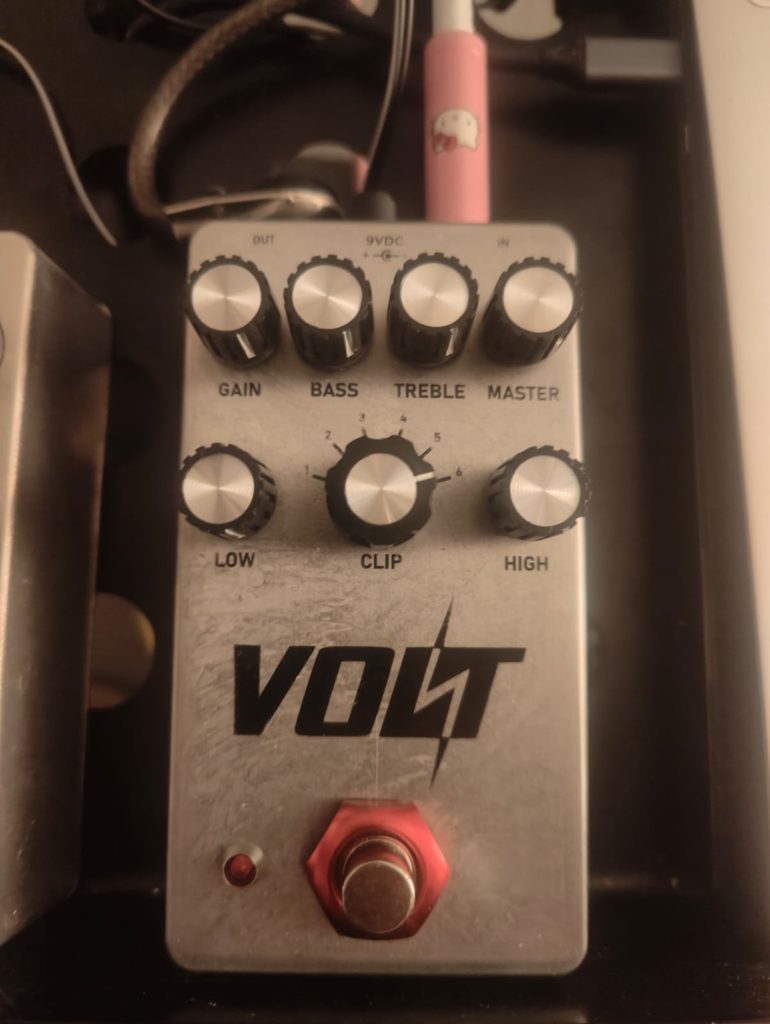
This is the Disssid Volt. It is a close copy of the Dunwich Volt Thrower, and might be described as a hot-rodded RAT to get an idea of what it does.
The special deal about the RAT is that it not only runs on silicone clipping diodes, but that it also overdrives the OPamp. In the old RATS, LM308 chips were used, the newer ones run on OP07 chips that are identical in every single way, except for the fact that a RAT with LM308 chip is worth a lot more than one with OP07. However, the Dunwich Volt Thrower and therefore the Disssid Volt have not only one, but two of those chips in some configuration that seems to be friendlier for the low end, and they did away with the single knob filter and put in an active two band EQ instead. Disssid goes one step further and the Volt has two more knobs on the top, which were supposedly hidden on the inside of the Volt Thrower. Apart from that, there are multiple clipping diodes to choose from with a 6 way rotary switch.
The Volt offers a selection of:
1. LED + Silicon
2. LED
3. Silicon symmetrical
4. Silicon asymmetrical
5. Germanium
6. Just the LM308
To get the terminology straight, I will call the upper EQ knobs, those between the gain and master the first EQ and the lower ones that sit right and left of the diode selector the second EQ. In terms of signal flow, that is incorrect, because the second EQ sits somewhere in the middle while the first EQ is post clipping. Have a look at these graphs where I mislabeled the second EQ as “Filter”:
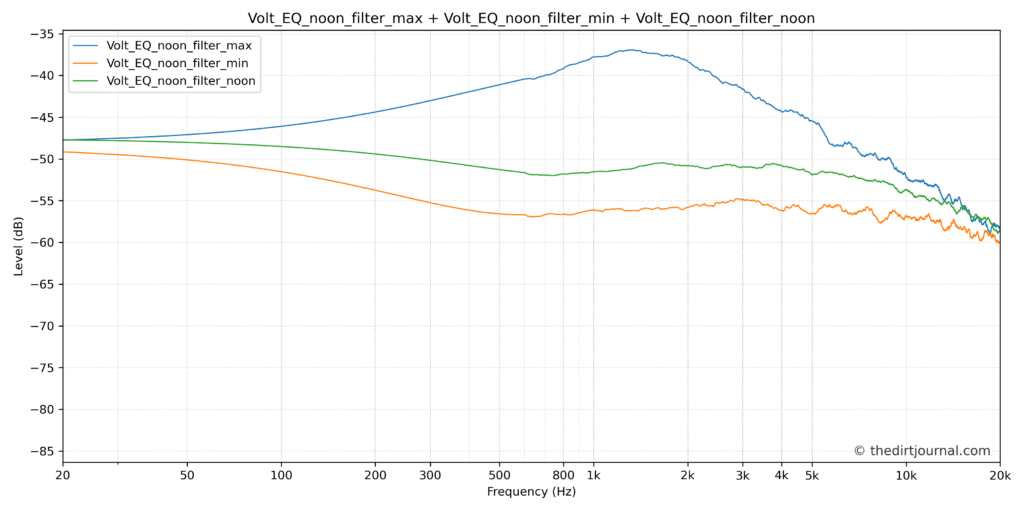
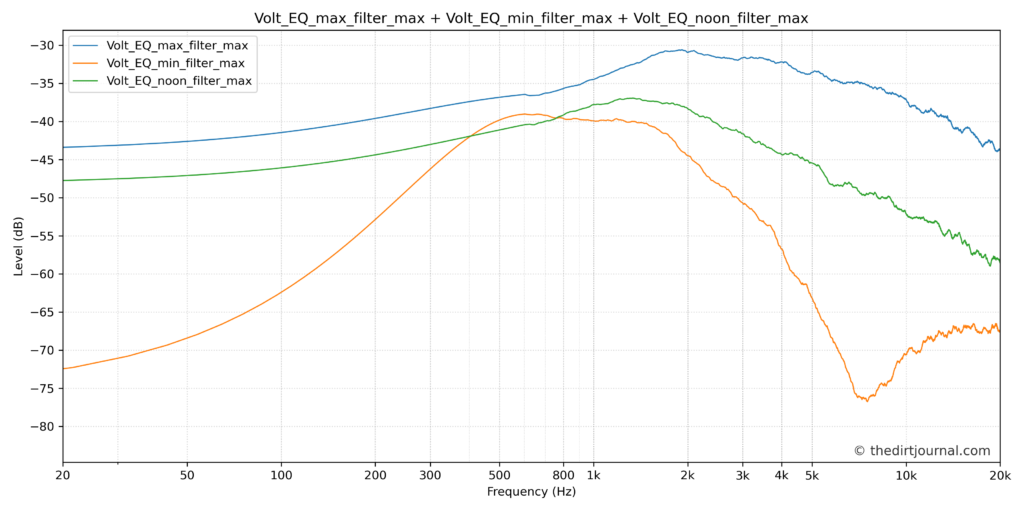
…and you can see that the first EQ’s knob positions are responsible for rather drastic tonal changes while the second EQ is much more subtle.
The second EQ does somewhat influence the nature of the clipping without too much shaping of sound otherwise, but it does make sense having these knobs on the top instead of on the inside.
One thing I learned about the RAT early on is that it is somehow capable of delivering a low gain sound, but that sound somehow does not feel right.
My best description would be it feels like driving a Ferrari in a zone where you’re only allowed to do 30. It is possible, but the car wants more rpm to feel happy. That’s how low gain RAT playing sounds and feels for me. At higher gain, the RAT is quite the mean beast, delivering a distortion that I feel is well described as cutting – and at super high gain, the RAT drifts of into synthetic sounds. AFAIK, the RAT is also quite popular in the synth community.
But el_murdoque, you cry. Is the Volt a RAT or why are you writing about the RAT all the time?
I’ve mentioned earlier that the Volt Thrower is based on the RAT, but there have been quite a lot of changes, too.
I’m on the fence about even calling this a modified RAT, because it has some vibe of its own.
First of all, it is a great low gain pedal, if you are into low gain hard clipping. There is a special vibe to that, like the German mineral water with a lot of gas, the stuff that hurts your throat when swallowing.
That sound often has not too much dynamic range and a tendency to hide wherever it can in a mix, so that’s not exactly a tone I’m gunning for, but the Volt is one of the few pedals I’ve encountered that makes it work in a way that’s pleasant to the ear.
Running the Pedal with my low output passive bass and worn flats, I get a surprisingly low gain result. I can max the gain easily and in most of the settings, I feel like a little more would do just fine. Using my Fender P bass with Aguilar Pickup shows better gain results, I get plenty of grind here – but still, I feel like a little more would suit the thing just fine.
I did my first test round with the pedal before I knew which setting is which, but it came as no surprise when I learned that those settings I preferred were the silicon symmetrical and no clipping diodes options. I’m not a great fan of Germanium clipping, and LED often sounds chaotic to my ear.
The pedal is capable to deliver heaps upon heaps of bass, but nonetheless I feel tempted to max out those knobs because the massive results do not feel like they overpower the low end in a significant way.
I made an interesting discovery when I hooked a booster pedal to the Volt, a strong one that easily overpowers most circuits when you overdo it. Not only does it get really dirty when you send generous helpings of +dB, but the amount of compression that happens is best described as a brick wall limiter.
In my test bench signal chain I have a Becos CompIQ mini Pro compressor sitting between the drives and preamp, and that device is set for peak limiting. WIth the Volt active and heavy handed playing, it was barely engaging. Normal playing would light up the -2dB LED on the Becos, while heavy handed playing would push it towards the -4dB LED lighting up. Sending north of +40dB boost into the Volt with identical settings would get me a super heavy distortion sound, but the Becos would still sit there with the -4dB light on. Double checking things, I deactivated the Volt with the boost still on, and all the lights would come on, and either the comp or the preamp gave me the nasty distortion of a device that does not want to be pushed past the threshold and since you’ve done it now, It’ll punish your ears for it.
The Volt does not really feel like it compresses that much, but once the device starts saturating, pushing more signal in will not raise the output at all, only the amount of dirt you get.
With all that said, I do think that the RAT and therefore RAT-Like circuits are either an acquired taste whose acquisition has eluded me up to this point, or — something I find more plausible — the RAT was created to get more out of your amp. In the seventies, playing through tube amps was pretty much still the norm and those solid state amps that were around were only capable of clean sounds. I believe the first SS amp designed to be overdriven was the Sunn Beta series, which had its debut in ’77. So it is fair to say that the RAT circuit was designed to be played into a tube amp that was already distorting on its own. The RAT’s job was to push that amp distortion to the next level, which it does really well. Using a rat on a pedalboard as the sole clipping device before a clean preamp and sending the result to FOH (or your headphones at home) will always sound a bit like you’re poking an angry pocket calculator. Lacking a tube amp rig, I pick the next best thing: My trusty ol’ Verellen Meatsmoke. It’s technically a pedal, but it’s actually more the front end of a tube amp squeezed in a huge pedal shaped box that barely fits a pedal board – and it runs off proper mains voltage, not the non-lethal stuff your Cioks can supply.
The Meatsmoke uses two 12AX7 tubes in the gain section and is by itself more than capable of producing more gain than you could ever want, but that’s only with the boost channel active. With the normal channel active, it skips two of the tubes’ gain stages and produces credible levels of gain.
I did set up my boost channel for a brutal game of fisticuffs and started comparing that to playing the Volt into the normal channel. The normal channel was set so it does produce a slightly dirty sound on its own. The result was shockingly similar in some ways. I wrote fisticuffs, but I also want to write “Killer Bees”.
Imagine a swarm of killer bees in 1950’s Tom and Jerry cartoon style. The bees crowd together to form a giant arm with bulging muscles. The arm ends in a meaty fist. But now leave the Walt Disney track and sprinkle in a little bit of Sin City. Make the bees look a fair bit more vicious and add a brass knuckle.
That’s what hits you when the Volt hits the front end of the Meatsmoke. The sound gets so angry, it barely manages to hold itself together, there’s just barely enough coherency to make out note pitch. Other than that, it’s an onslaught of gain that is a pure joy to behold – if you like high gain sounds, that is. It’s not the even clipping of a modern high gain distortion. It’s a swarm of angry bees being fried in glowing red-hot vacuum tubes running deadly voltages. There is pure chaos in this, drowning out order.
I said there are similarities between running the Meatsmoke in the Boost channel and running the Volt into the Meatsmoke’s normal channel. Both can be a bit much for the average household. Both can feel like Attack of the Killer Bees. Both can give you huge amounts of bottom end, but I have to admit, with the Volt up front, that bottom end has more … for want of a better word, I’m forced to write “definition”. The Meatsmoke bass control feels more fat, warm and rounder in shape, where the bass from the Volt has sharper corners and feels colder, but it’s huge nonetheless. The clipping of the Meatsmoke running full-on feels a bit more organic while the Volt launches more higher frequency pinpricks towards your eardrums. This is to be expected. The Meatsmoke is, in essence and after my understanding, an overdrive that goes all the way to 11, while the Volt is a hard clipping device.
Time for a verdict:
If you have ever found yourself enjoying yourself while playing through a RAT pedal (vintage ones, modern ones, Turbo RAT, FAT RAT … any of them), then you’ll enjoy yourself playing the Disssid Volt.
It is everything a RAT can be and more. The two EQ sections open up possibilities of sound shaping, but I want to claim that no matter what you do, in the heart of that thing, you’re making a Motorola LM398 micro chip angry because you feed it too much voltage. That’s what made the RAT a RAT and that’s what makes every pedal that applies the same principle sound like a RAT.