Empress Drive
This one hit me like a very heavy object at high velocity. On the day the first picture of this pedal showed up on the internet, I immediately declared that I want one. This was early 2025, and the actual release of the pedal was May 2026. Enough time to completely forget everything about it and to decide once more that I want one.
I sat down at my desk and logged in to talkbass to post some frequency graphs, but noticed an unusually high number of notifications, so I took a look first. Someone had posted this pedal, along with the BassTheWorld youtube demo. That video is 4:15 long. Around the 3:30 mark, my audio was interrupted by the “Incoming mail” system alert – the mail in question was the order confirmation.
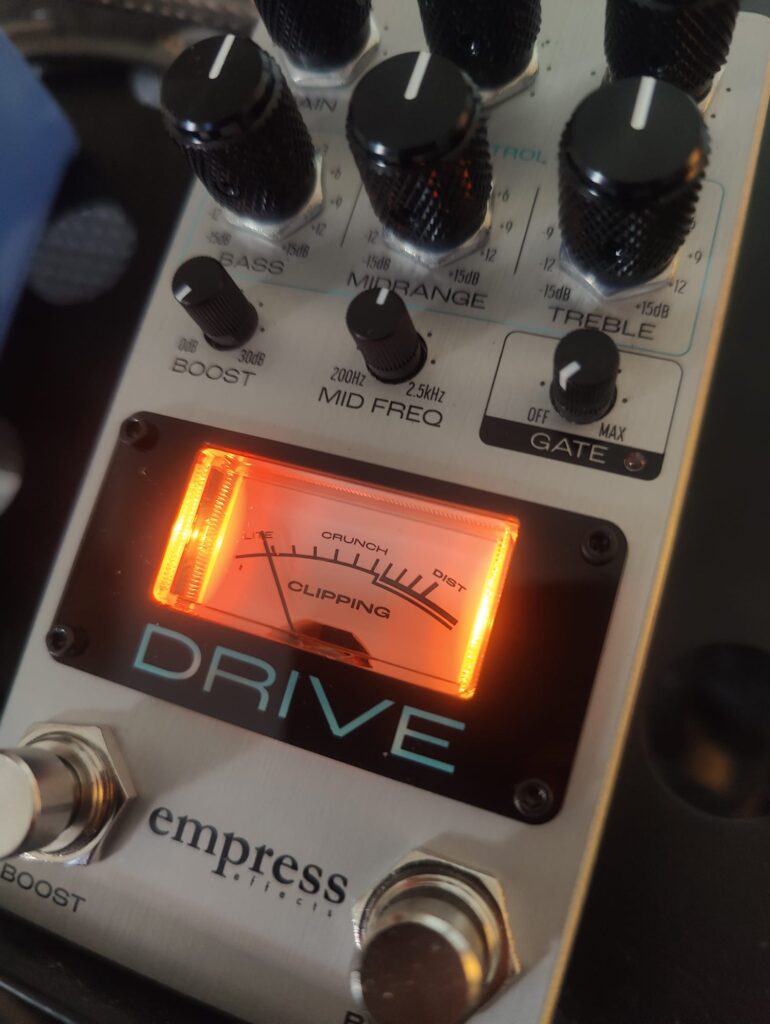
This is the Empress Drive. It’s obviously a drive pedal. One with a whopping 9 knobs, two foot switches and an analog VU meter. I love these things.
Let’s look at the feature set this comes with:
The top row is Gain, Mix and Level. These knobs have a firm resistance to them.
The next row is a three band EQ with Bass, Midrange and Treble; These pots turn a bit easier and have a center detent.
The bottom row is smaller and has Boost, Mid Frequency and Gate.
Then comes the VU meter that is labeled “Drive” and ranges from Lite through Crunch into Distortion.
The foot switches are labeled Boost and Bypass.
The EQ is set up with the Bass and Treble knobs being shelving filters, Bass has a corner frequency of 200Hz and Treble starts at 2kHz. The mids are semi parametric and while Bass and Treble are located post drive, the Mids are pre drive, adjustable from 200Hz to 2,5kHz. This means the Midrange EQ will help in shaping the drive, either by pushing or by reducing a frequency to fine tune the nature of the breakup sound. Boost can be set both pre and post EQ, so you can use it to simply get louder or to raise the gain even further, up to 30dB. Empress did not specify the nature of the clipping stage, but claims an amp like feeling, which suggests that some kind of Mosfet clipping might occur.
Edit: Empress told me that the clipping stage is fired by a mix of 1N4148 Silicon and 1N5819 Schottky diodes.
Empress pedals never disappointed me in terms of quality and the Drive does not break with that tradition. It is very well made and both looks and feels like a pedal that retails at €299.
With all that said, I am itching to dive into how it sounds and feels, but I want to start off with a grain of salt, namely the boost function.
When set post drive, it’s a simple boost. In my 30+ years of playing bass, I have never really needed one of these.
When set pre-drive, it has a high pass filter baked in that cannot be turned off.
I measured the frequency response with the EQ, Gain and Boost at noon and used the Level knob to compensate the difference in output:
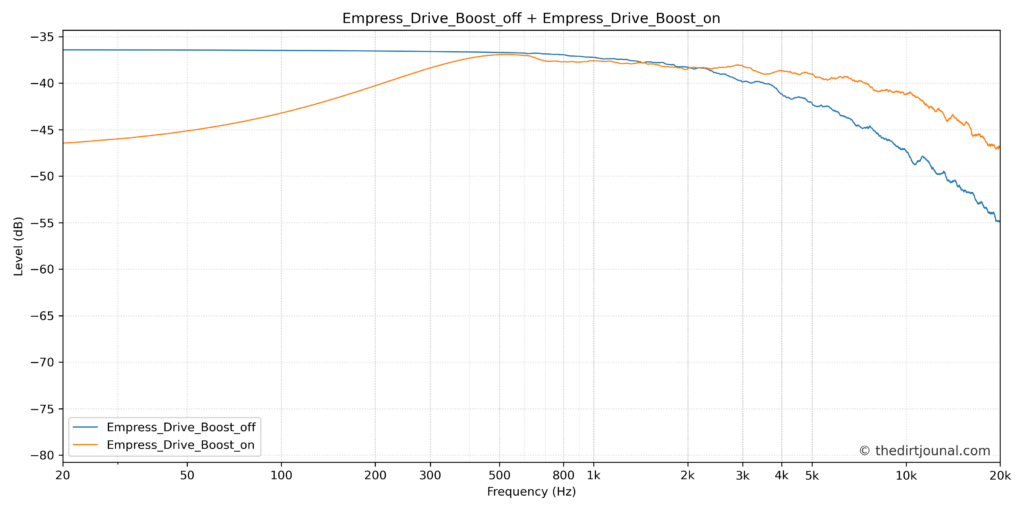
Which shows the applied high pass filter. To the naked eye it looks like 3dB/oct starting at 500Hz. The bass cut is very audible to the naked ear. I repeated the measurements without correcting the levels and with different knob positions, but the bass cut remains. You can easily use the Bass knob to counter that, but that would mean you’ll have a ton of bass when you switch boost off. So this is not a simple “more gain” foot switch that can be used as a second drive option – at least not without some serious tinkering in your signal chain. Empress has released the ParaEQ Deluxe a while ago and then followed that up with the bass version, which is nearly identical, but has a few minor tweaks. I would carefully hope that the Drive might be followed by the Bass Drive, which does not come with that problem challenge, even though the empress customer service agent jumped in on the discussion and claimed that no bass version is planned at this moment.
WIth that out of the way, I can go on.
Oh sweet empress Drive, playing you reminds me of other pedals. Certain characteristics feel similar, or close enough to make my synapses go pop, and the list of Pedals I’m thinking of is impressive. Impressive to me, that is.
It’s very easy to get a sound that makes your rig sound $1000 more expensive. That’s a trait I usually associate with the Origin Effects DCX Bass, one of my all-time favourites. The nature of the drive is dynamic and tube like, the generated harmonics have that feeling of ripping very expensive cloth. This reminds me of the normal channel of the Verellen Meatsmoke – one of my all-time favorites. The way the pedal pushes back and fights to clear up on note decay, something that I associate more with the feeling of the pedal than the sound, makes me look at my Audio Kitchen Fake Plastic Trees – you guessed it, all-time favourite. This is some pretty elevated company – it seems like I’m sorting this one into the top shelf, and I feel like I’ve only scratched the surface. We have 9 knobs to twiddle with, but this pedal does not feel complicated at all. With the aforementioned boost-issues, I can ignore the boost knob and switch for now. Then there’s the gate. As long as your intention is to add some tasteful drive to your signal, the gate is as useful as indicator lights on a BMW. In low to medium gain settings, his pedal is as silent as a bunch of toddlers who are up to something vicious. I played around with the gate to get a feel for it and it works. For my taste, it might be a bit quicker to choke sounds, but at least it does not slam shut like Paris Metro Door (if you’ve never been, these doors have been designed by the descendants of the people of 1789, and you’re involuntarily thinking of heads dropping in baskets), but glides in smoothly. If you’re running the gain super high and think about using the boost to add some extra, this function might come in handy – but I’m putting it in the same basket as the boost circuit and ignore it for now. What remains is a very straightforward drive pedal with gain, mix, level, and two band EQ, plus the parametric mids to shape the drive. Recalling the Hamstead Subspace, a pedal with six knobs and three switches, I remember that I often felt a bit overwhelmed with the options. I frequently found myself wanting two things at the same time, but had to choose one of them because they were mutually exclusive. The Empress looks a lot more complicated, but really is so straightforward, it’s downright simple to use.
The first setting I settled on is with the mix up nearly all the way, gain at 10 o’clock, bass slightly boosted, treble with a solid boost and the mids set to around 1k with a gentle boost. This gives my bass a bit ‘moar’. There’s more of everything and there is a touch sensitive saturation to be had. The gain is set so that playing with a soft touch does not add any drive to the low notes and they remain intact. The treble is turned up so that I get a little bit of sparkle up top, something my flatwound strings don’t do on their own. This lets me use the dynamic response of the unit to accentuate notes as I please and add some gentle and expensive sounding grind through plucking strength alone. There are few more responsive pedals out there, the empress is doing a great job in that regard. Double stops bloom up, but there’s note separation and they clear up on note decay. Push and the Drive pushes back. It’s not a fight, though. It’s a dance.
When I increase the drive, I get that sound of tearing cloth I know and love from the Meatsmoke. It’s a careful balance, though. The higher I go on the gain, the lower I have to go on the treble, because when I upset the balance, it quickly starts sounding too artificial for my taste. That’s an old problem of using flatwounds with drive. Since the strings themselves don’t do much regarding overtones and are strong on the fundamental, the added harmonic content has not much to mingle with and quickly sounds disconnected from the sound of the instrument. However, both the pre gain midrange and the treble knob can do a lot to re-establish the connection and heavier drive sounds are absolutely possible. Those sound more like vintage tube amp drive sounds than a Darkglass pedal, though. I can see those working very well in the context of stoner rock, and maybe less in modern metal. This strong tube amp like feeling makes me want to stack it with other, similar pedals like the Meatsmoke or the Audio Kitchen FPT.
For convenience, I did start by stacking it with the Singular Audio Tubedrve, though:
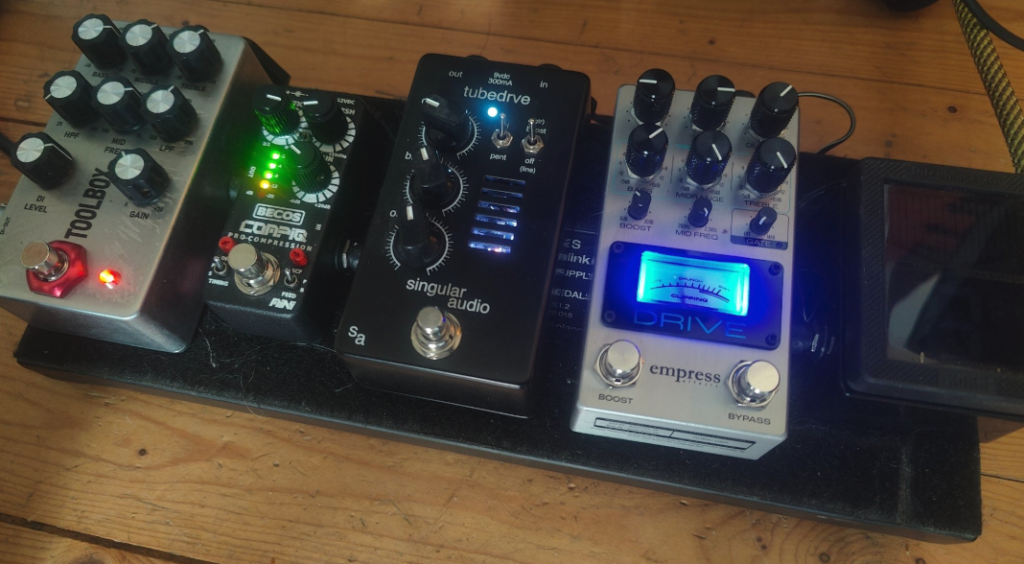
My small board was rigged Tuner -> tubedrve -> Origin DCX Bass -> Becos compIQ -> Disssid Toolbox.
I dropped in the empress and swapped positions so that the empress plays into the tubedrve, so I could make use of the boost function. I set boost to post (as you can see from the blue light), so I won’t have to suffer that bass cut and the extra dB’s can be used to blow the tubedrve up a little more (audio example below).
Quick verdict: It works, and with careful balancing of the levels and the compressor, boost can act as a second drive stage – a second drive stage of the tubedrve, though.
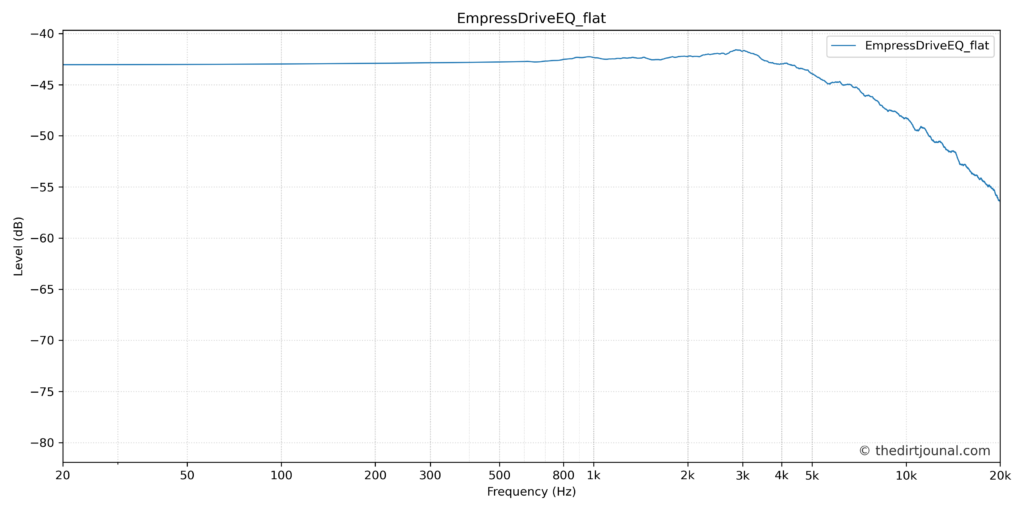
Curious about the EQ and its capabilities, I did measure the response of both Bass and Treble at minimum, noon and maximum:
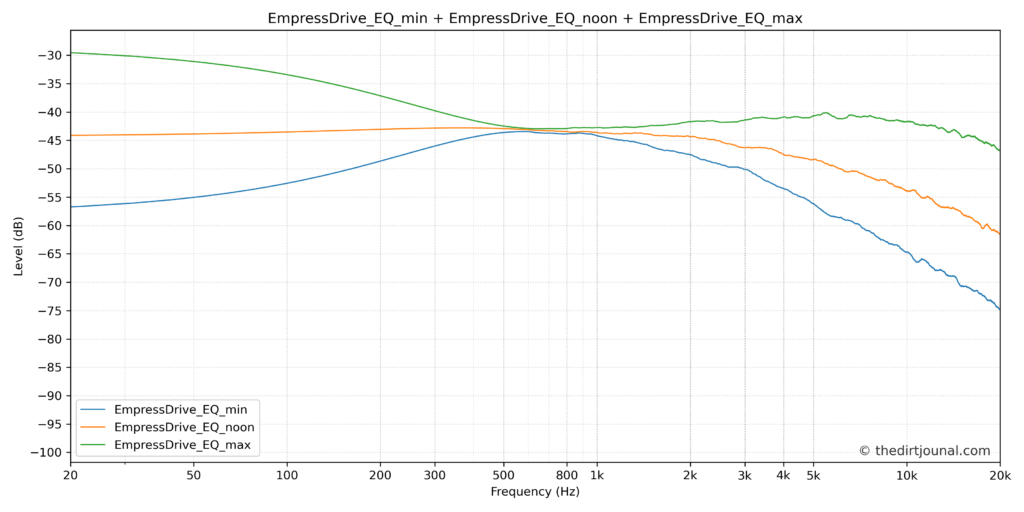
This clearly shows there is a baked in treble roll-off while the bass response is completely flat.
My approach to find the flattest possible response led to this knob position:
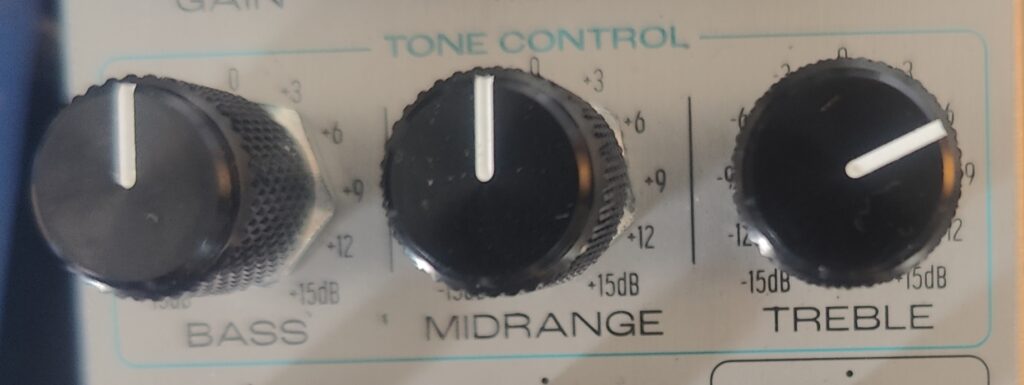
Next up, I set the Empress Drive against the Origin DCX Bass. Playing them, I get the feeling that the DCX EQ is more or less a tool to polish your tone to a shine, where the empress feels more like a tool to shape the drive and its nature. At a first glance, that’s hands down a win for the DCX, because it sounds more sophisticated and noble. Five minutes in, however, I feel like the DCX aces the Drive only in two distinct functions:
- Used as a super low gain drive to polish up the bass sound. The better treble response is one factor, and the bass somehow feels weightier, also the DCX in EQ mode has better dynamics in regards to how touch sensitive it is. Used like this, it’s more a second preamp or a magic tone sweetener pedal.
- Used as a higher gain Overdrive, a mean one that sounds really angry. The DCX has that density that balls up the bass in a mix and lends it concentration, heft and sting.
The Empress lives and shines between those two settings and in that regard, it’s so much better, it’s not even close. The barely there overdrive on the DCX is a great bedroom tone and it’s really subtle. So subtle that you can use it in almost any mix and no one would bat an eye.
The OD on the DCX packs a mean punch, with brass knuckles. The Empress has that tube-like quality. Something that reeks of tweed.
A drive you can use as a drive without sounding too offensive, but still have an audible position in a mix.
There is a lot of texture (to my ear) and it has a wooden, organic quality that I really like.
This makes it hard to hold a competition between the Empress and the DCX because these two can co-exist perfectly well without stepping on each others’ turf, and I move on to A/B the Drive against another pedal that does, on paper, more or less the exact same thing: Imitation of the feeling and response of a tube amp in general – not copying the sound of a specific model. I’m using the Audio Kitchen Fake Plastic Trees for that comparison. Side by side, there is one clear difference: The Drive has a three band EQ where only one band is pre-drive, while the FPT has a two band, with both bands located pre drive.
This means that the EQ clearly shapes the nature of the drive on the FPT, while the Drive has more capabilities to shape the tone in general. Going for a big bottom end is limited in the FPT, because when you dial in too much bass, you’re getting more bass distortion and you do have to stop at some point while you can go a lot further on the empress. The same goes for the treble, which kind of sets the amount of top end sizzle you’re getting and you need to stop before it’s too much – the drive sound I like is somewhere in the upper mids, so there is a sweet spot for the treble knob. Even with those limitations, the FPT is capable of sounding brighter than the Drive. Though I have to admit that the feeling between my fingers, the pedal and my ears is clearly better on the FPT, the empress feels great in that regard, too. It really is an unfair comparison because the FPT is ridiculous in that regard and hands down the best pedal I ever played. The empress ranks very high, among the very best and only has to fold when paired up with the undisputed champion. Is winning the silver medal in the Olympics counted as loosing?
In terms of sound, I want to say they both do great. The FPT is a little more raw and the empress sounds a bit more refined and polished – what you like better is down to personal taste – audio snippet below.
Should empress decide to bring out a bass specific version of the Drive, my wish list would be rather short. I’d want the HPF removed from the pre-drive boost ciruit and I’d want more treble. They could remove the gate entirely, and with the knob that’s freed up, they might add either a LPF or compression for the clean path of the Mix knob, or both. And I’d like an internal trim pot to adjust the VU meter sensitivity – when going for a nice low gain sound, the VU meter is doing some tired twitching here and there, but it’s not as much fun to watch as it is in higher settings. After all, it is a completely useless feature that’s purely there to add bling, so I think it’s reasonable that users can adjust it to look better.
You can already adjust the color of the VU meter backlighting in the normal operation mode. Pre-drive boost engaged will turn it red and post-drive boost will be blue, but the normal operation is up to you. While you’re in there (just hold down both foot switches when powering up) you can also select the position of the boost (pre/post) and the default state the pedal is in when it powers up. Great stuff! I’d want it to default to ‘on’ when running it with a loop switcher and I’d want it to default to ‘off’ when using it on a smaller board. Great stuff! (I said it twice).
Time for a verdict.
The empress Drive is something of an instant classic. Even though it has some weaker points for the bass playing folk – stuff that totally makes sense for guitarists – it nonetheless looks, feels and sounds great. You can tweak some unusual parameters, but the pedal never feels complicated. You get a tube-like response, and it’s capable of breakup with an organic texture that works very well for bass in general, but especially for flatwounds. It can produce a sound that will place the bass well represented and audible in a mix without cutting through, without a farty bottom end. While it can certainly keep up with other well established pedals, it nonetheless carves its own niche. If you already own more dirt pedals than you strictly need, the empress Drive will probably not replace one specific pedal, but add to your arsenal to give you a new sound and flavor. I ordered mine from a place with a great return policy and even if I do not see an immediate use for it, I don’t think I will send it back. I’m empressed!

This first snippet is the pictured pedalboard setup. First pass is the tubedrve only, second pass is the empress Drive in normal mode, third pass is with the boost (set to post) engaged.
This is showcasing the Audio Kitchen Fake Plastic Trees against the Empress Drive
First pass is clean, second is the FPT and third is the Drive
And here’s a very subtle one.