Haggtronix Rotten Sorcerer
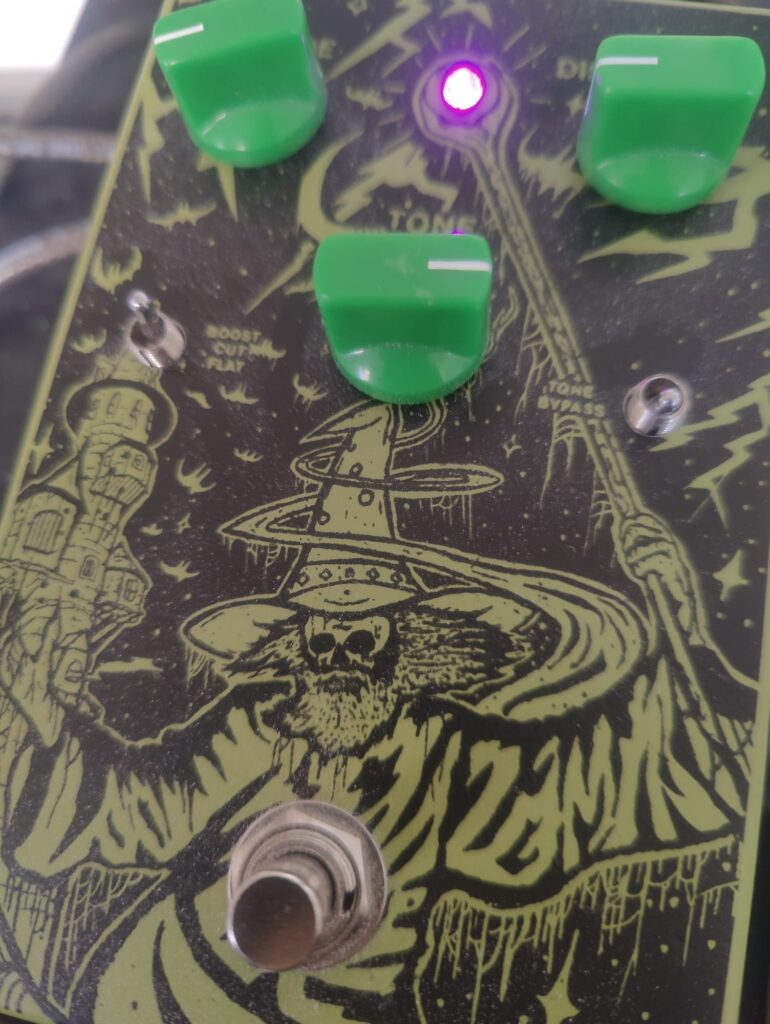
I received this pedal in a trade. Before it arrived, my knowledge was limited to the name, the fact that it’s glow-in-the-dark and that it works for bass. Looking at it, I want to say it’s a fuzz for those folk that play doom, stoner or sludge. The graphics and name suggest that it’s probably not subtle.
When the pedal arrived, the first thing I noticed is that it’s a fair bit larger than I anticipated. This is a big pedal. The box it came in is black and the writing on it is of the “Death Metal Band Logo” variety. I have no clue what it says. The box is high quality though, and the pedal itself comes in a nice pouch with drawstrings.
At first glance, it’s a simple affair. The knobs are named Volume, Tone and Distortion, the two switches Boost/Cut/Flat and Tone Bypass. The LED is purple, which works very well with the artwork of the pedal – the gem of the sorcerer’s staff will glow in that hue when you activate it. The sorcerer himself is painted on in glow-in-the-dark-paint, so the effect is even more spooky on a dark stage. The foot switch is soft touch. All in all, it’s a very well made boutique pedal.
I did brace myself before I plugged it in for the first time. Pets were shooed out of the house, I had the insurance company ensure that fuzz related damage to the foundation of the house will be covered, I even glanced down the street to see if any neighbors were in. So when I sat there, with a cocktail of anticipation and fear bubbling up my spine, hitting the switch for the first time was a bit anticlimactic.
The anticipated super-high-gain floor noise was not really sounding like super-high-gain floor noise at all. It felt like switching on a mild overdrive. Until I played a note. Whatever component feeds this pedals output jack is a bit oversized. Or turbocharged. Or maybe someone misplaced a decimal point? With the volume knob and the distortion knob at, what I’d have estimated a fairly low setting of 9 o’clock, I see all the lights on my compressor come alive and the unit starts sweating and pumping. With the volume around 8 o’clock I’m closer to unity. There are enough decibels available to really show your amp’s front end who daddy is.
The EQ works with three controls. The on/off switch will either let the signal pass through the EQ section or it will go raw. The raw signal is significantly louder and it has its own distinct sound that no EQ setting will duplicate.
With the mids switch set to the flat position, the Tone knob’s influence looks as follows:

The blue line is the EQ bypassed, which is much louder up until 2k. All measurements were taken with fixed knob positions. It looks a bit like a tilt EQ that hinges somewhere around 1k.
The EQ switch will simply trigger a broad boost or cut:
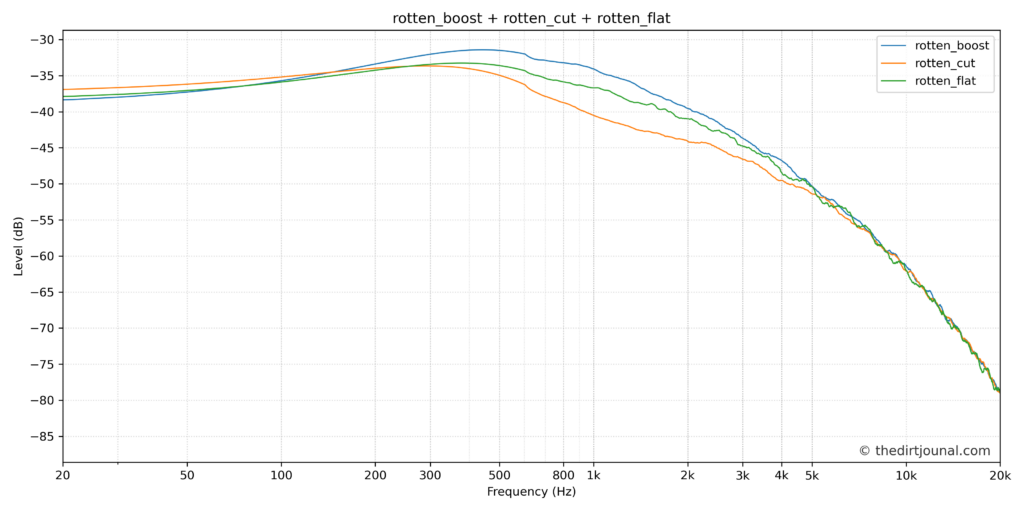
Starting already at 200Hz the boost peaks around 500 and the three lines join each other around 5k.
This graph was taken with Tone and Distortion at noon, volume set to unity (in the boost setting).
However. What I did encounter in terms of handling and sound is best described as a well mannered and educated ferocious feral beast.
Let me give you a little insight into my brain when it comes to fuzz pedals.
Germans are quite strict and very particular about their beers. We have the “Reinheitsgebot”. An iron law, dating back to 1516, which states that beer may only contain water, hops and malt (yeast was unknown back then and later added). You can be a convicted tax criminal and still have a career in Germany. You can assault people, rob, loot and still manage to be re-integrated into society. But when you mess with the Reinheitsgebot, a mob will gather – torches, pitchforks and all – and drive you out of the country. You’ll never be allowed to return, even if you lived to be 500 years old. The Germans do not forget these things.
For that reason, most German beers taste very similar. Sure, you get the outliers, but the mean German usually likes his “Pils”, and all the big breweries do “Pils” and those are all very similar. (Note: All of this is very true for most parts of Germany, but the Bavarians play by their own rules. None of this applies in Bavaria).
Enter the small craft beer breweries. These people might try to do a standard beer, but usually, they do that crafty stuff.
I sometimes think that these makers are either driven by the need to explore what is beyond regular beer and others might have given up and went completely bonkers. Beverages with names like “Purple Monkey Dishwasher” do not really speak of a beer with a five century tradition behind it.
Fuzzes, for me, are the craft beers of dirt pedals. If I were to categorize them, I’d say there are the synthy ones, the wooly ones and the angry ones.
The synthy ones are led by the Doom2, of course, and many fuzz circuits can deliver a synth feeling – usually, you just have to push the gain high enough and at some point it stops sounding wooly or angry and starts sounding artificial, but some fuzzes get there easier and/or have their sweet spots there.
The angry ones are often Muff types, but I also think the Tone Bender or Superfuzz get there easily, and for the wooly tones, the Wooly Mammoth would be the first address.
This here pedal, the Rotten Sorcerer has a variety of all three to offer. With the tone bypassed, it’s a Muff, and it sounds angry. With the tone active, you can get a variety of wooly tones from it with the tone knob below noon, and some of them really feel useful. At certain points I get that artificial feeling that I’d really dislike in a metal setting, but slap on an envelope filter and ride the bus to synth-town! There is a huge difference in sound when I’m swapping between my 6 string with Aguilar pickups and my Aria Pro II Rickenbacker copy. On the Fakenbacker, switching the pickups has a huge impact, and for some weird reason, the fuzz really likes the neck pickup. On every other pedal I ever tried, I get a LOT more dirt from the bridge pickup – I even used that effect by setting up the signal chain to have a solid grind with the bridge pickup soloed, a hint of drive with both pickups on and a clean sound on the neck pickup. Well, the Rotten Sorcerer drops a heap of dirt on the neck pickup, and the settings sound about equally dirty. Other than that curiosity, I can report that the pedal really likes a Ric style bass, they play well together.
I did describe the Rotten Sourcerer as well mannered and educated, yet called it ferocious and feral in the same sentence. Let me elaborate on this: The Rotten Sorcerer almost feels like a gated fuzz. There is, of course, floor noise when you switch it on and it runs on a high gain setting – but it’s not as bad as one would imagine. Furthermore, there is feedback when you play loud, but it’s not as bad as one would imagine. I often feel like I’m in a car with the accelerator pedal stuck when playing high gain setups. You need to control the unwanted noise and the feedback and make sure only wanted noise comes through, and unwanted noise and feedback always break through once you stop, so as long as the high gain stuff is active, you gotta feed the pedal notes, lest it will feed back at you. The Rotten Sorcerer is a high gain fuzz pedal, so it is in its very nature to behave like that, but I’ve encountered MUCH worse in this regard.
It’s also worth mentioning how good the Rotten Sorcerer feels when playing into it. It’s sensitive to attack and also the tone and volume knobs on a passive instrument, and will give you a different texture and feeling when you move your plucking hand position. The rich and fat low end this pedal is capable of, along with the impact the tone knob has on the nature of the sizzle – and the great sounding raw mode where all EQ is cut from the circuit makes it a great bass fuzz pedal. The name and graphics seem to push the pedal firmly into the realms of stoner, sludge and doom, and I could not really see where any of the offered sound would work in a worship band setup. I guess that in most, if not all, places where a rotten sorcerer is frowned upon, the sounds it creates are not really missed, either. There is no low gain with a lot of cleans and just a sprinkle of fuzz. The pedal passes signal with the Distortion knob at minimum and that’s already pretty loaded with dirt. The tonal manipulation of your signal is as subtle as a rotten sorcerer on a battlefield.
I am very glad I accepted the trade for this pedal, because I would never have gotten my hands on it otherwise. I did not expect to have this much fun putting it through its paces and trying to find uses for it.
I am seriously contemplating to experiment with it as a third gain stage for my metal board, and I am intrigued to try out more pedals that are based off the Green Russian, if not a Green Russian itself.
This is the Haggtronix Rotten Sorcerer with the EQ bypassed.
This is the tone active, set to slightly before noon, mids boosted (added drums and no clean pass)
Fakenbacker bridge pickup, played with pick
And another