Greer Amps Lightspeed
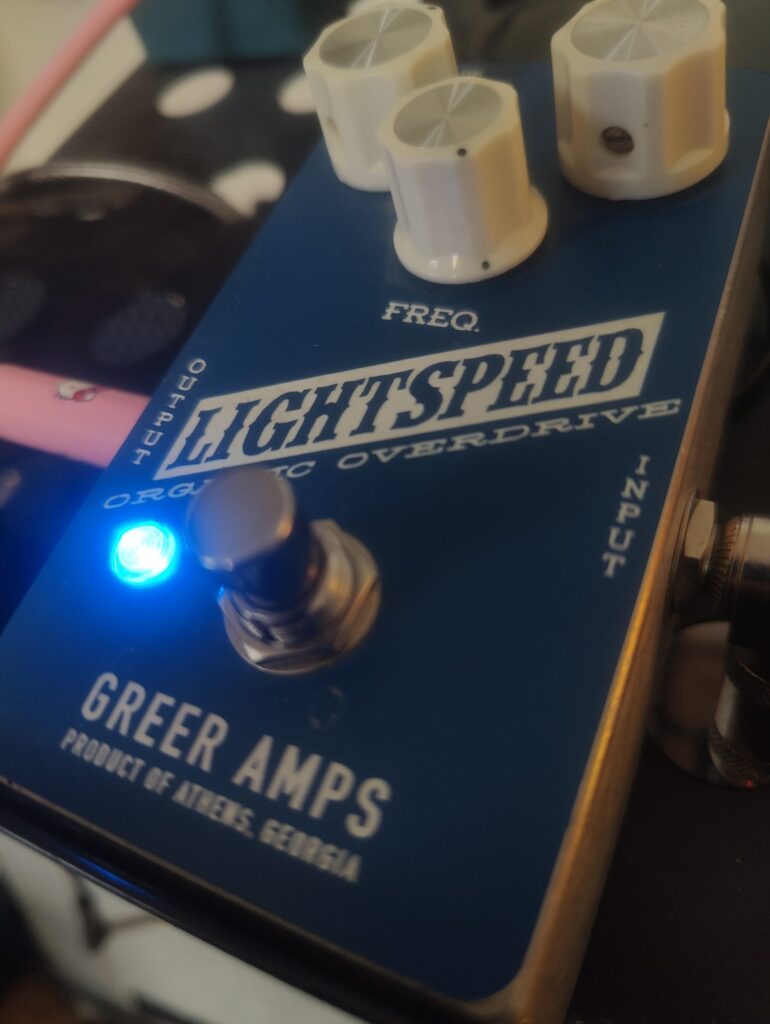
At first I thought this is just another Tube Screamer. Then I did some very brief research and the computer told me it’s actually based on the Timmy circuit. I should have stopped there, but I did ask the search engine if the Timmy circuit is based on anything and lo and behold, the Timmy is based on the Tube Screamer.
It might be a stretch calling the Lightspeed a Tube Screamer, because it’s based on the Timmy, but modified – and the Timmy is described as a heavily modified Tube Screamer, so the bloodline surely is watered down, but let’s see if some of the genes have been passed down through the generations.
It’s a heavily hyped pedal because apparently it’s a good start to get a John Mayer tone on guitar, and it was recommended to me multiple times as being excellent on bass, too. Because of the hype, it took a while to snatch one up for a reasonable second hand price.
There’s three knobs for volume, gain and tone. It’s simple. The tone knob is labeled FREQ, but it does as a tone knob would:
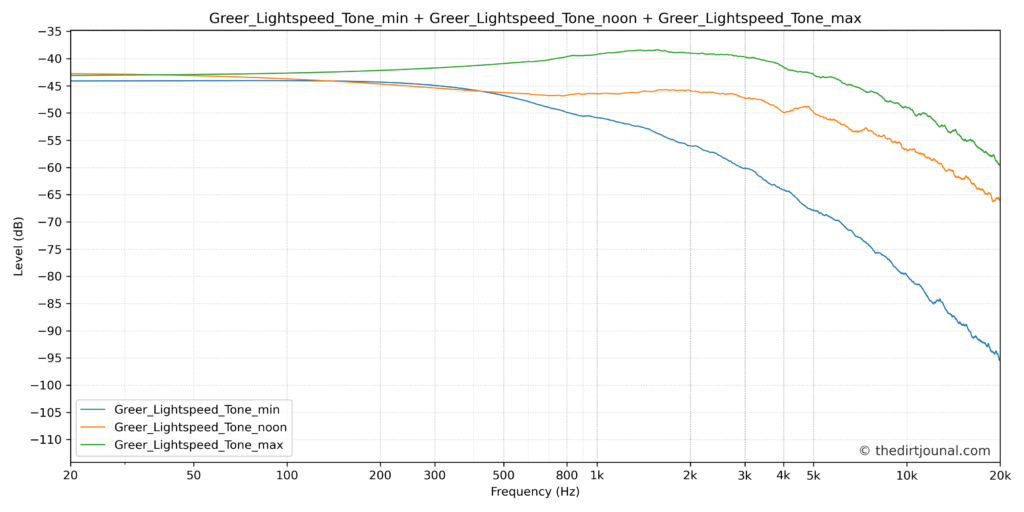
This graph not only illustrates the workings of the FREQ knob, it also shows there’s no cut of low end, and also no accumulation of decibels in the 720 Hz area, both typical Tube Screamer feats. Another feat of the green grandfather is that it passes signal with the Drive knob at zero.
The pedal itself is brushed aluminium with a glued on faceplate. The knobs are pretty nice and feel very good, although they could use a little more friction. Standard boutique level pedal building, nothing special to remark on, no complaints either.
For me personally, the Lightspeed is an extremely simple device. As you can see the FREQ knob at noon is just shy of a flat response – about 1 o’clock should meet the flattest line possible. I’m running FREQ between 4 o’clock and max, the master volume set to unity and then it’s all down to how to set the Drive knob. The last two reviews I finished were the empress Drive and the Becos Ziffer Overdrive, and these two had a load of options that needed to be balanced against each other to yield great tones – fun stuff to tinker with, but I also do enjoy a well built pedal where I don’t drown in options and endless tweaks. On the Greer Lightspeed, I set the Drive by eyeballing it, play a few notes, adjust a little bit more, this time by ear, and I’m there.
Not much to tweak, but at the end of the day, it’s about getting a decent sound, not twisting knobs with no end in sight.
The Lightspeed feels like it’s a bit more forward oriented than a classical Tube Screamer. The TS hangs smack middle between what I call amp-like pedals and drive pedals. The Lightspeed feels like it’s just left the middle spot, slightly leaning towards drive pedal behavior.
The Becos Ziffer Overdrive I have on my bench, a pedal that’s directly based on the Tube Screamer (but also heavily modded), does better in how it feels while playing, but that’s not to say the Lightspeed does not feel good. It’s actually quite nice and there’s more than enough feedback to really feel what I’m doing, it’s just that the Becos is extremely well made in that regard. The clipping on the Lightspeed is soft. It feels like velvet. Like a well made cocktail that contains a sparkly liquid in such an amount that you feel the sparkle, but barely – just knowing it’s there, for a more interesting texture, not to dominate. The Way Huge Pork Loin or SolidGoldFX Beta, as well as the Horrothia Teeth can clip even softer, but on the Pork Loin I did think the texture is a little bit too soft. The Lightspeed is in a very good spot. Same as any TS based pedal, when sending it over the edge, the upper mids go first. It’s easy to dial in a low gain sound that leaves the low end largely intact and only comes through on the higher notes, blooming up double stops higher up the neck. The flat response of the Lightspeed will not add much in terms of color, but it lends a slight emphasis on the upper mids when you make it sing, which works very well in a mix. When used as a very light drive, it is a pedal that works very well as an always-on option that will add the little something, the cherry on top of your sound. It’s not a miracle device that will take a mediocre sound and make it better, but it can work to make a great sound greater.
When crossing from light drive to audible drive everything increases in a linear fashion, as one would expect – it’s basically the same sound, only more audible dirt. Going up further, the Drive knob reaches territory that feels uncomfortable. The added harmonics come apart from the dark tone my flatwound strings produce and they feel detached and artificial. Gone is the organic feeling. Luckily, at this point, I decided to try my trusty old Aria Pro II Rickenbacker copy played with a pick to go for a more aggressive bass sound to see what happens. The tone did not improve, but instead of turning down, back to gentler tones, I turned the Drive knob all the way up and hit a note. I was greeted by a tone that would hold its own in a stoner or doom scenario. The sound of an insectile chainsaw ripping strong canvas, something I dearly love from my Verellen Meatsmoke. The Lightspeed gains a mean edge when dimed. The sound stays organic and warm, and the clipping we’re experiencing here is still soft, but I would like to point out that ironwood is also organic and warm. In this context, the clipping of the Lightspeed sends a seasoned lumberjack home crying, cradling the remains of his ruined axe, barely a mark on its bark. There’s no metallic clank in this tone, but it’s something that sees towards metal on eye level. At times, I tried to copy the Lightspeed tones on the empress Drive, but the Drive could not get that hardness at the core of the drive, remaining a little softer and warmer. This tone by itself works very well for me, but sending this into another device that is set up for a relaxed kind of drive also gets a massive response, keeping the organic feeling and sound alive. Calling the Lightspeed a Tubescreamer variant feels like it would not paint the real picture. There is a lot of Tubescreamer in there, but it’s also its own thing. The clipping feels a little different. The low end stays intact. The mids and high mids tend to go first when driving over the edge, but it’s lacking that solid mid hump a true Tubescreamer typically has, which is good news to my ears.
Verdict:

I expected the Lightspeed to be a one-trick-pony and hoped that does a great light drive.
Which it does.
A really good heavy light drive surely comes as a welcome bonus. It works great in my setup and it’s a simple three knob pedal, easy to set and easy to play. What’s not to like?
This is with the FREQ knob wide open and the gain around 11 o’clock.
This is played clean in the first pass, with the Lightspeed in the second pass and the Empress Drive in the third.
This is the Aria Pro II bass, Drive and Freq all the way up.