Genzler Amplification 4 On The Floor
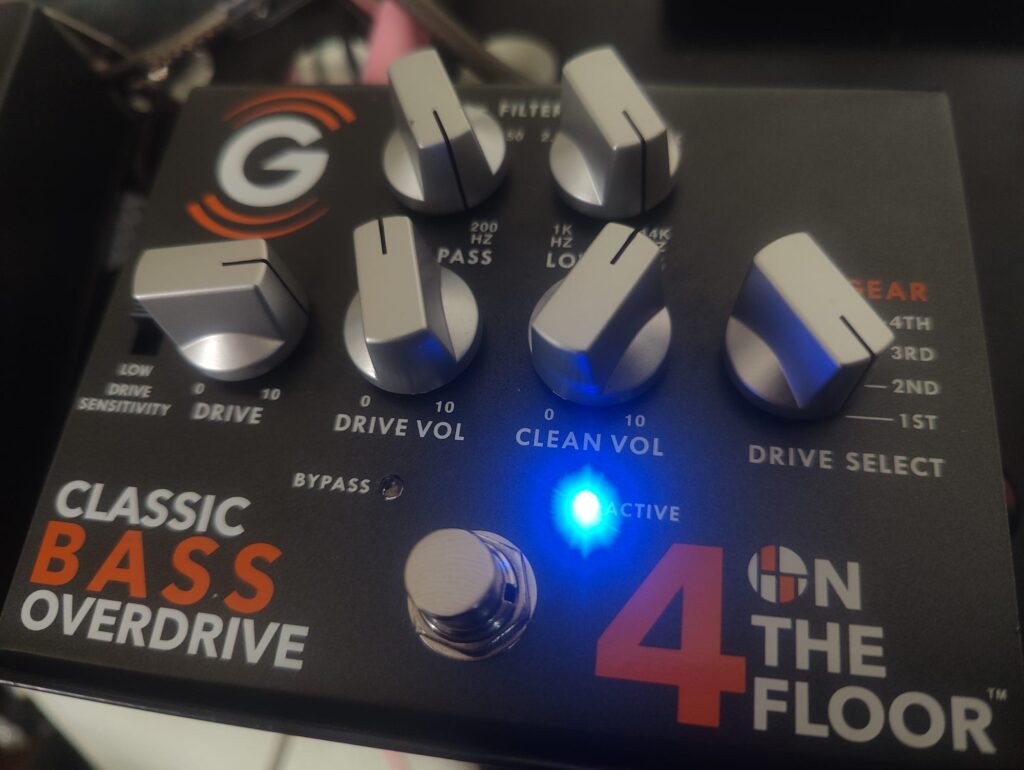
This is the Genzler 4 On The Floor. You could say it’s four drives in one. Or can you?
The control layout is somewhat unique: You get a switch that seems to act as an input pad to tame high output basses. Then you get a Gain knob and two volume knobs, one for clean and one for the dirt engine. The dirt engine has a four way toggle, ranging from the imitation of a tube amp’s clean channel to full-on overdrive. In the top row, there are high- and low pass filters. The high pass is located before the clipping happens, while the low pass comes after the clipping stage. Both filters only affect the drive part of the signal and leave the clean signal as-is. You do not really get any tonal options here, but a lot of knobs to shape and fine tune the drive that’s happening. By balancing dirt and clean signals and using the filters, you can dictate the frequency range in which overdrive happens and the frequency range in which it does not. With the low pass on the drive section, one should also be able to use the 4 On The Floor running directly into a PA system without the need of a cabinet simulation.
Printed on the enclosure, you’ll find the words “Designed and Inspected in the U.S.A.”, while a sticker on the bottom proclaims that it was made in Taiwan.
The chassis is not your standard Hammond 1590 format, but something Genzler came up with. Fit and finish remind me of the Strymon pedals, the execution certainly is nearly as flawless.
Also a bit unusual is the dual LED setup. One LED lights up when the pedal is in bypass, the other lights up when you engage it. Even though the bypass has an LED status, it is a hardwired true bypass. The pedal lights up as soon as power is connected, even with no audio cables connected – and there is no battery option.
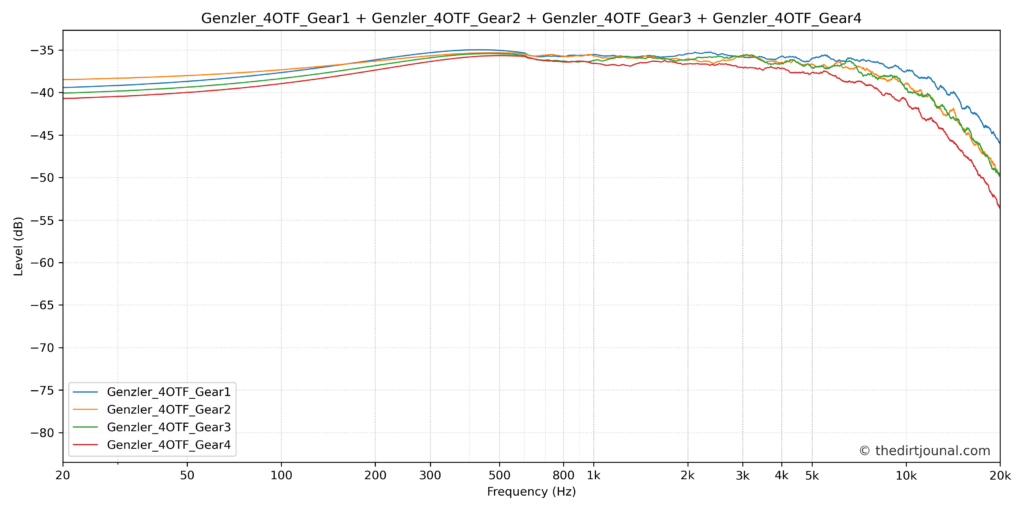
This is with the filters wide open, the clean signal turned off and the Gain at noon.
Not much to report here. This looks fairly flat, with a slight accentuation around 400Hz. The fourth gear did a little less on the meter, which is probably due to heavier compression.
I found that unity on this pedal is not noon, but closer to 2 o’clock on both the drive side (with Gain at noon) and the clean side.
So what’s the path to tackle this pedal? I try to walk myself through the thought process behind the pedal and how the makers might have envisioned the sophisticated bassist of today might go about setting it ‘just right’.
First in line is the switch. I do treat it like any input pad switch on anything: Leave it on the sensitive setting and ignore it unless you run into problems that are a result of feeding the unit an input signal that’s way too hot. My input signal is not, so ignore it is.
Drive and Drive Vol are a couple that will determine the output level of the drive part of the signal, Clean Vol is the single knob that determines … you all are smart enough to figure that. Drive does work in conjunction of the gearbox, though.
At this point, I need to expand my horizon in the English language. I do assume that Jeff Genzler is, to say it with the presidential vocabulary, “A high-IQ person”, because his designs in the amp world suggest that either he’s a brilliant engineer or he can tell a normal engineer from a brilliant one and hired the latter. Why am I writing all this? Well, in my limited understanding of American English, the term “4 on the floor” refers to a drum beat, a 4/4 in which all four measures are played with the kick drum. An okay name for a pedal, but somewhat weird on a pedal that uses car-terminology. Lo and behold, there’s another explanation, though. In automotive context, the late sixties and early seventies saw a relocation of the lever that shifts gears. The olden days, the cars had three forwards gears and the lever was mounted on the steering column, which was referred to as “Three on the tree”. The new cars that came out found the lever mounted between the driver and passenger seat, on the floor, and guess what? They expanded the amount of forwards gears by one, to a total of four.
Americans did abandon manual transmission shortly after and never cared to update the term to modern cars, where 5 and 6 gears became the standard, because driving stick is for Europeans.
However, in the Genzler pedal, the 4 On The Floor surely refers to the automotive origin, with a tip of the hat towards the drum beat to connect the world of cars to the world of music. I’m no expert in cars, but I’m pretty sure I’ve heard the term overdrive used there, too.
Sadly, there’s no little lever that can be cranked into position to select the gear the overdrive is in – it’s done by a four way rotary switch. The switch travels easily and with not much friction, which feels surprisingly good. I would have thought that I strongly prefer a rotary encoder that snaps over with considerable force and comes to rest with a satisfying click, but this smooth operation totally works for me.
Let me quote the scripture:
1st GEAR: Reminiscent of a tube amp’s clean channel (including natural harmonics) with a bit of overdriven tone when driven hard. A nice “always-on” selection.
2nd GEAR: Emulates a tube amp’s mildly overdriven tone, with a small amount of dynamically compliant clipping asymmetry. This is a natural feeling, touch sensitive algorithm with very mild compression that responds with more texture and complexity, the harder you dig in.
3rd GEAR: A more aggressive up-shift from 2nd gear, this moderate, asymmetrical overdrive is less compliant, with greater compression for a tighter feel.
4th GEAR: This is the most aggressive gear of all — a heavier, symmetrical, low compliance overdrive that can enter distortion territory when driven hard. While there are a lot of harmonics and compression present, this gear does not give up tone or feel.
Here’s a snippet of me shifting through the gears. First pass clean, second pass 1st Gear, third pass 2nd Gear and so on. Drive is set 3/4 up, Clean signal is just below unity, high pass at just before 100Hz.
I don’t know about you, but to my ear, the first three gears sound basically the same, it feels like every flick of the switch just heaps on a little more gain, with the biggest change happening when shifting to Gear 4.
If I am brutally honest, my impression after playing the pedal for a while with different basses, then getting a night’s rest and trying again is this: To stay with the automotive motives, it feels a bit like a stock car (nothing special) was taken to the shop, where it was gutted first, then a rollcage was installed, cross bracing added everywhere, the stock suspension ripped out and replaced with track suspension, plus race tires, spoilers and ceramic brakes. The little X’s were added to the headlights and the new paint job included a big number on the hood and sides. This new, heavily modded version can withstand the rigors of track racing, keep grip in tight corners and can repeatedly brake from 300kph to 80kph at the end of the finishing straight without overheating issues.
However, the engine and drive train were left completely stock. This car is capable of cornering with immense G-force and can stop from ultra high speed in the blink of an eye, but it is completely unable to accelerate to the required velocity in the first place.
In the 4 On The Floor, the drive part of the signal has high and low pass filtering to reign in even the nastiest of drives and there is a clean blend to allow for ruthless filtering of the wet side, so you can really go to town on the drive and then reign in the brutal onslaught with those tools, but then you get a selection of four nearly identical mild overdrives that are well behaved and do not require any reigning in in the first place. Here’s an example:
This is the absolute maximum of dirt I could get out of the pedal. The filters are wide open, it’s in 4th gear with the gain maxed and the clean signal completely off. Furthermore, I used my Aria Pro II Ric copy with the bridge pickup soloed and played with a pick, hammering the strings so hard they called me Daddy afterwards. You can hear it clip on the clean setting already.
While it certainly shows a heavy overdrive here, this is the absolute maximum of the highest gear and none of the stuff that can tame it. Even without touching the filters or clean blend, you get back into calmer waters just by reducing the gain from maximum to maybe 2 o’clock – and then you can still shift down to third or second gear to get a result that’s even more civil.
The dynamics of playing the pedal in the different gears vary a bit. Gear 1 is a bit tame and feels like it is made to add some subtle saturation that feels like an afterthought, while gear 4 has solid compression going on – the middle gears feel okay to play into and have a good amount of dynamic response.
The haptic feedback is okay, too. Both the dynamic response and the feeling of feedback from the pedal are nothing to write home about, though.
I guess this pedal works well when you play into an amp or preamp and are quite happy with your sound, but you’re looking to add a little bit of grit into the mix without changing anything else. Especially the filters on the drive section might help to limit the amount of sizzle you’re getting. For me personally, it’s a bit too bland and/or tame. There is not that much excitement to be had.
It is a solid tool that works reliably – but at the end of the day, it’s about as exciting as a hammer.