Nobels ODR-B
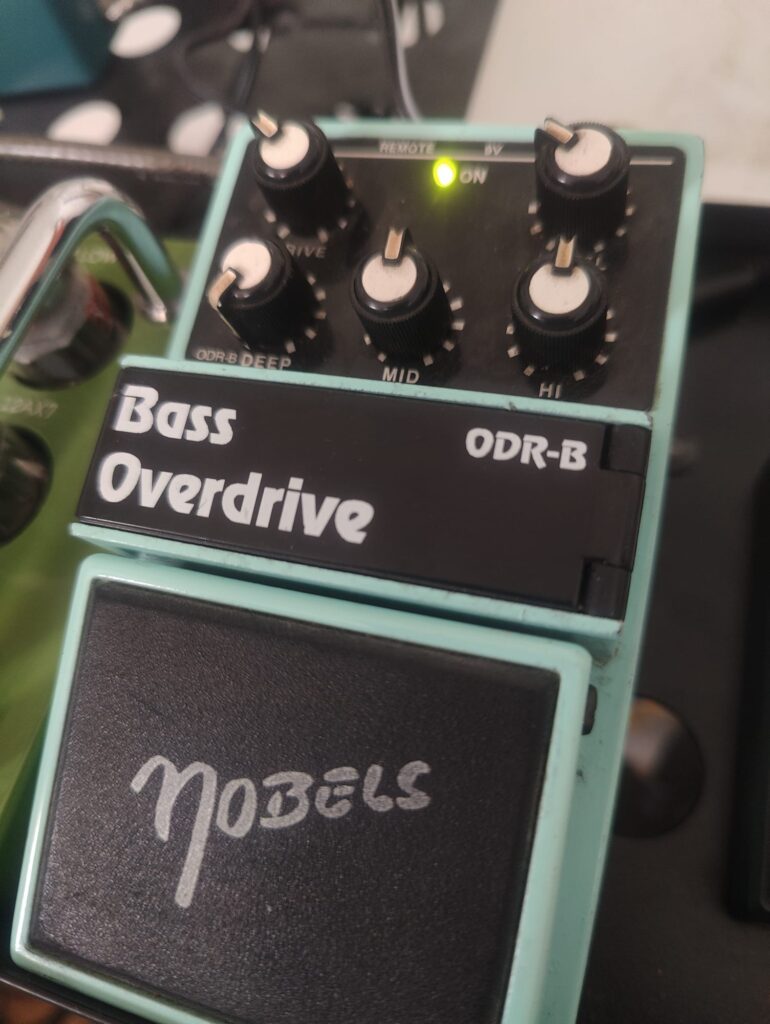
After I was very pleased with the Nobels ODR-1 Natural overdrive – the bog standard version already worked great for bass – I was interested what to expect from the bass specific version.
One small problem: These came out in 1993 and were discontinued 2003, so one could carefully start calling them vintage. There is a limited supply and from time to time, one moves for an attractive non-collector price. Up until now, I did discover some good deals on an ODR-B, only to find the pedal already gone. Well, my patience paid off or my luck changed – I was quick enough this time.
In terms of build quality, the ODR-B is the same thing as the original ODR-1. It’s nothing to write home about, but there’s also no real room for complaints. Handling boutique pedals that boast the finest components on a daily basis, the Nobels stuff feels cheaper. However, these are sturdy enough to withstand gigging, and they work reliably. My pedal is about 30 years old by now and it’s working just fine. The design is clearly based on the Boss pedals, but the Germans went for top jacks instead of side jacks, which is a big plus in my book.
The big difference between the ODR-1 and the ODR-B, apart from the blue enclosure, is the amount of knobs. There are gain and volume, named Drive and Level, but instead of the tone (Spectrum) knob, the bass version comes with a three band EQ. This makes it very similar to the ODR-S, the Overdrive Special.
The knobs are labeled Deep, Mid and Hi. Reading the manual, it seems the Deep knob is a boost only knob for bass frequencies. The manual does warn that the Deep knob boosts sub frequencies and to watch out for one’s speakers. The Mid and Hi knobs seem much more common boost/cut equalizer bands.
Let’s have a look at that first:
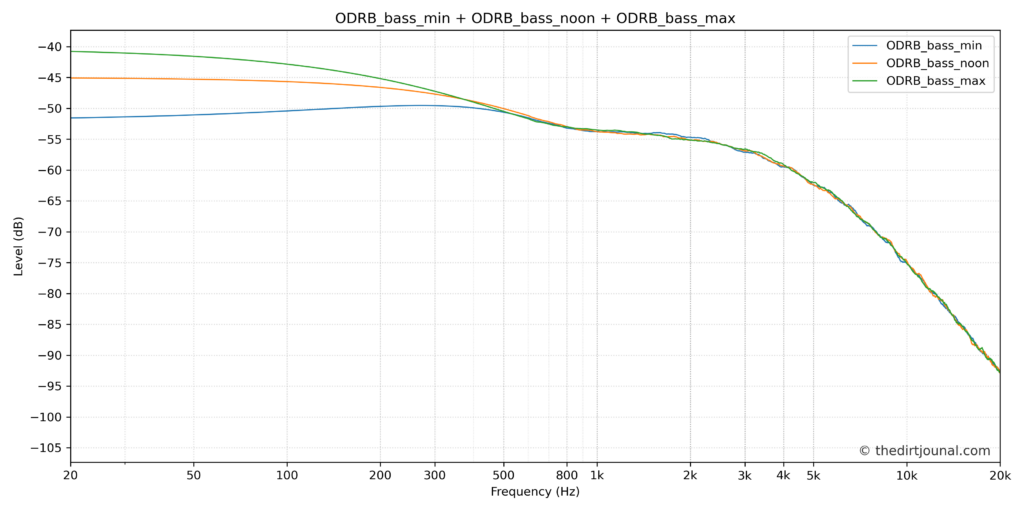
This measurement was taken with all knobs at noon, except for the Bass (Deep) knob. Even with the knob setting at minimum, the bass is still slightly elevated – and it only goes upwards from there. Kind of like the frequency chart of the Klon when you flip the image.
Toying with the knobs even without playing I can tell the EQ feels powerful, so let’s look at what the other knobs do. I returned the deep switch to minimum, left the mids at noon and tried the treble knob next:
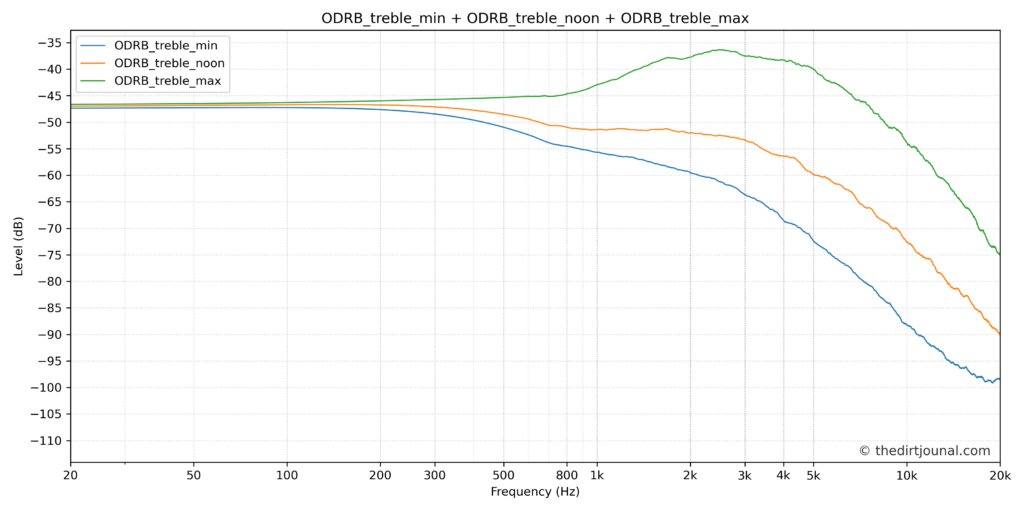
Okay. That is a broad application to the term “Hi” in relation to EQ. The curves separate visibly before they even reach 200Hz. That leaves the mids, so I repeat the process:
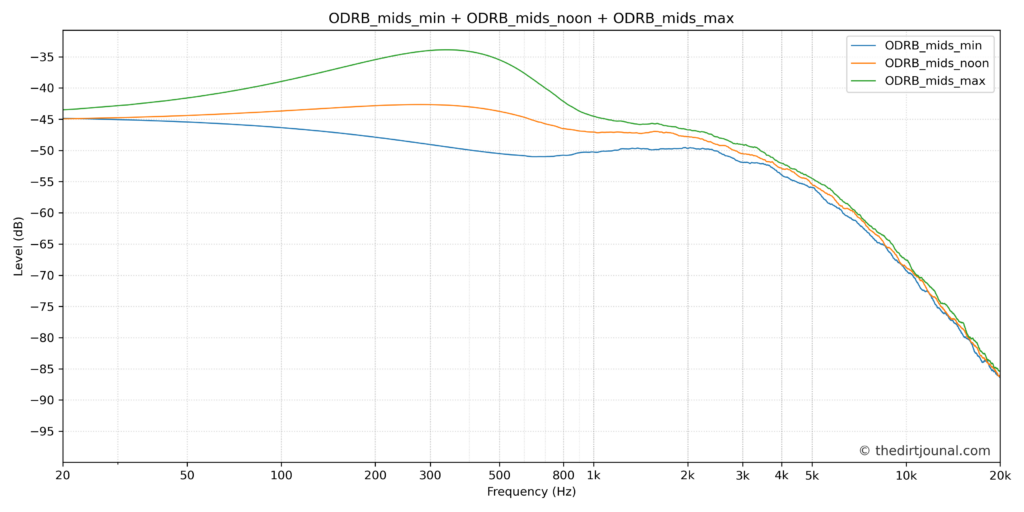
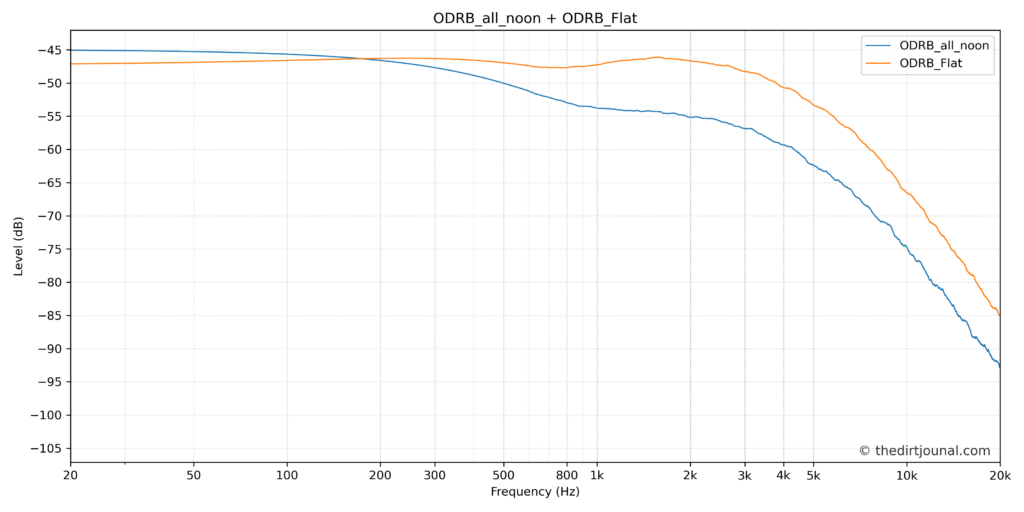
Trying for the flattest possible response, I ended up with Bass completely off, Mids at 9 o’clock and Treble at 2 o’clock. Here’s the comparison against all knobs at noon:
And to finish things off, the Drive knob:
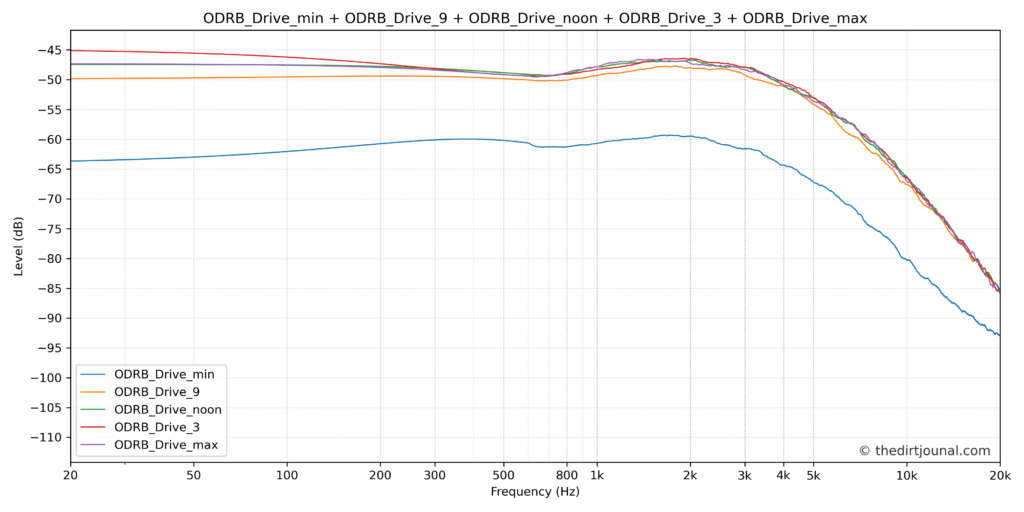
With the Drive at minimum, the pedal still passes signal, but it’s a lot weaker. Just after minimum, there’s a jump in volume and from there, not much happens.
This is what machines can tell us about the pedal. What happens when I unplug the spectrum analyzer and plug in the speakers? We’ll have to stay with the EQ for a moment longer.
I did measure what it does, but the next question would be where in the circuit the EQ knobs are located, pre or post clipping? This is not as easily answered as one might think. I usually set a low value on one EQ knob, then set the gain and play to get used to the sound, then I raise the EQ and carefully listen to what happens. When the signal gets more distorted in the frequency area I’m manipulating, then that very knob is located pre clipping. When the grit stays the same through the process, the knob sits post clipping. In case of both the Deep and Mid knobs on the Nobels ODR-B, the opposite happens. When I set the amount of grit with the Drive knob while Mids and Deep are at minimum and then raise those knobs, the grit disappears. My current working theory that explains the phenomenon is that the pedal runs an internal clean path with either a fixed dry/wet ratio or the ratio dictated by the Drive knob, and those two EQ knobs influence the dry signal instead of the wet one. This would mean that raising the EQ on those raises the dry signal and alters the dry/wet ratio or something. Very curious.
The Deep knob is, as already mentioned, a boost-only bass control and man, it boosts bass. I’m a fan of boosting bass and I will overdo it if given the chance – but even I won’t turn that thing past noon. The mids control has a well chosen frequency range to bring the bass forward in a mix. The baked in sound of the pedal is already a bit mid-forward, so with the knob at noon, you already have a good position, turn it up to step forward even more or turn it down a little for a flat response. Scooped sound is not really its thing – but scooped mids are for bedroom players. The treble control is controlling the treble – even though the pedal has a steep drop at 4k, you will get a brighter sound out of it. That treble rolloff means you can use it with modern bass amps that have tweeters or going direct without strictly needing a cab sim in place.
With that said, it’s an easy thing to make that pedal sound terrible. Run the bass too high and you’ll release a mudslide of epic proportions onto whomever happens to be in the sonic range of your suffering speakers. The treble is the same. When I compare it to the Origin DCX, it’s like the sound you get from each pedal is perfectly aligned with the haptics and looks. The DCX is made of a steel so fine, I bet you could forge a decent knife blade out of it. Turn up the treble and you get that polished steel quality in your tone. The ODR-B is probably made from die cast aluminum, and lots of plastic. And the treble has that ring to it that you associate with die cast aluminum and bits of plastic. Even if the quality of both aluminum and plastic is high, it’s not stainless steel.
Playing the ODR-B, that’s like Bam Magera skateboarding in 2026. Have you seen him lately? This whole pro skater business along with the Jackass series and movies and the CKY stuff meant that harshly abusing his body was his day job and he does not look like he spent his time off leading a healthy life either. He looks like he lived an unhealthy life to the max and paid the price. He’s stiff and looks like many movements cause pain (which they probably do). When he’s skating, there’s no elegance or grace in his style. It’s pure efficiency. This slightly elder, slightly overweight man gets on a board and attacks the obstacles like he knows what he’s doing from long years of experience. You can see that he can’t match the fire and fervor of the guys that are half his age. He’s not going for the demanding tricks or takes the insane risks he did in his youth, but he’s still on a board, still skating on a level that is astounding. He’s got muscle memory and experience, so he knows what muscles are needed, and he needs less tension in his body, can ride with a higher center of gravity than a less experienced skater.
The ODR-B is also a little bit stiff in the middle, and also a bit chubby, but it also knows where to center its gravity and how much weight to put exactly where to get the job done. I feel like when you try to make it give your sound a shiny polish, it kinda lacks panache.
It is a great pedal for bass dirt, don’t get me wrong. For the elitist gear snob, however, the most appealing factor about it is that it’s been discontinued for a while now and therefore somewhat rare, although these pop up frequently in the used markets. However, I do understand why Nobels did discontinue the ODR-S and the ODR-B while they happily kept making the ODR-1 and still do today. If given the choice, I’d actually prefer the ODR-1 to the Bass version, because their claim of it being a “Natural Overdrive” feels very true to me and the “Spectrum” knob works very well – it’s generally a little bit more dynamic and lively and works better as a low gain drive for some sparkle.
Here is a sound sample of low gain tones, the best “barely there dirt” I could coax from the pedal.
This is to demonstrate the dynamic range. The first pass is with the pedal off, the rest is played with varying plucking strength.
A little more gain, playing my P bass:
And finally, enough gain for the pedal to feel “right”, P bass with a pick: