Becos FX TS8-JZ Ziffer Overdrive
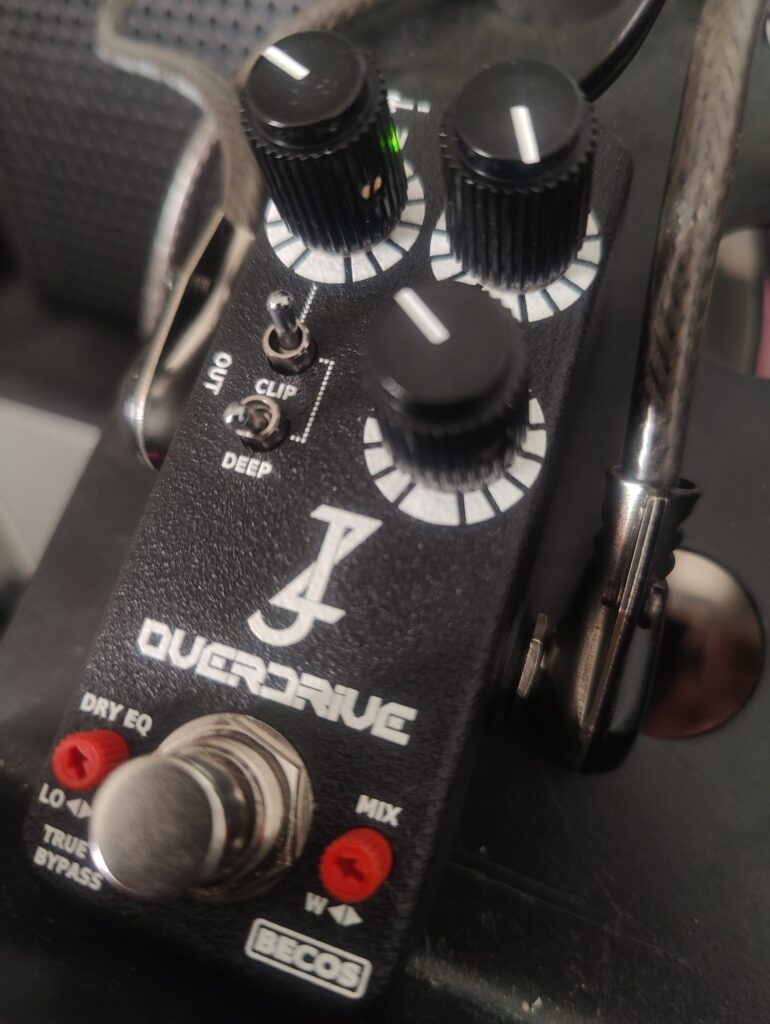
This is my second Becos FX pedal. At the time I’m writing this, Becos are somewhat obscure as a brand.
They hail from Austria, do direct marketing and only build to order, which usually takes less than a week.
My first Becos pedal was not a drive, but a compressor, the CompIQ mini PRO, which essentially is a fully featured compressor in a 1590A size.
I am fairly sure that Becos is still flying under the radar for most people. These are very high quality pedals with often impressive feature sets.
The TS8-JZ is their only drive pedal. As the name suggests, it is a Tube Screamer variant.
It’s a 1590A mini format, and just like the CompIQ mini, it’s jam packed with features.
Apart from the obvious Gain, Tone and Level controls that act as one would expect, there are two mini pots that control a dry blend. One sets the ratio of dry and wet, while the other acts as a tilt EQ for the dry signal, with a center frequency of 750Hz. Not enough with that, there are also two switches crammed on the tiny faceplate. One will select the means of clipping. It offers a selection of the classic silicon diode clipping, an asymmetric version of those and also clipping by the means of a set of LEDs (red ones, if that matters).
The remaining switch is labeled “Deep”, which will allow more low frequencies into the clipping to fatten up the sound a bit.
Becos also claims to have altered the frequency response of the original Tube Screamer, giving the pedal a better low end response.
The pedal is a signature model for artist Jordan Ziff, who is a metal guitarist – had I not known this, I would have assumed from what the knobs and switches do, that the Ziffer Overdrive is a bass pedal.
Since this is an interesting pedal with some concepts I have not seen before, I’m gonna play it first and do measurements later.
Mastering the Becos Ziffer Overdrive is attached to a learning curve, because as a bassist, one has to balance three knobs. The dry/wet mix, the dry EQ and the gain all play into getting a great drive tone.
The Tone knob feels like a standard passive treble control that’s neutral when wide open, so I leave it there. The diode selector switch poses as the next challenge, because all three options have their special charms and it really is hard to settle on one. I usually experience switches like this with one setting being an instant and clear favorite of mine and the rest as the lesser options. Not so in this case, even the LEDs sound great. The Deep switch allows more of the lower frequencies to be clipped – if there’s too much drive in the low end as a result, I can balance that out with the mix knob, or turn it off.
The first thing that really sticks out when playing the TS8-JZ for just a minute is how good it feels to play into it.
True to a TS variant, it’s neither amp like, nor drive pedal like in its response, but hovers right in the middle between those two. When you push it, it moves – without push back and without creating momentum on its own. It’s literally hanging on to your fingertips, reacting to every one of your moves with dynamic precision. It is one of these pedals that is exceptionally good at creating a direct connection between your fingertips and your ears. I find that most Tubescreamer type pedals have good dynamics and can be controlled well with how hard you hit a note, but the Becos really shines in that regard, it’s easily two or three notches above most others. You can go from almost completely clean to solid grind without touching a single knob; The old saying “The tone is in the fingers” gains a new aspect here.
Play for five minutes and you really feel how the pedal will react to your playing even before you hit the note. It’s just the slightest bit gooey. Not like 15W-40, but more like the stuff they use in F1 cars. There’s barely any friction, just enough to provide feedback (probably not if you’re ham-fisted, but ham-fisted people are rarely interested in provided feedback due to their ham-fistedness).
I already said there’s a learning curve attached to manipulating mix, dryEQ and gain into providing the perfect tone. Let me elaborate on that:
It’s three knobs, and there is interaction. It is quite predictable and linear once you get used to it, but basically it means when you change one of them, you need to touch the other two to balance the change. This leads to a mild case of choice overload, because I’m constantly feeling that while I am in a good place already, one more minor tweak gets me to an even better one – and it often does.
The same ‘problem’ occurs with the clipping diode selection, because they all sound great. The LEDs are somewhat tamed (compared to what I’m used to from LED clipping which usually sounds quite chaotic to my ear). The Silicon clipping is smoother and has the densest texture to it, both the LED and asymmetrical silicon have a bit more air between the drive chunks. At first, the asymmetrical silicon sounds a bit like a lower gain version of the standard option, but a few notes in I realize there’s a different texture to it. This is in equal parts great and terrible. The part of me that wants a simple pedal with one clear sweet spot is pulling its hair while the part in me that enjoys a well made drive pedal rejoices in so many options.
I do think the same goes for the Deep switch. It’s not a “if you play bass, you want that always on” type of switch, but an option to lend the drive part of the signal more heft. Heft that is not strictly necessary because there’s always the clean EQ and blend.
I did sit down and plotted some graphs after my first playing session.
Without the dry blend, the clipping set to standard and the deep switch off, it’s quite TS-natured:
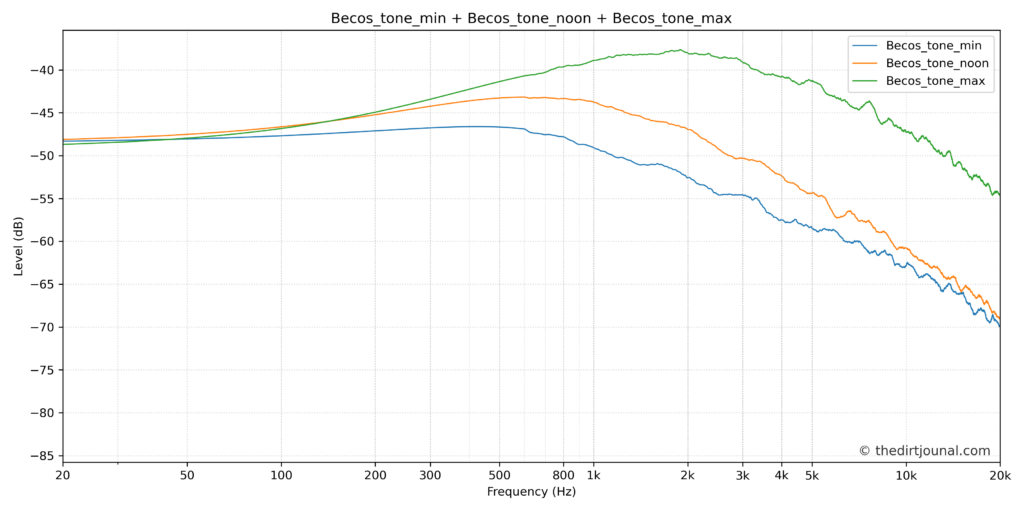
I do think the Becos FX description of a Tube Screamer circuit with enhanced low end fits. The tone knob gets a muffled response at minimum and is not overly bright at max.
Just to illustrate that the pedal is absolutely capable of solid bass, I did use the clean blend, with the Dry EQ knob around 10 o’clock and the blend knob between 1 and 2 o’clock:
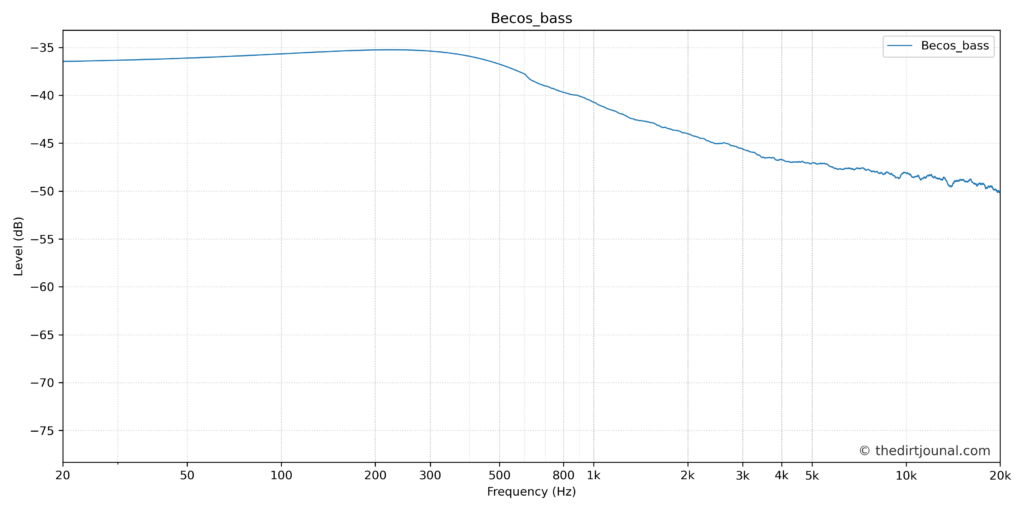
This yields massive low end, and there’s more on tap, if needed.
I already “complained” about the pedal having too many good options. That problem continues when setting it up for playing. I am incapable of settling down on the one sweet spot that works best in my signal chain and to my taste. I find the Becos is capable of a great always-on tone where it adds just a little bit of grit on top while it leaves the low end intact, a sound that feels more like a more sophisticated grown up version of a low gain drive pedal. The asymmetric silicon clipping works great for that with the Deep switch off.
It also feels great when adding a little more gain and flipping the diode switch to LED and the Deep switch to on, this places a bit of audible dirt right at my fingertips and I can make the bass growl by hitting a note a little harder.
With my dark clean sound, it’s not easy to get higher gain sounds that still feel coherent, but the standard clipping option is the best bet here. Flats and higher gain are always difficult because when the pedal produces a lot of harmonic content where the bass does very little in that regard, I quickly get the feeling of the harmonics from the pedal and the actual bass note are somewhat separated. On the Becos, I found that raising the gain, which yields even more harmonics, and then countering that with reducing treble via the tone knob works very well. Playing with a pick also helps with that, on my Rickenbacker copy with the treble pickup solo I can easily max out the tone and gain without too much separation (see last audio clip).
The Pedal runs safely at 9-18V, so I tried upping the voltage and was surprised that I could still be surprised when this pedal adds yet another layer of tonal options that have me choose between “good” and “equally good, but slightly different”. Running at 18V adds a bit of clarity into the notes. Running super low gain sounds you need a keen ear and good headphones to make out the difference, but running higher gain sounds, the clean blend feels cleaner and crisper and I imagine there’s more dynamics in the way the pedal responds to note attack.
While feeling a bit like Buridan’s donkey when using the Becos Ziffer Overdrive, confronted with a multitude of equally good choices, I also think of the pedal as something of a Swiss Army Knife. Slapping it on my board means I can have multiple options covered with a single, tiny pedal. Just bring it to the jam and see what the context calls for. Subtle tone enhancement, low gain drive or solid growl with a great dynamic reaction to pick attack, it’s all there.
The current MSRP for the Becos is €179. MSRP for the Ibanez TS-9 is €159. As a bassist, this is a no brainer. €20 extra get you a handmade boutique pedal with a host of additional features, some of which are necessary to make the TS circuit work on bass. Looking at other pedals of the same caliber, I want to call the Becos Ziffer Overdrive cheap for what it is. My gut feeling about the price would say it’s a €239 pedal, if not more expensive.
Verdict:

The Becos FX TS8-JZ Ziffer Overdrive is among the best Tube Screamer variants out there, at least from the viewpoint of a bassist. It has a bunch of interesting features, housed in a tiny enclosure. The EQ on the dry signal and the great choice of clipping options set it above the rest, but the extraordinary feeling, the haptic feedback when playing it is what’s making it really special.
The Becos FX TS8-JZ Ziffer Overdrive with a drum track:
And solo, LED clipping:
Silicon clipping:
Asymmetrical Silicon, very subtle:
Here’s the Pedal with Drive and Tone maxed out, Deep off, standard clipping. First clean, then the pedal at 9V and the last pass is with everything the same, but at 18V.