Origin Effects Cali76 Compact Bass
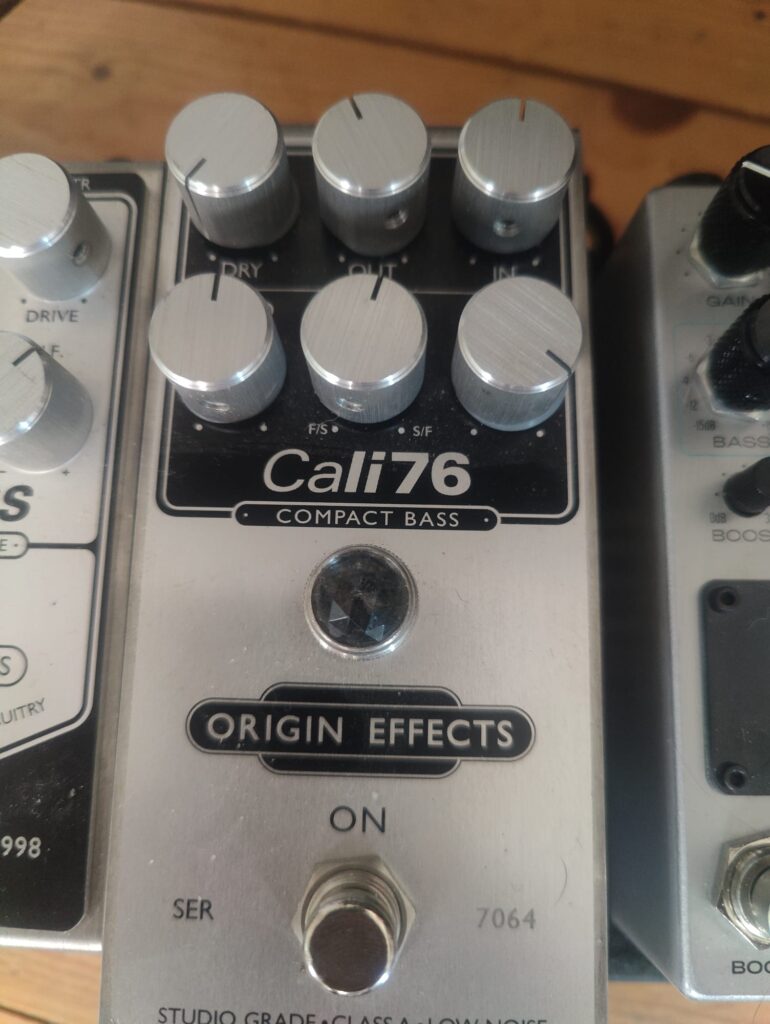
Origin Effects Cali76 Compact Bass.
Wait, that’s a compressor pedal. Is this a troll post? Maybe a bit. Or is it?
Backstory: I am not only an Origin Effects Fanboy, I’m also a huge fan of the Cali76 Compact Bass in particular. So much that I have two of them, and only size restrictions make me use something else (The Becos CompIQ Pro mini). The Cali takes 9-18V, and higher voltage operation increases the clean headroom, I usually run it at 18V whenever possible. When I migrated one of my Calis to my small pedalboard, I did not keep that fact in mind. The small board is a Pedaltrain Nano and it has a Cioks Adam mounted underneath, that is 9V only. The Nano is populated with the Empress Drive, the Origin DCX Bass, the Disssa Toolbox and the Cali.
When I took that setup to band practice, I did notice that when I switched on the Empress Drive, which was set to be used as a preamp/EQ that day, with the drive very low and the treble turned all the way off and the bass boosted a little, imitating an old school tube amp that is set dark and just on the brink of breakup, I got some pronounced distortion when playing notes on the B string. My initial thought was that the bass in use was in dire need of a setup and that the pickup was probably too high on the bass side, and I naturally suspected the Empress was the culprit. Later inspection revealed it was actually the Cali that added the drive. I ran the Empress Drive and Origin DCX in front of the Cali and had a bit of a bass boost set on both units – that strong fundamental from the B string overwhelmed the compressor because it ran at 9V instead of 18V.
I did solve that particular issue by swapping positions with the DCX. With the bass boost from the DCX being added after the compressor, it runs clean again, even at 9V.
Having experienced that issue, I got curious, though.
I do have the Empress Drive up front and that pedal has a boost function – so I turned up the boost knob, turned down the drive knob and sent a bit of a bass boost and a lot of +dB into my trusty compressor, and sure enough, I triggered a dirty response.
What makes it especially interesting is that I get a bit of a pumping compressor feeling, and the dirt clears up incredibly quick.
You know, there are pedals that push back when you push them – and then there are pedals that push back strongly when you push them. The push back of the Cali feels more like stepping into oncoming traffic and trying to push an 18 wheeler that’s doing 50mph. There is the briefest of moments where you’re actually pushing, and then there’s the push back. (Do not try, you’ll not only traumatize the truck driver, whoever has to clean up the mess afterwards will also curse you).
I’ve not found a suitable application for that effect yet, but the dirt sound is not half bad – it’s a lot more musical than you’d expect from a unit that was probably never meant to be overdriven, and it’s just a bit of sizzle on the very attack of the note and then immediately clears up.
That is, when you’re playing around on the threshold of the drive.
By setting the boost and bass EQ going into the Cali just a bit higher, the drive it yields becomes more pronounced and more persistent.
Needless to say there is a lot of compression going on, since what I’m doing here is pushing a compressor pedal past its intended use, but there is a certain aggression coming with that heavy squishing of the signal. It feels a bit weird setting up a signal chain with the Empress Drive, Origin DCX Bass and Origin Cali76 and then run one of the two dedicated drive pedals as a clean EQ and use the other also in a clean setting – to push the only non-drive pedal into saturation, but the sound this yields is not possible with either drive pedal.
Here’s a small example. I had to fiddle some knobs to get the clean and drive sound to at least roughly even levels.
First pass is with the Cali off and the Drive on, but the boost off, second pass is with Cali and boost activated