JHS Pedals Morning Glory Clean
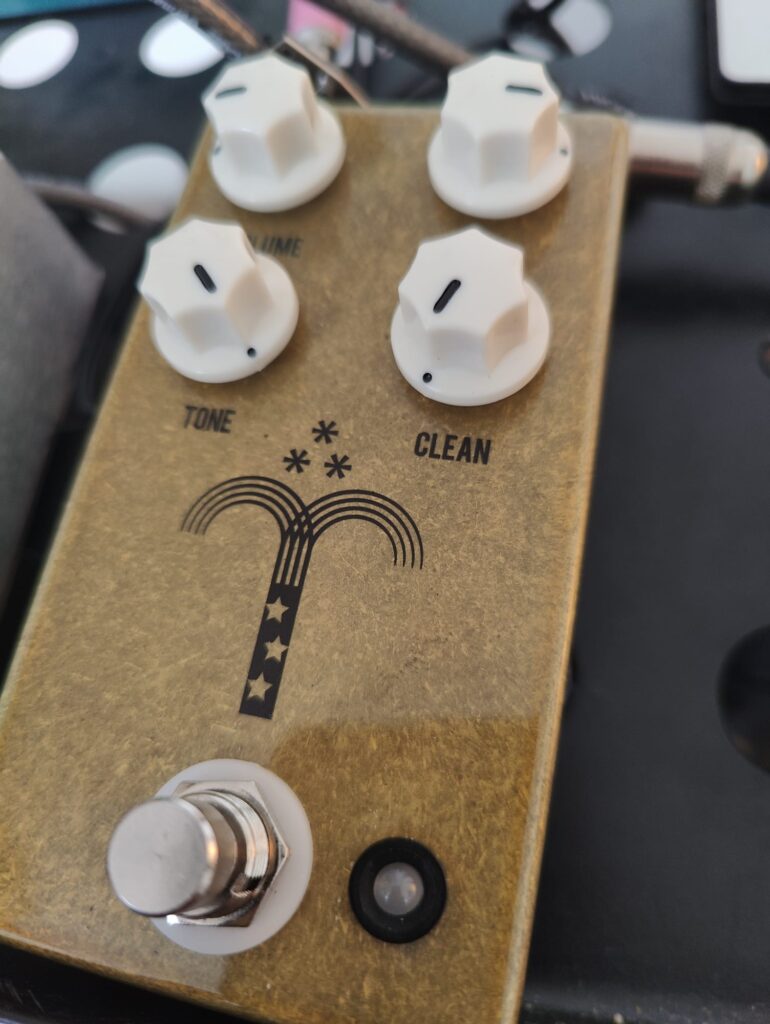
This is the newest version of the JHS Morning Glory, or much rather, this is the other Morning Glory, the Morning Glory Clean.
The current JHS Morning Glory has been unchanged for 10 years now, and it is called V4. It’s the golden pedal, with the roman candle graphic, three knobs and one switch, side jacks and the possibility to run the JHS Red Remote with it.
This here is the Morning Glory Clean, which did not supersede the MG V4, but runs parallel. It has the same golden hue, the same roman candle printed on, but it has four knobs instead of three. Ah, and top jacks (which is great).
The Morning Glory is the first pedal JHS ever made, and it is based on a Bluesbreaker circuit. It still has the rough topology of a BB, but I’ve seen Morning Glorys on bass pedal boards before the Clean version came out, so I guess that the massive low end loss of the original BB circuit was addressed in earlier versions – there is a cut of low frequencies, but apparently it’s not so dramatic that it scares off bassists even without the clean blend. If you want the full history, hop on to the JHS website or visit the JHS Youtube channel – Josh is doing a great job at becoming the world’s leading effect pedal historian and there’s lots to read and/or watch.
What’s in the box? This is the Morning Glory Clean, and it has four knobs. One does volume, one does gain, one does tone, and the fourth is the clean blend.
The website and manual are a bit too excited to explain this in a sober, scientific tone, but here’s what I gather:
The Clean knob does not merely control the volume of an added dry signal, it sets the blend between dry and wet.
The Drive knob is pulling double duty, it sets the amount of gain on the wet signal and the volume of the dry signal at the same time. So when you set the Clean knob all the way to wet, you get the full sound of the Morning Glory and your pedal behaves just like the normal one. When you set the Clean knob all the way to dry, you get no Morning Glory at all, you get a clean boost. The volume of the boost is set by the Gain knob (and, of course, the Volume knob).
There is not too much info on the Tone knob, this might either be a tone stack with a tilt or it might be a passive treble cut – I’ll have to plot that out to be sure.
The idea behind this is that at higher settings (which is not that high, because the Morning Glory is not a high gain drive), the compression sounds a bit sweeter and the added harmonics are great, but you will lose that “hovering on the brink” vibe. By adding back some of the clean signal, you get another way of balancing the whole thing out. It’s a bit like the Horrothia Teeth in that regard – offering you more than one way to add or reduce gain to the signal, focusing on the low gain edge of breakup thing.
When you’ve set a sound and you feel like it’s a bit too much, you can either decrease gain or tilt the dry/wet blend a touch more towards the dry side.
But I’m getting ahead of myself! How about playing that thing first and writing about it afterwards?
Construction and finish are typical JHS. These are hand made, but given that they are available through major retailers worldwide, they have a bit of a factory-vibe to them. The housing feels like the gold paint job has gotten a massive layer of clear coat, so much that the haptic sensation upon touching it resembles that of plastic instead of metal. The knobs and jacks feel solid and work well.
Plugged in, my fist impressions are that the fine tuning of the pedal for the lightest of drives work as suspected above, plus the pedal feels best in that range, too. I can squeeze a solid amount of drive from it when I dime everything, but that sounds a bit harsh, the breakup does not feel perfectly right under the fingertips and it’s a little detached from the playing.
The frequency response feels solid, though.
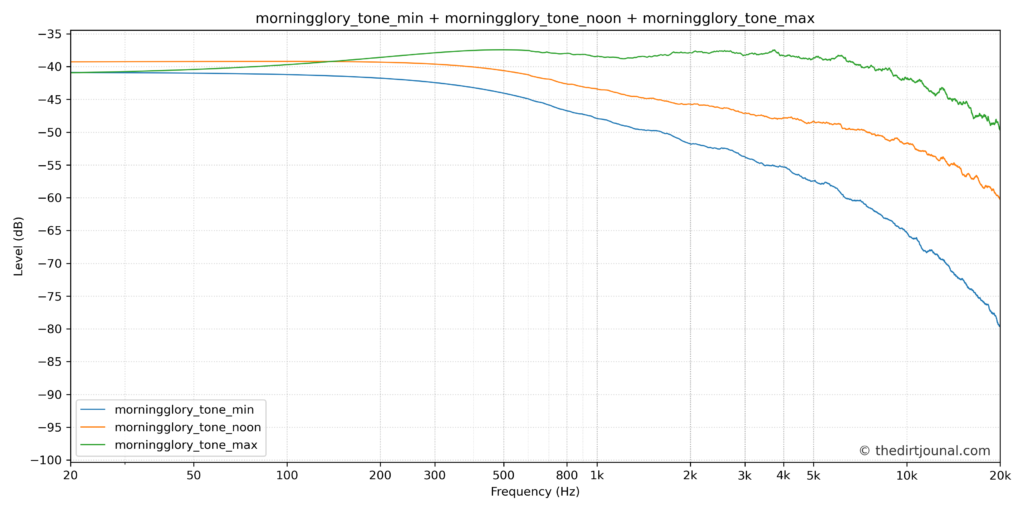
This graph was taken with the clean knob set all the way to the wet side and the gain at noon, showing the workings of the tone knob.
Out of curiosity, I also checked the pedal with the clean knob all the way to the dry side, but the response of that was a flat line, so there is no coloring from the clean preamp JHS put into the pedal.
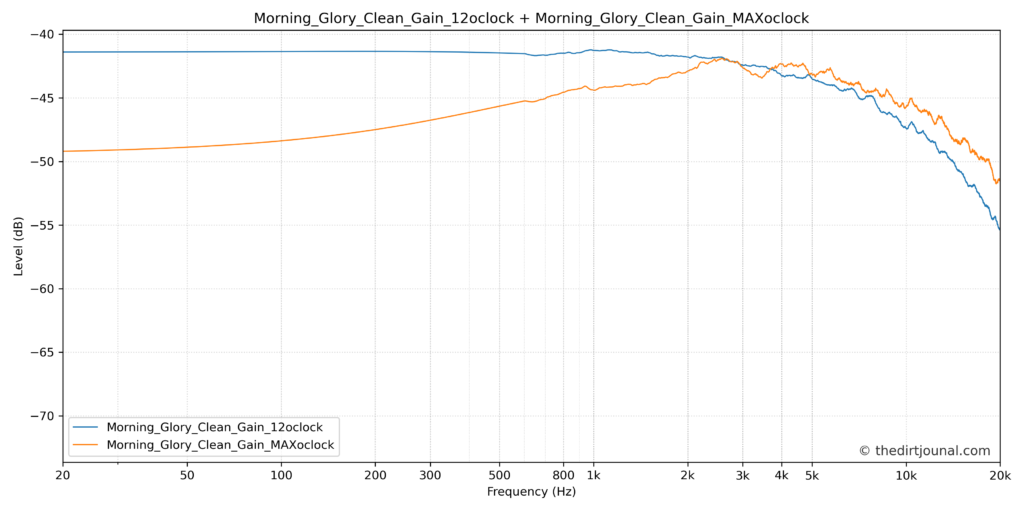
When playing around with the Clean knob set to completely wet, it feels a bit like the low end is dropping out with increased gain.
As stated, the above measurements have been taken with the Drive knob at noon, where the low end was untouched – but increasing drive from there will decrease the low end. This graph was taken with the tone knob at 3 o’clock, with the Drive at noon and maxed out and the Clean knob set to fully wet.
With all that out of the way, how does it sound and how does it feel?
It’s a bit weird. When I sit down and compare notes, the Morning Glory Clean seems pretty bad. It’s not the most dynamic pedal. It has a limited drive range because too much will sound and feel wrong – and it’s not a high gain pedal to start with. The haptic feedback when playing it is merely good, not excellent. So a pedal with limited dynamics, not the greatest feeling and a limited drive range should go directly to the pedal snob’s waste bin, right?
Not so fast! One man’s “limited dynamics” is another man’s “even response”. A complaint about a limited drive range is quickly countered by “Why should I care how much unused extra room there is left and right of the sweet spot?”. The feeling of the pedal is obviously tied to the dynamic response, so one could argue that it does not matter how well you feel it, because you do know what you’re getting here.
It is, for me and my purposes, far from a versatile pedal – much rather a one trick pony. That trick is to add a little bit of grit and a certain sharpness to the tone, which works best with the tone knob above 3 o’clock and both drive and clean between 11 and 1 o’clock. Heavier settings feel a bit disconnected and subtler settings are too subtle to warrant having the Morning Glory in the signal chain. I begin to understand why the Morning Glory has been popular with bassists before the Clean came out. It’s stealing lows when you run the gain very high, but running high is not what it’s supposed to do. When you use it to add a little edge to your sound, you probably run the gain in the noon region, and the low cut is negligible.
As I said before (did I say before?), the clipping on the MG, or much rather the texture of the clipping on the MG, is quite harsh. In that it kind of reminds me of the Klon – a soft spoken hard clipper. It feels a bit like a distortion was robbed off it’s massive compression and most of the gain was taken away.
In Germany, we make a difference between “Bitumen” and “Asphalt”, even though both words exist in the same way in the English language.
German Bitumen is a bit softer and stickier than asphalt, and it’s often used as a band-aid on a damaged road. Or it used to. I know that back in the day, when a road was fixed using the stuff in a curve, they would put up warning signs. I wondered why that was, but asked someone who knows these things, who told me that it’s not of any importance for cars, but quite spicy for motorcycles – that stuff has nasty habits. It’s more even than asphalt, and it’s softer. As soon as the road gets warm, the stuff gets even softer. As soon as the road gets wet, that stuff gets slippery – and when it gets cold …. does not really matter. When you’re riding your motorbike in the cold, you’re a real biker and know how to handle yourself.
Let’s say you’re in Florida, you’re over the age of 21 and carry the necessary medical insurance to ride a motorbike without a helmet (alternatively, you can also paint yourself as an outlaw that does not meet the criteria for legally driving without helmet, but does so nonetheless).
The important bit is that it’s warm, you’re going through the curve and the clean and tidy asphalt quickly becomes a patch of the bitumen stuff. Your bike jumps off the projected track and throws you off in the process, the applied momentum spins you such that you land face first at, let’s say, a horizontal momentum of 28 miles per hour – a low speed for a motor vehicle, but just a bit too fast to run – even for prime-time Usain Bolt.
The skin on your cheeks is incredibly sensitive. When performing CPR in a closed room, it’s often used to detect whether or not the patient is breathing.
So it is ideal to make out subtle differences in texture, too. Landing face first on well used asphalt feels different to landing face first on warm bitumen.
The asphalt in this picture is how a drive pedal with the clipping characteristics of the Morning Glory should feel, the bitumen is how it actually feels, if that makes any sense.
The Clean option is a great feature for that entire thing, because you can balance the dirt and clean sides nicely while fine tuning the grit, so you get a signal that’s not only a bit sharper and has a gravelly growl to it, you also can sorta mix that more towards the background to preserve much of your original tone. There is a difference between running the gain very high with the clean blend strongly favoring the dry side and running the gain lower, and the blend favoring the wet side. I can’t say if it is a universal thing, but in my case, it was rather easy to find the sweet spot for the desired amount of drive in the signal, and I personally preferred less gain and more wet signal in almost every case.
This is a sweep through the clean blend of the pedal, starting at three quarters dry and moving towards full wet in small increments. The Drive knob is three quarters up, so you notice the bass dropping out from pass to pass.
This is the maximum Gain I could milk from the pedal, Drive at max, and just enough Clean to keep the lows. Heavy handed playing on my Aria Pro II Ric copy.
The opposite here: Very low gain sound that blends in well.
And another lick with more gain: