Origin Effects Bassrig Fifteen
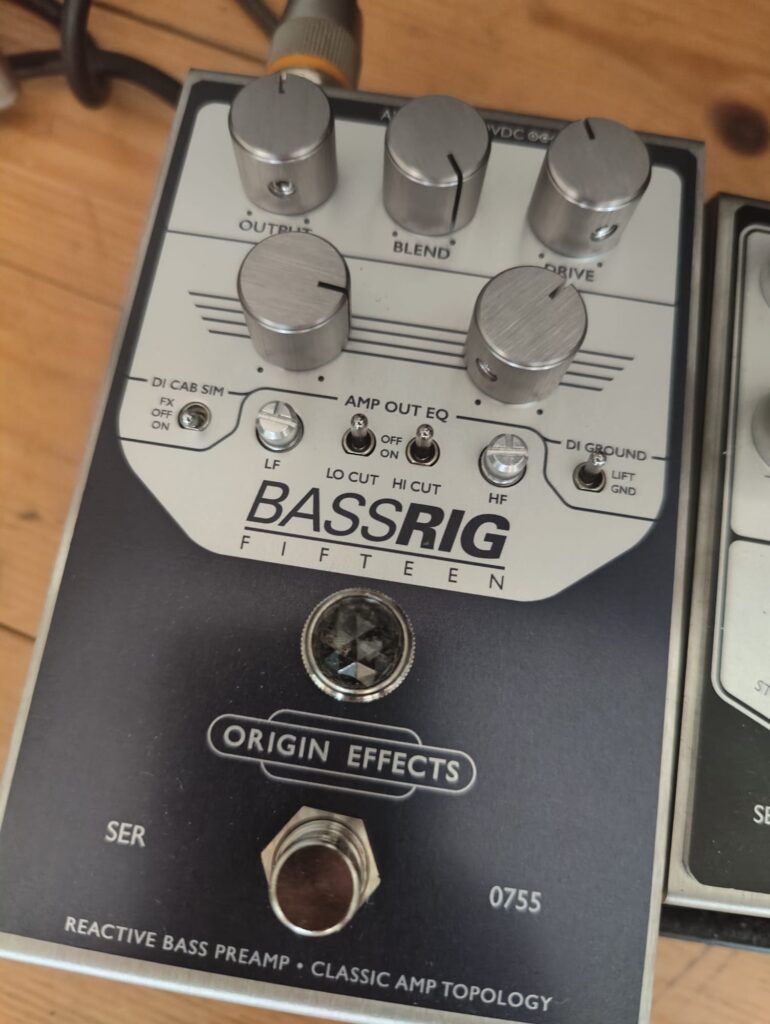
This is the Origin Effects Bassrig Fifteen. It is the third pedal in the Bassrig series. Let me give you a very short summary of the first two: The Bassrig ’64 is a well made Fender Blackface in a box. The dirt sounds it is capable of what I call white collar dirt. Very civilized. The cab sim, which cannot be defeated on the XLR out, emulates a 2×15″ cabinet and sounds like someone threw a wet blanket over the cabinet before recording it. I liked the pedal, hated the cab sim and sold it rather quickly. The Bassrig Super Vintage is a faithful reproduction of the Ampeg SVT, the cab sim is the matching 8×10 Fridge. I’m not the biggest fan of SVT pedals, but on this one, Origin knocked it out of the park. At the time of writing this, the Bassrig SV is in my “Personal Picks” list and on my pedal board. In my humble opinion, this pedal tries to capture the amp and cab in their entirety, instead of focusing on one single sound (usually the beefy rock grind it’s capable of). It’s a versatile pedal that works both as a luxurious drive pedal or as your amp-in-a-box pedal at the end of the chain.
Now there is a third pedal in the lineup, and as you might have guessed already, it’s a copy of the Ampeg B15 and matching fliptop 1×15″ cab – the legendary studio amp, if there ever was one – widely accepted as the most recorded bass amp in music history.
Looking at the controls, you get the three knobs that the B-15 comes with, Volume/Bass/Treble, but also a master volume and a clean blend. Furthermore, there is another two band EQ that lives post drive an only affects the 1/4″ output, same as the lo-cut and hi-cut switches. The intended use for those is to match a backline amp to the sound you get from FOH.
A new feature for the Fifteen is that the cabinet simulation on the DI out can be switched off.
In size, weight and haptic experience, the Fifteen is identical to the other Bassrigs. The build quality is top shelf, the pedal is oozing quality from every orifice. When you hold it in your hand, you think “this feels expensive”.
I hooked it up in my test setup, and for first contact, I did not put it into the dirt pedal position on the test bench, but into the preamp position, using the XLR out and feeding my other pedals into it. Two things became abundantly clear within the first few notes. Firstly, I can’t just plop it in, replacing another pedal and expect it to work, especially when the compression, EQ and gain staging of the rest of my pedals all were carefully balanced to cater for the other pedal. The Fifteen has the size, the quality, the reputation and the price tag to demand you create an environment around it, using it as the cornerstone.
Secondly, and this is much harder to put in words, the depth of the thing. I’ve played a few pedals that hinted towards being B-15 inspired, or B-15 recreations. However, there’s a bit more to the iconic little fliptop amp than a tube stage in the preamp and a James (passive Baxandall) EQ. I instantly get the feeling that there are multiple stages my signal passes, and each of them does a little something. This might be true, or it might be clever deception – either by Origin consistently pumping out great pedals for so long that my ear involuntarily finds greatness where there is none, or by tinkering around enough to give the impression of a complex system, albeit just using a simple schematic. I want to go with the true multiple complex stages theory, though.
It feels like your average “Fliptop” inspired pedal is a two dimensional drawing of the real thing, while the Fifteen is a three dimensional object that your ears could actually touch, had they hands.
There are more than a few options to hook it up and therefore, more than a few options to tweak tones, so prepare for a bucket full of frequency plots .
Let’s start with the pedal switched off. Yes, off.
The DI out still can impart the cabinet simulation on the signal, even with the foot switch set to bypass.
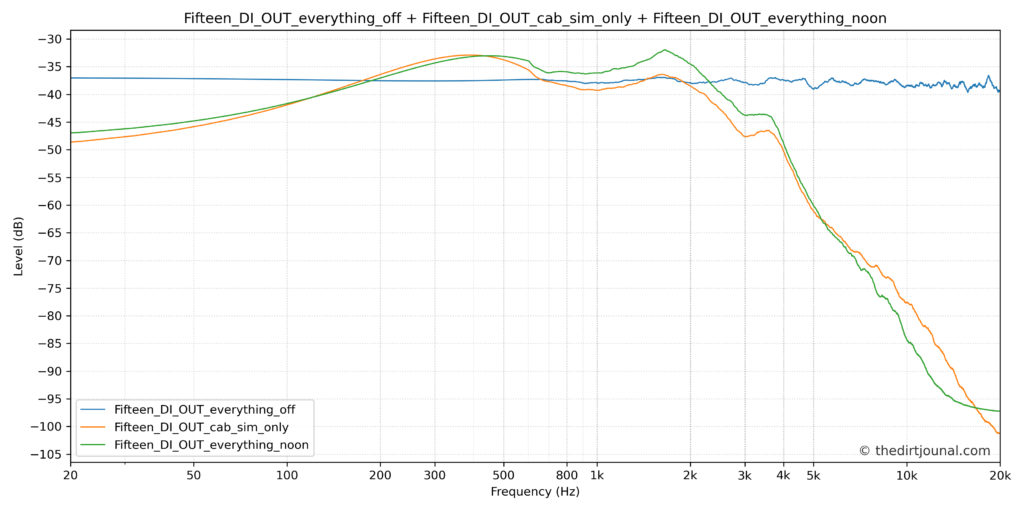
The blue line shows the DI out with everything off. The yellow line is everything off, but the cab sim active and the green line shows the pedal on, but everything set to noon – except for the blend, which is set all the way to wet and the output, which is lowered to roughly match the output levels with the pedal off. It looks like with everything at noon, the Fifteen imparts little baked in colour.
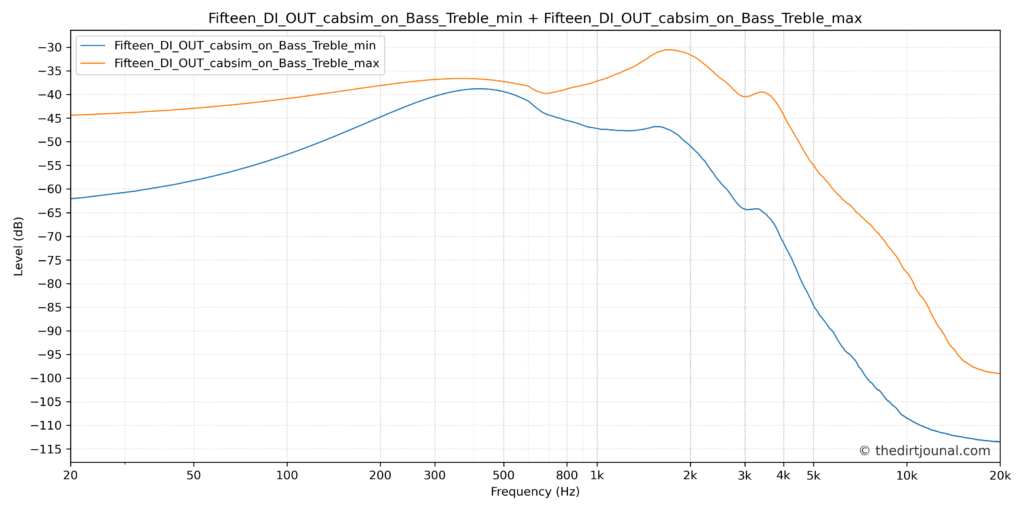
This graph shows the Bass and Treble knobs at their minimum and maximum postitions. Obviously, the cabinet simulation does interfere with the EQ on both ends, cutting both the lowest and the higher frequencies – the Fliptop cab is a tweeterless vintage 15″, after all.
Here’s the same thing, but with the cab sim off:
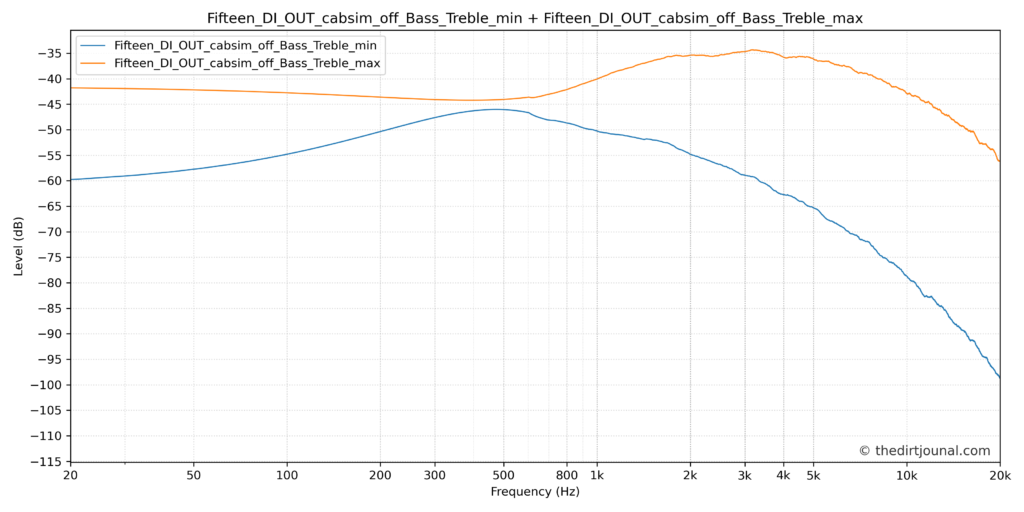
The output of the AMP OUT and DI OUT are identical, as long as the cabinet simulation is off on the DI side, and the LF and HF knobs are at noon and the filters are off on the AMP side.
The Filters on the AMP side do as follows:
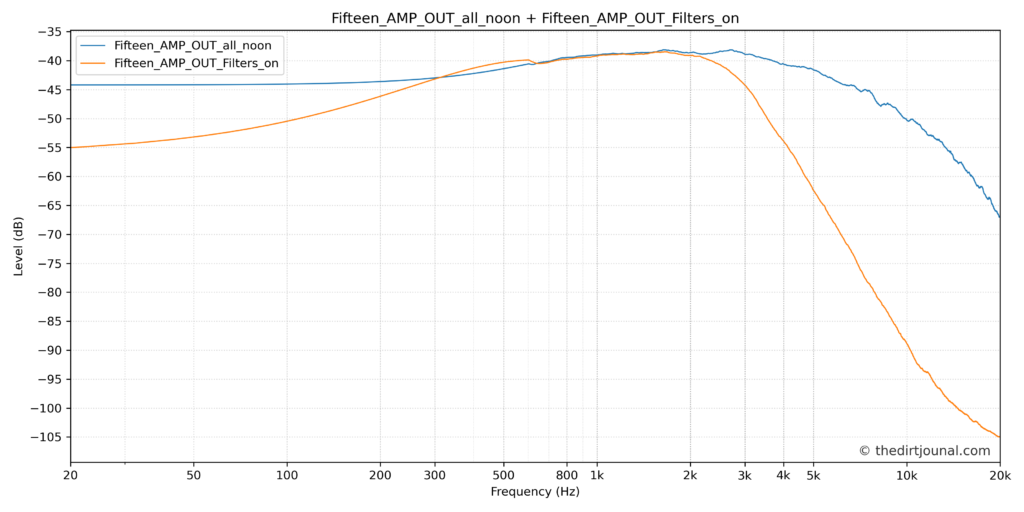
…The LF and HF knobs:
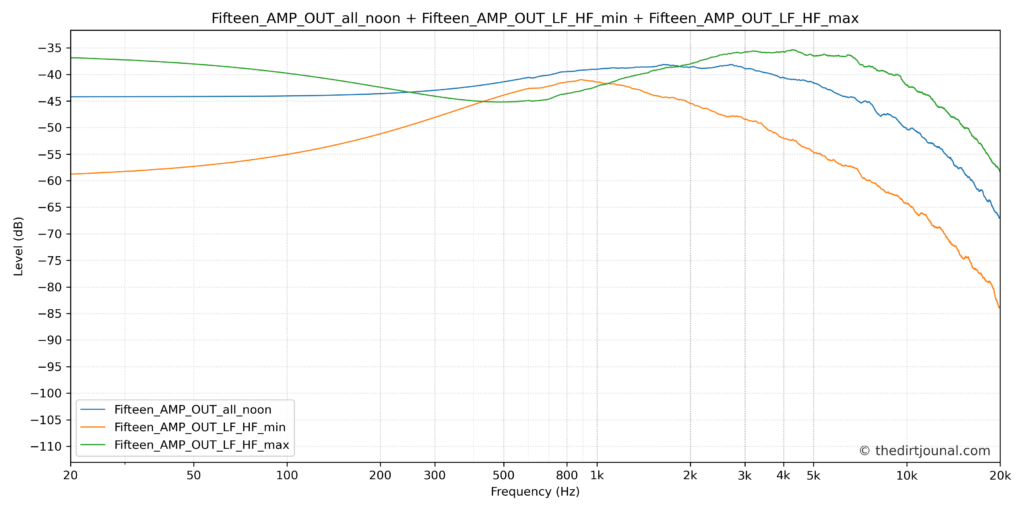
I did check whether the Drive knob has any impact on the EQ, but the results showed nothing worth reporting.
Since this is the Dirt Jounal and not the Preamp Jounal, let’s focus on the dirt for a second.
Diming the Drive on the pedal instantly yields a sound that is not unlike diming the gain on a mixing desk. You need special ears and a very special taste to like that. In conjunction with the cab sim (or filters, should you go the 1/4″ way out), you can tame a lot of the nasty sizzle, but it still feels like poking a badger in the one sore spot on its belly. There’s squirming, and sharp artifacts flying around and you want to evacuate yourself from the situation as fast as possible. If you go down on the Drive knob into more credible settings, you get into the regions that are packed with fun stuff. If you set it to be on the edge of breakup, there is considerable push back from the Fifteen, and it feels great under the fingertips. You can make the attack of a note growl just a little, clearing up quickly into a clean, luxurious decay. It’s often said that you can’t make a James tone stack sound bad. As you can see, the center frequency for the tone stack is sitting around 400Hz, and the bass knob’s range is less than 20dB from fully CCW to fully CW. The EQ is located pre-drive, so when you’re going for edge of breakup or a mild drive sound, the EQ shapes the nature of the drive, which works very well.
Yet again, there are quite a few options to approach your desired tonal goals. You can, for example, crank the Bass knob and flip on the cabinet simulation (or filters) to counteract the low end rumble, then set the Drive knob to the desired level of subtle grit, and you’re getting a nice growly sound which you can fine tune with the Treble knob.
The first ‘favorite’ sound I arrived at was with the cab sim off, the treble cranked, and a little bass boost. There’s limited space for dialing in grit, because without cab sim and with the treble boost, it’s a thin line between a bit of dirt that adds to the flavor and too much sizzle. The boosted treble translates to more accentuation of the little plop when the plucking finger releases the string and playing through the pedal feels more lively.
Next up, I hooked the Fifteen into the middle of the signal chain, the place that is currently occupied by its little cousin, the Origin DCX Bass. This brings the AMP OUT control section into play, which means I can go back on the Bass knob, set the Drive a little higher and compensate with the post drive LF knob. I also can use the low cut filter, and then play into a variable low pass filter to set the limit myself instead of using the built in filter that is a bit too muffled for my ear. This yields a finer grit and I can push the gain a bit harder because the bass frequencies don’t drive the clipping stage so much.
In my humble opinion, the Fifteen is not a drive, though. The Super Vintage can easily double as a drive pedal, because the SVT-like grit and girth shout with such authority, it’s a great means to bring the bass into the right position in a mix, using elbows and shoulders and body weight. The Fifteen is all about nestling in. It’s cozy, warm and can get fat if you want it to. The added harmonics and the saturation feel, in my hands and ears, like something to be wielded carefully. No sharp or pointy ends, please. Enjoy the wide range where it already started breaking up gently, but is not fizzing out yet. With more drive added, the cabinet simulation or the high cut filter do help in reigning in the top end sizzle, but for my taste, both filters start too early for comfort.
The great difference between the ’64 and the Fifteen is that both filters and cabinet simulation are optional. My main beef with the ’64 was that the DI out was unusable for me because of the harsh treble cut. On the Fifteen, I can simply switch it off and it works beautifully for clean’ish sounds. It’s a great addition to the Bassrig lineup and fits right in. I really hope Origin is already looking for other iconic bass amps to recreate in that format. Every single Bassrig they made so far did capture the respective amp on a scale that was unheard of.
I am really glad that a reader of the Jounal was kind enough to send his Fifteen to me so I could check it out. Why?
The Origin Effects Fifteen is hands down the best analog pedal recreation of the legendary B-15, including the cabinet. It’s more complex, has the best haptic feedback and sounds better than anything claiming to have nailed the B-15 sound I ever played.
If it was a square peg, it would not only be perfectly made and aesthetically pleasing, it’d be the nicest square peg you’ve ever seen. The craftsmanship, the dimensions, the surfaces and the material would be the best in class to make a square peg. The perfect square peg. The thing is, in my current situation, all the holes I have are round. I don’t see any immediate use for the pedal, nor do I see myself needing it in the future. Had I bought the pedal, I would have kept it nonetheless. It’s too much fun to play to sell on. I will have to return this one, though – and I think I can muster the discipline not to jump on the next Fifteen offer I run across. It is a great pedal, because it’s simple, yet complex. It feels great to play and is easy to set, yet capable of a few different sounds that all are great. Should I join a band or project that calls for these tones, I’m sure I will get one immediately.
I feel that I need to mention one more time, right at the end, that it’s not only the sound that comes out of the pedal that is great, it’s also how it feels playing into it. It is an amp in a box, and it feels like playing an amp. It is somewhat rare that a pedal sticks out in that regard, so it’s worth mentioning multiple times!
This is the Fifteen in the preamp-position, using the XLR out with the cab sim switched off. Treble fairly high, bass a bit past noon, gain at noon.
This is the Fifteen, using the AMP out, with a bit of LF boost, the low cut filter engaged and running into an external low pass filter, set around 6kHz.
On both sound samples, I raised the gain a hair over what I would have personally gone with, to showcase the capabilities of the drive.