Weehbo Guitar Products Tackleberry
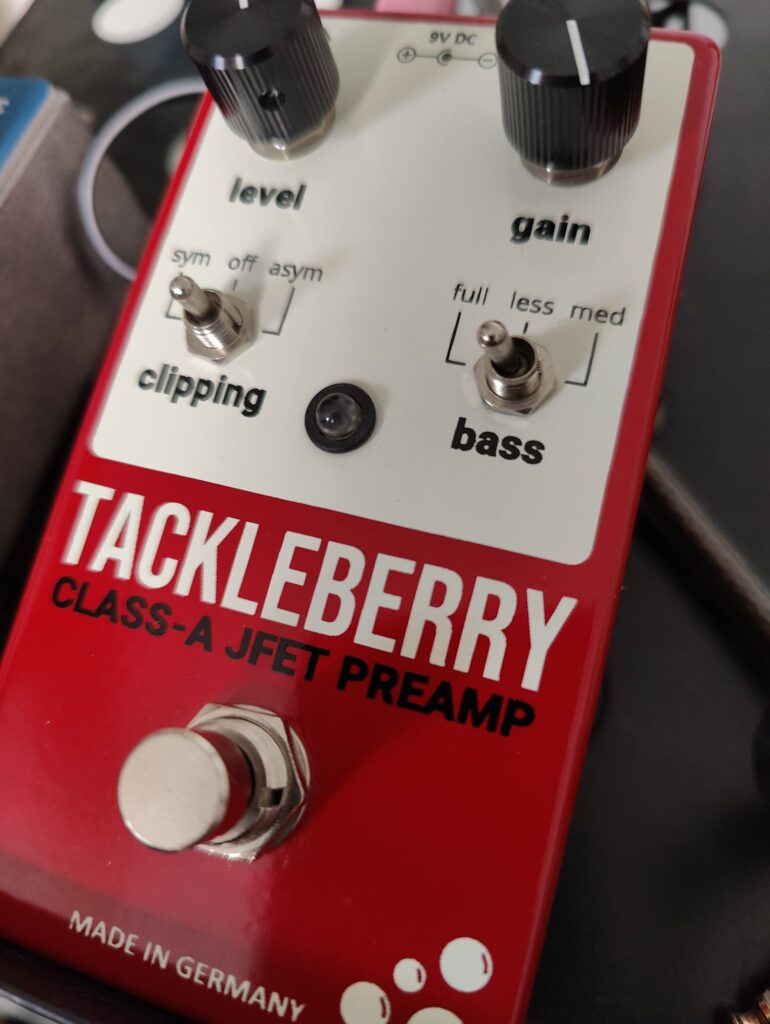
The Tackleberry is a weird little pedal that I have seen floating around local used markets several times, yet somehow never pulled the trigger to check it out. In fact, a reader of the Jounal pulled the trigger on this one and let the seller send it to my address, so I could give it a run for its money and then send it on. Thanks, mate!
As you might have deduced from the picture, it’s a mostly red pedal that is named Tackleberry. The only reference to that name in recent history is that guy from Police Academy who uses that absurdly huge revolver instead of the standard issue .38.
It’s also further classified as a Class-A Jfet Preamp. And it’s made in Germany.
The control layout is simple. Gain and volume come as knobs, and then there’s one switch that handles the bass cut and another that handles the clipping options. That’s it for the uninitiated. The curious tinkerers will eventually unscrew the back and find two dip switches. Those control the clipping options. The outward switch offers three options, symmetrical clipping, asymmetrical clipping and no diodes at all. The asymmetrical clipping is handled by a team of silicon diodes and mosfets. The symmetrical clipping is set by the internal dip switches, which offer the option of silicon clipping, LED clipping or both.
But first, let’s address the thick skinned pachyderm in the room.
The bass cut switch. If you are like me, you wonder. This pedal is marketed as a bass pedal, yet even on the manufacturers website demo video, people play guitar through it first. The only EQ option this pedal gives us is the option to reduce low end. Quo Vadis, Weehebo Guitar Products?
Listening with a keen ear, I flip through the options, which are labeled full/less/med.
Compared to my clean sound, even the setting named full sounds like it bites away a solid chunk of my low lows.
Without further ado, I start measuring and looking up specs on the internet.
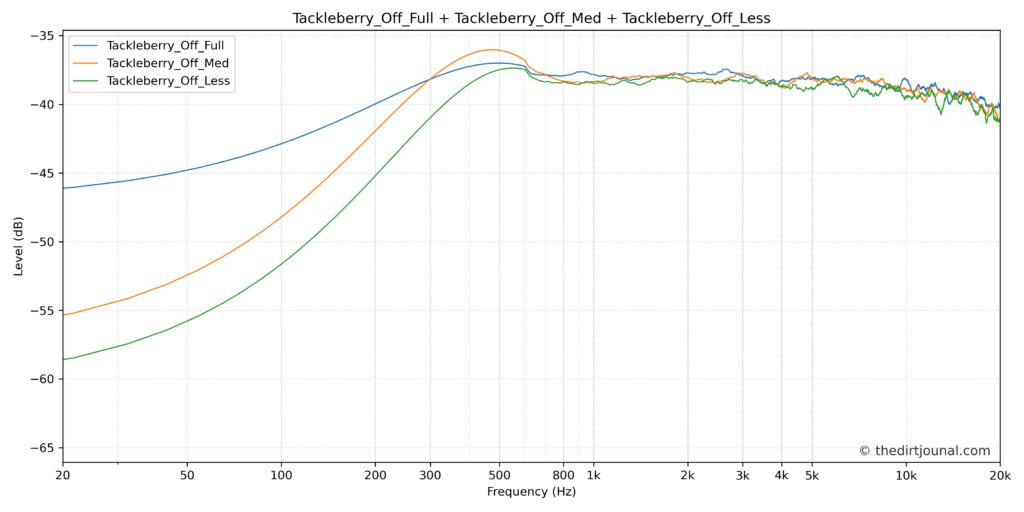
Here’s my measuring result. You get a low cut with a resonant peak that sits around 450 Hz. On the “full” setting, the bass audibly drops at around 200Hz, at the “less” setting, it starts around 300Hz. I am a bit stumped by this result, I would not have expected a pedal that is marketed towards bass players to drop off the lows by 6dB well before we cross the 100Hz mark.
Reading up on the internet, I learned that there has been a revision of the pedal, which altered the frequencies of the bass cut.
The old version of the pedal seems to have the cut off frequencies set at 210 Hz for “less”, 150 Hz for “med”, and 75 Hz for “full”.
The newer version puts them at 180 / 100 / 30 Hz, which sounds much more reasonable. I am assuming I have the old version in my hands. Here’s a gut shot:
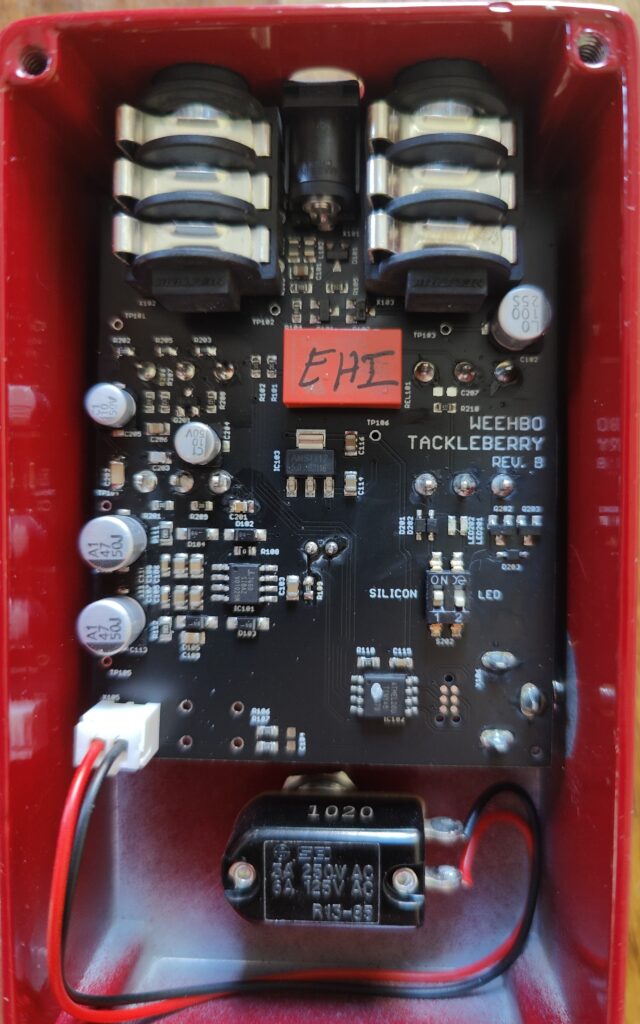
It says REV. B on the PCB, but I have no Idea what that refers to.
The Weehbo Guitar Products website states that the Tackleberry is modeled after a legendary 80’s amp head’s boost circuit, while remaining vague about the exact model. However, there are not that many legendary amp heads from the 80’s – and even less that feature a boost circuit. The most likely candidate would be the GK800RB. I found a thread on Talkbass, where a user claimed to have measured the GK800RB and the response from the power amp (signal in at the FX Return) showed a bass cut that is quite similar to the Tackleberry with the bass switch set to ‘Full’ – stating there was -2dB at 180Hz and -12dB at 40Hz.
While this bass cut is going on, it’s not as bad as I thought at first. It actually feels more like a mid-boost in some way – if that makes any sense to you.
Here’s what playing around with the Tackleberry yielded for me: I don’t like the asymmetrical clipping option. It just does neither sound nor feel right to my ear. LED clipping is hit or miss in my opinion, and it’s a very small target. For a long time, I thought I don’t like LED clipping at all because it’s too chaotic, but then Becos made the Ziffer Overdrive and on that pedal, the LED clipping is divine, so it can be done right. The Tackleberry’s LED option is of the standard variety which is too chaotic for my taste. The silicon is good, though. The three sweet spots I identified for my personal playing were
- No clipping diodes, gain at maximum.
- Silicon symmetrical clipping, gain before noon, at the edge of audible breakup
- Silicon symmetrical clipping, gain past noon, just past the edge of audible breakup.
With no clippers selected and the gain dimed, the pedal adds harmonics without audible grit, and that feels quite nice when playing. The bass sound feels a little bit snappier and crisp, it’s almost so good that the loss of the lows can be forgiven.
With the silicon clipping and the gain before noon, it’s a touch sensitive drive that favors the higher frequencies and does not fart out when you play low notes. It feels a bit like the amount of drive doubles when you move up an octave.
Raising the gain so that the drive is ever present, it’s still very touch sensitive and works well as a mild drive sound.
My guess is that those of you that single out the bridge pickup, play with a pick and use fresh roundwound strings won’t notice the bass cut of the Tackleberry as much as those of you that do the opposite. It’s not the best device for a massive low end, but the cut does not feel as drastic as it looks in the graph. The tonal options are a bit limited – you get the baked in tone and that’s it, unless you have a thing for extra anemic sounding basses, when you can engage the low cut switch – I would assume that this works much better on guitar, especially when you have something with dual humbuckers and want to get more of a single coil sound.
Apart from that, you get multiple options for the clipping diodes, three symmetrical ones and one asymmetrical one – and when you drive the front end of the Tackleberry with something stronger than your basses output, you can also push the no-clipping-diodes option over the edge. It’s an easy device to figure out, given the limited amount of controls and the resulting limited range, but I want to say that my personal tonal goals and what Weehbo Guitar Products envisioned for the Tackleberry don’t align well.
This is the Tackleberry with no diodes selected, maximum gain:
This is the symmetrical clipping option, silicon diodes, medium gain:
This is the maximum amount of dirt I could squeeze from the Tackleberry, using my Ric-copy, bridge pickup, played with pick.
…all the above audio files have been played with the bass cut switch set to ‘Full’.