Taurus Abigar Xtreme Mk2
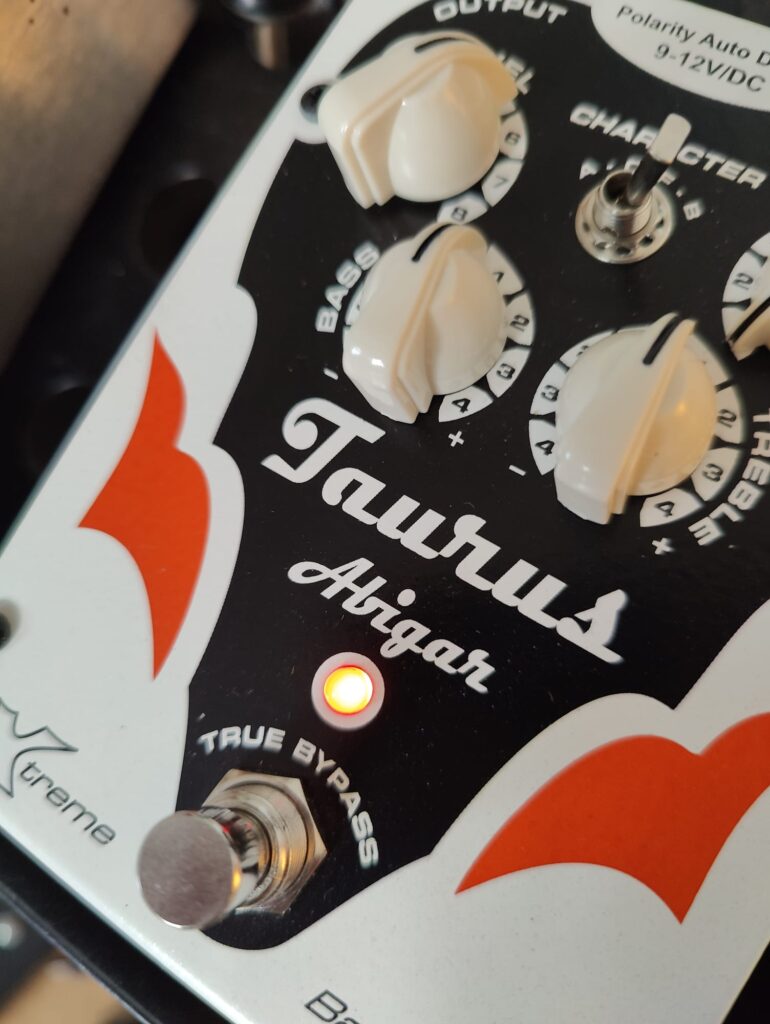
This is the high gain version of the second issue of the Taurus Abigar, if my research is correct.
Taurus is a Polish company and I’ve only known them for their pedalboard guitar amplifiers – not just pedal format power amps, but fully fledged guitar amps with everything on board.
However, they also do normal pedals, and they also do bass pedals.
A short model history reveals that they started with the Abigar, then brought a different color scheme of the same pedal, then did the Abigar Mk2, and parallel to that, the Abigar Xtreme Mk2, which has more gain – their website is not exactly up to date and research is somewhat tricky with such niche brands, so don’t quote me for your scientific dissertation.
This here is the last of the lot, the Mk2 version with more gain.
It comes in a non standard enclosure, has top jacks, and apparently, the pedal has an internal charge pump that sets it to a higher voltage – it does accept 9-12V DC and does not care about the polarity.
There are four knobs labeled Level, Gain, Bass and Treble, as well as a character switch with three options – A, B and off.
The build quality of the pedal is surprisingly good, given that these are quite cheap in the used market. They are hand made in Poland, though – so there should be some quality to be expected. The knobs are of the chicken head variety, so you can spot the exact pedal settings from across the stage, even in bad light.
Documentation and manuals are not exactly the strongest suit of the Polish makers. The box contains a simple manual that is somewhat helpful as long as you’re either fluent in Polish or able to wield modern technology with enough precision to make it translate a Polish text into a language you can understand – but even then, you get opaque descriptions of what the knobs and switches do, no specifics. Instead of diving even deeper into the internet to maybe find a proper description of the inner makings and going-ons, I opt to don my trusty ol’ headphones and give my best shot at figuring that out myself.
Other than that, the Box contains a pair of rubber feet to stick on, as well as velcro strips – both hook and loop, so you can mount it to a pedalboard. I like that.
Before we get into the sound, let’s take a look at how it measures.
The pedal not only passes signal with Gain at zero, it also already adds drive at this setting. Looking at the EQ section first:
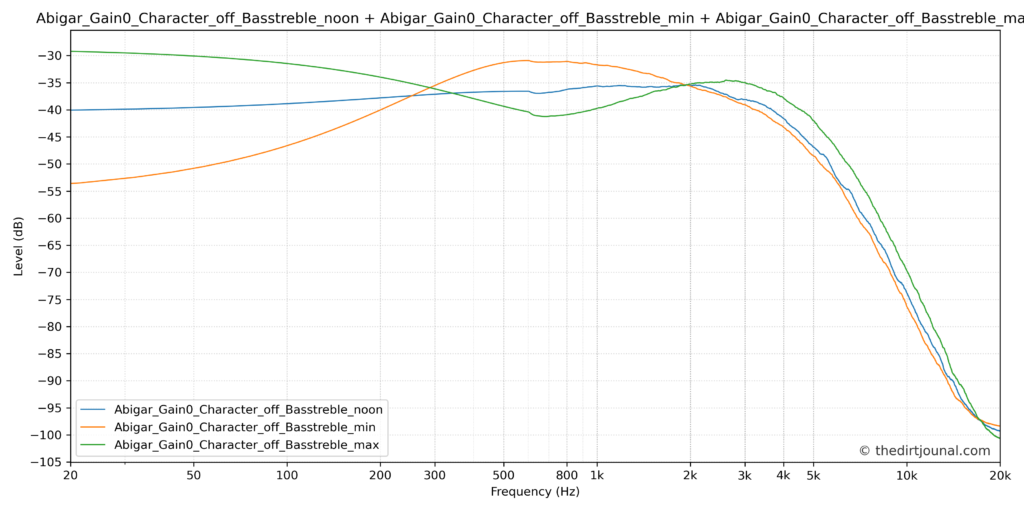
Interesting oddity: The two band EQ seems to somehow influence the mids – in the opposite direction. Boosting bass and treble leads to a mid scoop while cutting bass and treble leads to a mid hump.
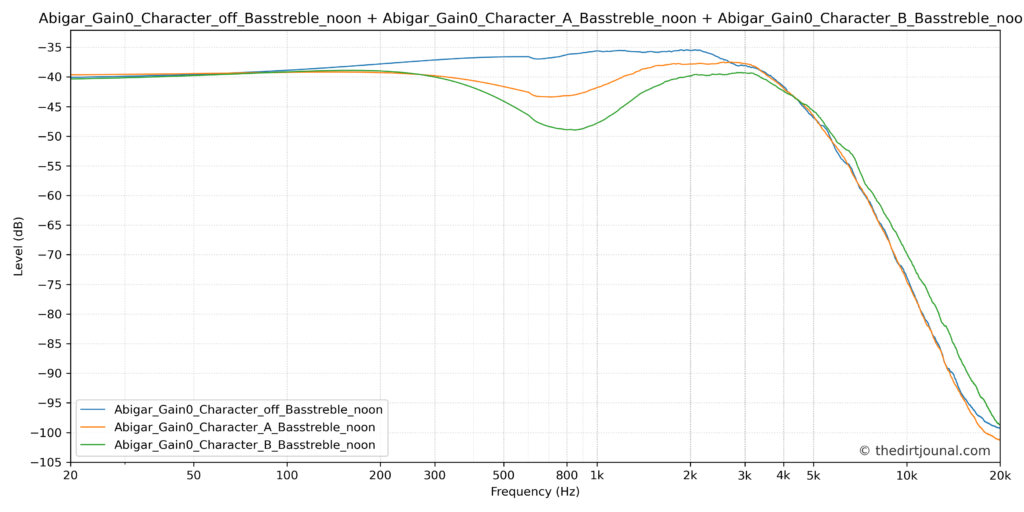
The Character switch introduces a mid scoop. It’s somewhat gentle at setting A and a lot bigger at setting B.
Neither the Gain knob nor switching the Character switch has any further influence on the EQ of the pedal. I tried measuring with different gain settings and EQ positions while switching the Character knob. The frequency response stays consistent through the range of the Gain knob and switching the Character switch only introduces the 800Hz scoops.
So let’s look at the EQ knobs independently. Treble:
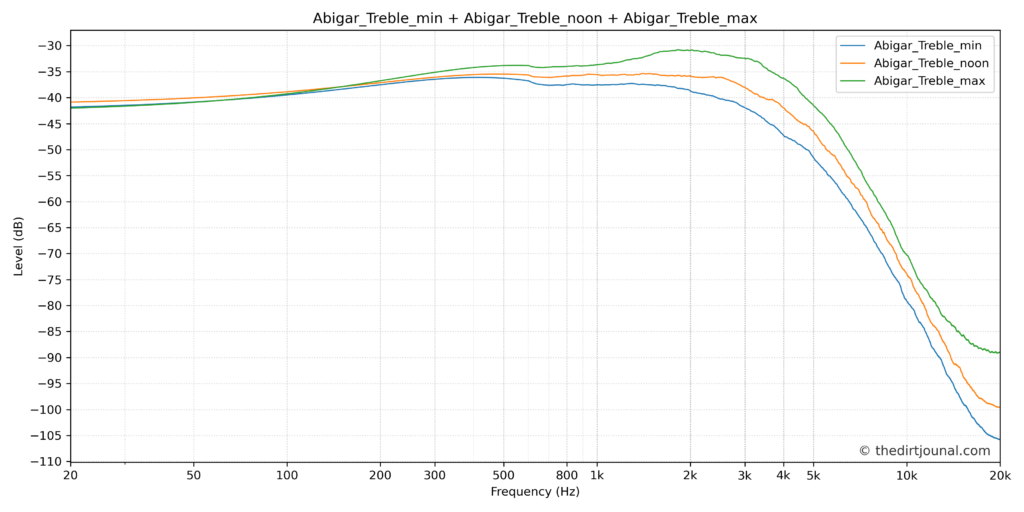
Not too much to look at here. Bass:
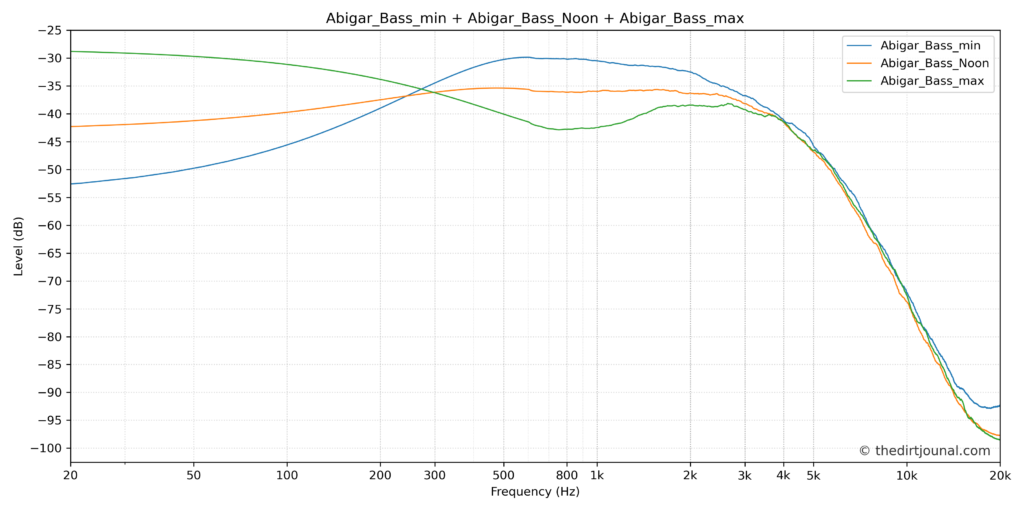
Here we go. The bass knob influences the area below 275Hz in the way one would expect, but at the same time, there is a lot happening in the mid range and it’s opposite to what happens in the bass registers.
Measuring the gain knob revealed something interesting, too:
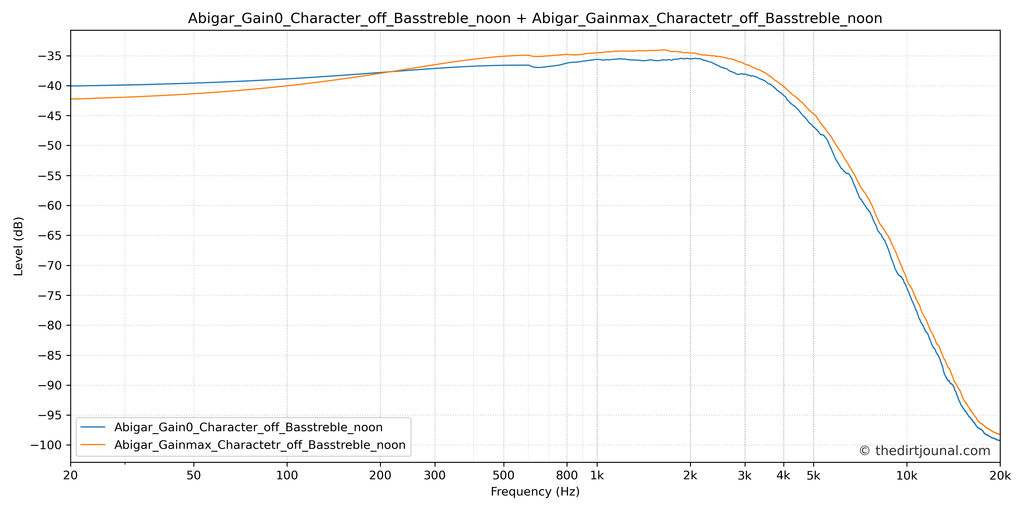
This graph was not compensated in any way. The difference in volume between gain at zero and gain at max is minimal, and probably explained with the fact that more gain means more harmonics added, wich equals more signal coming out of the box.
Now finally, lets get to the sound. I will try my best to describe what the controls do and I shall do so in order of how complex using them feels.
Level is easy. It sets the output volume.
Treble comes next, because it is something that gives you a reasonable amount of control over the top end, including the sizzle. Its flattest setting is noon, run it higher to get some emphasis on the top end and make the sizzle sharper, run it lower to subdue the harshness.
Character is the first weird one. As the second graph shows, the response is more or less flat with it in the off position, and selecting A or B gets you a mid scoop or the same mid scoop, but stronger. The weird bit is that the pedal feels substantially different when you flip the switch. It affects the way it responds to your fingers. Trying to record that is downright impossible, because listening back to the recording only shows the mid scoop applied. There is a solid gap between the difference in sound and the difference in feel. I prefer the sound with the scoop off, but enjoy playing the pedal more in the B setting, with the biggest scoop.
With two controls remaining, I struggle to make up my mind about which one is more complex to use, Gain and Bass will get a shared #1 spot.
Bass is easy when you have it set to noon and then go from there to 1 o’clock or to 11 o’clock, because one will give you slightly more low end and the other will give you slightly less, while noon feels flat. It was established through measuring that not only a shelving filter affects the range from around 275Hz downward, but a bell filter happens above 300Hz in the opposite direction. However, there seems to be a solid portion of clean bass fed into the whole thing along with the EQ. I don’t think the bass knob affects the amount of dry and wet signal and I’m unable to tell whether or not the dry portion is low pass filtered, but I suspect it is.
Gain is a bit weird, too. As stated above, gain does not really affect the volume of the pedal. You don’t have to compensate (much) to accommodate different gain settings. More will lead to more harmonics and harsher sizzle, so you might want to check how it sits in a mix, but it’s not a huge volume jump from gain at zero to gain at max. That’s not what feels weird, though. I could swear there is more going on than just the gain thing – I do believe that raising the gain will increase the drive in a predictable, normal fashion for the higher frequencies, but the bass frequencies don’t feel like they work in a linear fashion. It feels like either the balance of clean lows and lows that get clipped gets raised with raising gain settings, or something akin to the Depth knob that’s to be found on some of the Broughton pedals is at work here. It feels like the higher up you set the knob, the more lows get fed into the clippers.
This means that the Taurus Abigar Xtreme Mk2 is capable of solid distortion sounds that will not neuter your low end unless you want to. The steep drop of frequencies past 5kHz also makes the Abigar capable of driving a bass rig that is equipped with a tweeter or sending the signal straight to FOH without an additional cabinet simulation going on, which makes it quite handy for minimal pedalboard designs that offer solid drive.
At times, I feel reminded of playing the Haggtronix Rotten Sorcerer pedal – not because the Abigar sounds like a Green Russian Fuzz, but because both the Rotten Sorcerer and the Abigar Xtreme do have manners. The reaction to pick or finger attack is very predictable and playing at even higher gain settings sounds quite mean, but it does not feel like you’re trying to ride a feral beast that has a saddle strapped to its back, but no training whatsoever.
Any drive pedal will lead to feedback if you run a single coil into a cranked amp that’s right beside you and the Abigar is no exception, but it’s not one of these pedals where you step on the mute switch the second the song is over. It’s mannered. It’s easy to control. It does not feel like a fight where you have to keep the upper hand at all times lest you get devoured if you but blink once.
The nature of the clipping is of the angry hornet swarm variety. Bigger than bees, more wingspan and lower frequency, but still insectoid buzzing, all carapace, no fleshy bits, but also no metallic clanking and none of that nasty bite. It sits well in a mix – the Character knob can nestle it a little deeper when activated.
I do suppose that with a set of fresh rounds, the metal might get back into the picture, but as usual, I only have flatwound strings at my disposal. There is no disconnection between what comes out of the bass and the generated harmonics, even at higher drive levels the sound remains a single unit.
It is a well made pedal, and at the current second hand prices an absolute steal for what you get out of it. If you’re looking for a distortion pedal that can do some rough textures for harder music, it’s absolutely worth trying out!
This clip showcases the Character Switch. First pass is in OFF position, second pass in A, third in B:
This has the top end dialed back a little and a small boost on the lows: