Strymon Fairfax
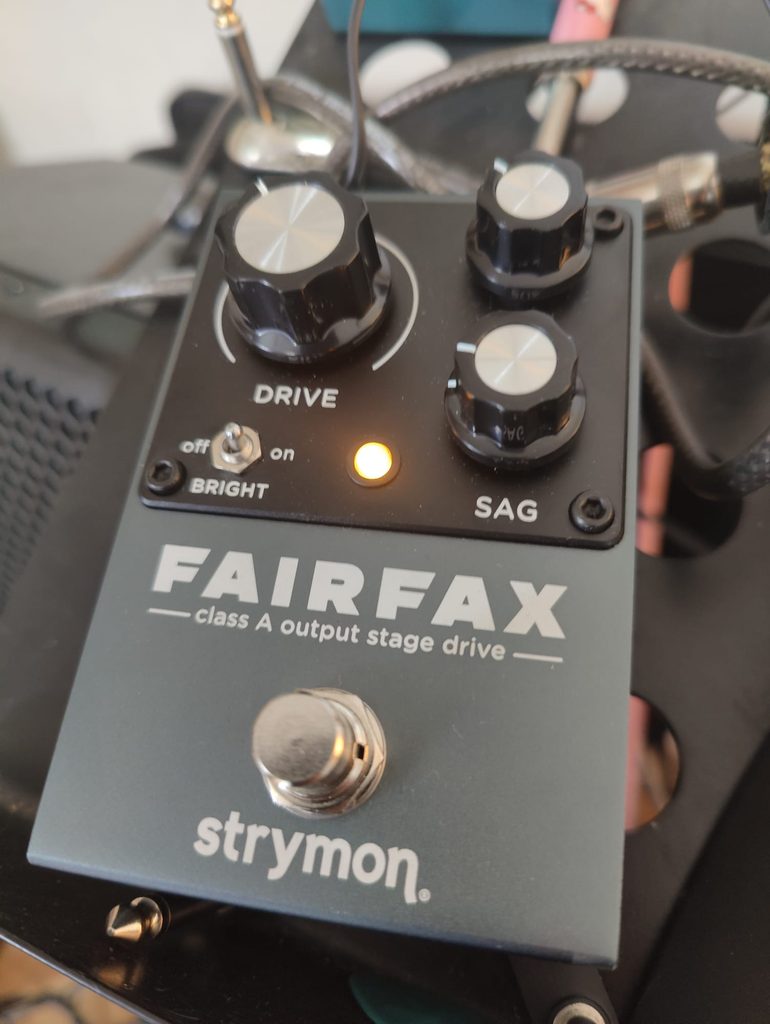
This is, as far as I know, the first pedal Strymon ever did that is completely analog.
I do have a soft spot for Strymon, their reverbs are among the best I ever used and I’ve had the Mobius on my board for a long time. However, Strymon and dirt did not go over so well thus far. They did have their stake firmly placed in the digital realm and the only pedal I tested was the Riverside, because the Sunset did not look like it’s any fun at all on bass, and even with the Riverside, I felt not really at home, or happy. The Fairfax is a step back from the typical Strymon approach. No Midi. No A/D or D/A conversion, no hidden menus you access by holding down foot switches while powering it up. It’s a super simple pedal.
Okay, it has one hidden feature: You can set a jumper on the PCB to set the default state of the pedal (on or bypassed) when it is powered up. That’s a really clever option. On my big board where I switch pedals via looper, I want everything to power on when the board comes alive, while on my small board, I’d prefer the drive pedal to be in the bypass state when power is applied.
Other than that, it’s three knobs and a switch. The owners manual says the switch, which is named “Bright” and changes between on and off, triggers some sort of low pass filter. You can choose between flat (on) and mellowed (off). The three knobs are Level, Drive and Sag.
Strymon did not go for the umpteenth Tube Screamer copy, nor did they base their first analog pedal on any other of the popular circuits. The Fairfax is aimed at tube amp emulation. Internal components are, if you want to believe the manual, not only overdriving a clipping diode, but using JFETs to emulate the preamp AND power amp in discrete gain stages. They even added an emulation of an analog output transformer into the box. The internal power supply takes the 9V going in and puts out 40V – which probably explains why Strymon says you should feed the pedal 500mA – that is a lot for an all analog pedal that does naught but drive.
So the Fairfax is simple on the outside, but features complex inner makings – or at least the Stymon marketing department makes the avid reader of owners manuals think so. The difference is evident: While you gain access to hidden menus and sub menus in most other Strymon pedals when you read the manual back to back, you only get the idea that more than just a preamp, a clipping stage and a makeup gain stage are applied to your precious signal in the Fairfax, but you can’t influence any of it except for the Drive, Sag and Level knobs and the Bright switch.
In terms of build quality, it is your typical Strymon pedal. The form factor is different and there are more edges, but you get aluminium with a perfect finish along with high quality knobs, jacks and switches. Those knobs and switches are fixed to a metal plate which is bolted down with allen screws, giving the pedal a more rugged and industrial look, underlining the analog nature of the thing. All in all, it’s a high quality pedal that is made very well, as one would expect from a brand like Strymon.
There’s not much else to do but to plug it in and see how it performs, so let me do just that.
Before I hook it up to the white noise machine to take measurements and also before donning my analytical set of ears to see if I can verify the claims of the manual, I do the simple and obvious thing. I play my bass, then step on the footswitch to see where it gets me. With Drive at zero, Sag completely CCW, Bright set to ON and Level at noon, there’s not much happening except for the LED coming on. Increasing Drive and Sag a little gets me into the territory of amp-like breakup. There is a solid push back and the pedal fights tooth and nail to get back to clean after the initial attack of the note forced it to drive. The feeling of the drive is astounding. The Fairfax also has a very clear opinion on note separation. Each note is to be portrayed in its own glory. There is no mushing them together.
First impression is great. I really like what I’m hearing, and I like even more how it feels while playing.
Let’s look at the Bright switch. The Manual says its flat in ON position and has a high cut in the OFF position:
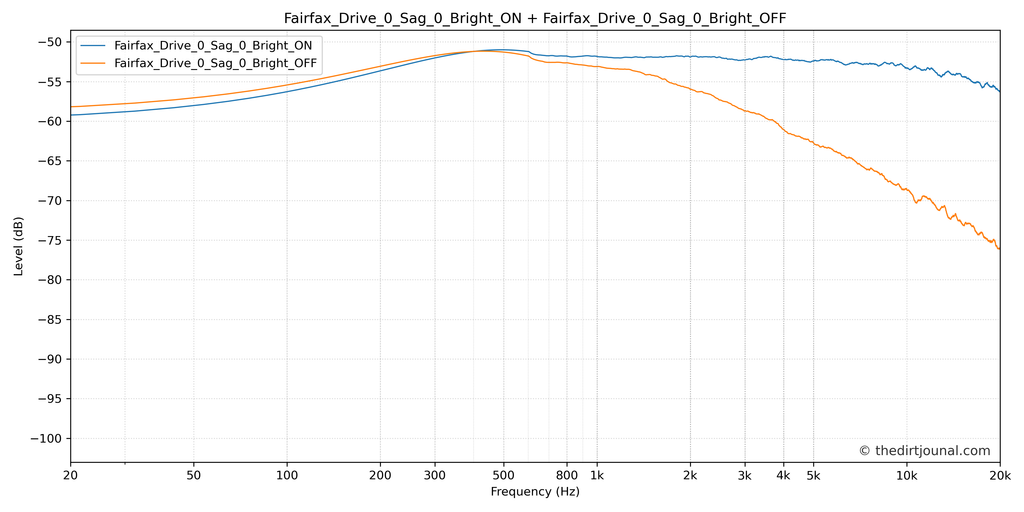
Which looks like it’s a very exact description.
Next thing I wanted to know is if the Drive knob affects the frequency response of the Fairfax:
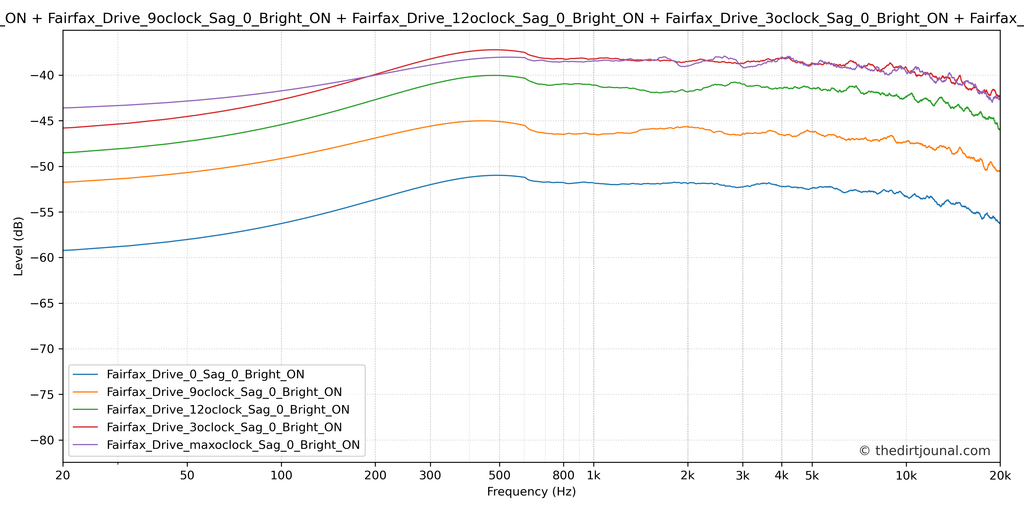
Which is a no. The frequency response remains the same through the travel of the Drive knob. It passes signal at zero and increases output volume, but you see that the volume jumps between the positions get smaller with increasing gain.
Is there anything learned from measuring the Sag knob’s travel?
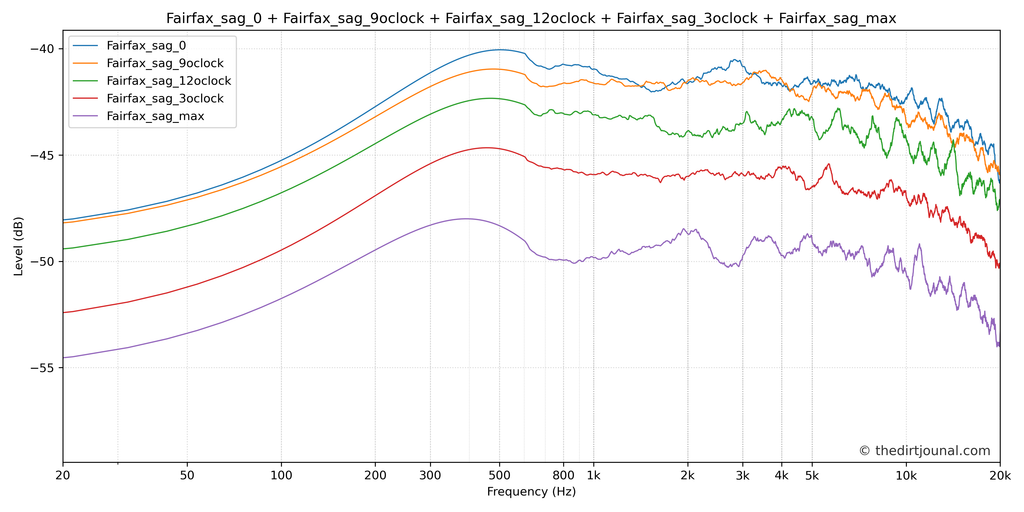
Increasing Sag will decrease the output volume, which was to be expected. To my ear, the low end drops out a little at higher settings, which does show in the graph, especially looking at the 12 o’clock and 3 o’clock position. Sag works a lot more subtle than one might suspect. You can’t go from overblown to completely starved, it is a very reasonable range that’s covered by the knob’s travel.
Looking at the controls and the description, one pedal immediately springs to mind: The Fairfield Barbershop. It has a similar layout, with Drive and Sag knobs plus a switch that takes off the top end. However, being nearly identical on paper, they feel quite different and sound quite different, too.
While I’m pointing fingers and naming names, I want to drop these:
Audio Kitchen Fake Plastic Trees – The Fairfax and FPT share the great feeling and the healthy pushback behaviour.
Effectrode Tube Drive – the way Fairfax and Tube Drive keep note separation on double stops feels similar.
Verellen Meatsmoke – the organic feeling of tearing fabric at higher drive levels feels similar, but the Fairfax has a baked in warmer texture.
Empress Drive – because it’s also a fairly recent solid state pedal that emulates a tube amp, and works really well.
I don’t want to say the Strymon Fairfax has the same attributes and resembles a ‘best of’ of the aforementioned pedals.
I do think the Fake Plastic Trees still has a better feel to it, but the Fairfax is aiming for the same thing, to a slightly lesser amount, and the same goes for the special tricks of the other pedals mentioned. That makes the Fairfax its own thing.
Let’s get to what is not exactly perfect about the pedal: It’s breaking up easier the lower you play and there’s no way to adjust that.
You know those pedals you set for the lightest drive and when you play in the money register, there’s just a tiny bit of hair around your notes, but when you slide up the neck and play a double stop, it blends together and blooms up? The Fairfax is the opposite of that. You get solid grind down low which gets lesser when you play higher up and I already mentioned that it’s not a fan of mushing notes together and much rather represents them individually.
The Fairfax has a baked in sound that you will have to live with – basically you should choose the Fairfax because of that jind of sound. I want to say it feels warm, organic and fat. Which is somewhat interesting – because looking at the graphs above, one might accuse the Fairfax of grand theft lowend, or cross ones fingers that the low cut is not so bad as to be clearly audible when playing. This does not exactly couple well with the description “It sounds fat and warm”, but here we are.
There are a few weird little quirks that are quite charming once you understand them a bit. When playing with the Drive knob and the Sag knob at around 9 o’clock — fairly low — the feeling that translates back to me is not that of an amp, at least not first and foremost, it’s much rather the speaker. You can feel the cardboard of the cone, it’s a vintage one, and I do think it’s open back. It feels like a 30w speaker pushed by a 50w amp – so the pushing is relentless, and a bit too strong for comfort. The rubbery part around the outside that does most of the movement is hanging on by the skin of its teeth.
It feels like a Gentleman in his late forties that participates in a young man’s sport. Said Gentleman is the competitive sort, and used to be quite good at this sport – in his prime, that is. Family and Job were quite demanding in recent years and he did fall out of shape. He’s not gotten fat and lazy – he’s just fallen out of shape for performing that sport at a competitive level. So here he is, driving himself to levels he used to reach when in his body was two decades younger. Instead of a well maintained muscle apparatus, he purely relies on spite, grit and testosterone to show the young folk their place. This whole endeavor is crowned with success, but the cost – the cost is dear. That knee won’t move without agonizing pain for at least a week, the ankle is clearly bruised (judging from the color and swelling) and let’s not talk about the back pains – and that’s how the gentleman feels after applying a thorough coat of Voltaren to all the affected areas. The wife, Gods bless her, helped with the lower back.
Turning up the Sag knob kinda fits into this description thusly: Every increment of Sag adds another year to the Gentleman’s age.
There are finite amounts of grit, spite and testosterone said Gentleman can use to make up for advanced age, so at some point, muscles give in and the ability to compete decreases and the Gentleman gets angrier with each passing decade.
This effect makes the drive sound like a tube amp that’s hoarse. There’s just a bit of prickle on the creamy drive that roughens up the surface and gives it the edge of a freshly sharpened chainsaw spinning at minimum rpm.
Comparing the Fairfax closer to the empress Drive, it’s that prickle that sets them apart, the Fairfax just has a slightly rougher edge to its drive. The Drive is, of course, capable of EQ and can boost your low end better, but it’s also a fair bit pricier.
I enjoyed the Fairfax most with a solid bit of grind dialed in. It can do edge-of-breakup sounds, but other pedals feel like they enjoy that more, the Fairfax wants to do audible dirt that sounds like you mean it. There are several pedals out there that emulate the signal path of a tube amp, and the Fairfax comes in that circle with a bit of a ragged edge to the drive that feels like it’s passed the point of smooth tube drive, but only just. It’s not a super aggressive tube drive either, but it’s more aggressive than the smoother ones.

You might notice that the picture to the left looks a bit faded and washed out. That is because I really debated decorating this post with my sign of approval. I did use it playing with others, and I largely enjoyed the sounds I created with the Fairfax, but after a few days of playing, my mind was already made up and I knew that with the tests concluded, the Fairfax will be released back into the second hand market. There are other pedals in my collection that do a very similar job and I simply enjoy playing them more. I’ve had pedals that I liked a lot without handing out the badge, and I’ve had pedals that I enjoyed less, yet pinned the badge on them because they worked so well. This was the first time I had trouble with the decision, so it’ll be the “Slightly faded badge of approval”, which I still count as a good thing – a grudging approval coming from a gear snob is still worth a lot.
This is my P-bass into the Fairfax at minimal settings with the bright switch engaged. Note there is a slight drive coming from the preamp in use (Origin Bassrig Super Vintage). It totally escaped me when recording this. But note also how the drive increases with the Fairfax activated, even though the level is slightly lower.
Same bass, same preamp settings. Now the Sag is raised to about 8 o’clock and the Drive to 10 o’clock.
I tried to compare the tone of the Fairfax with the empress Drive. First pass clean, second pass Fairfax, third pass Drive.
And this is high gain, high’ish sag, and my U-Bass with tapewounds.