Origin Effects EQ Deluxe
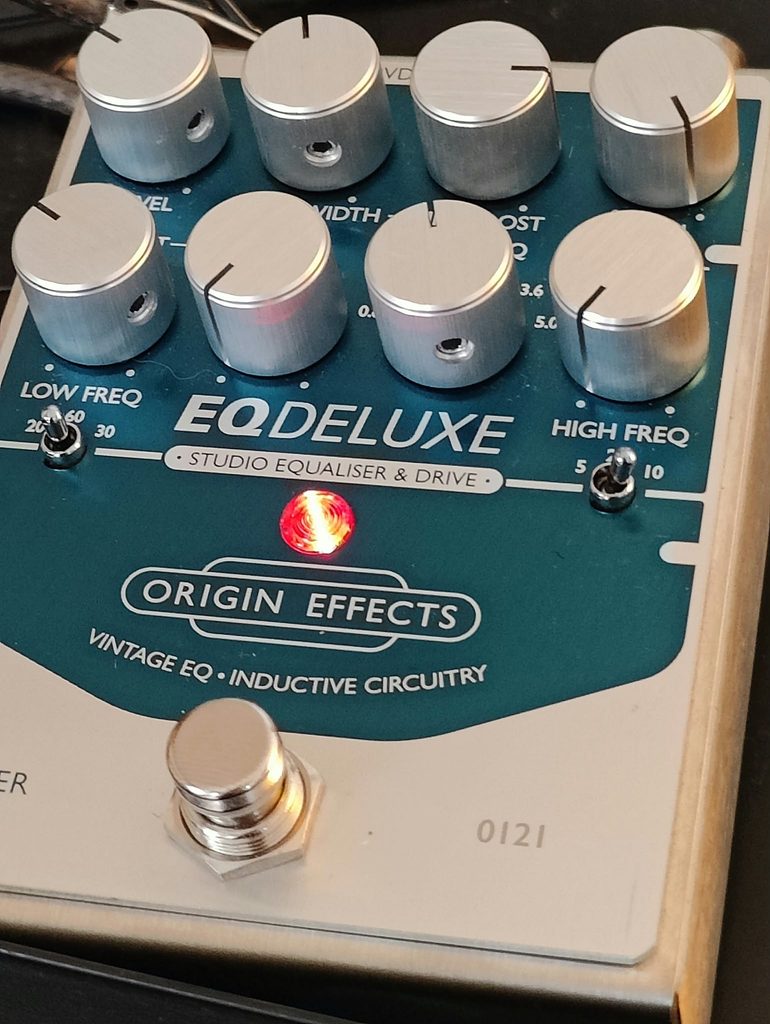
Finally, Lady Luck was smiling my way and tweaked the Universe enough so I could get my hands on the Origin Effects EQ Deluxe Studio Equaliser & Drive.
As you might have put together by now, I am considering myself an Origin Fanboy. At the moment of writing this, two of their pedals are in my personal favorites as bass dirt pedals (DCX Bass and Bassrig Super Vintage), the Cali76 Compact Bass (the old one) is my favorite compressor pedal of all times and the only pedal I like so much I own two identical ones.
This here is Origin’s newest creation, the EQ Deluxe.
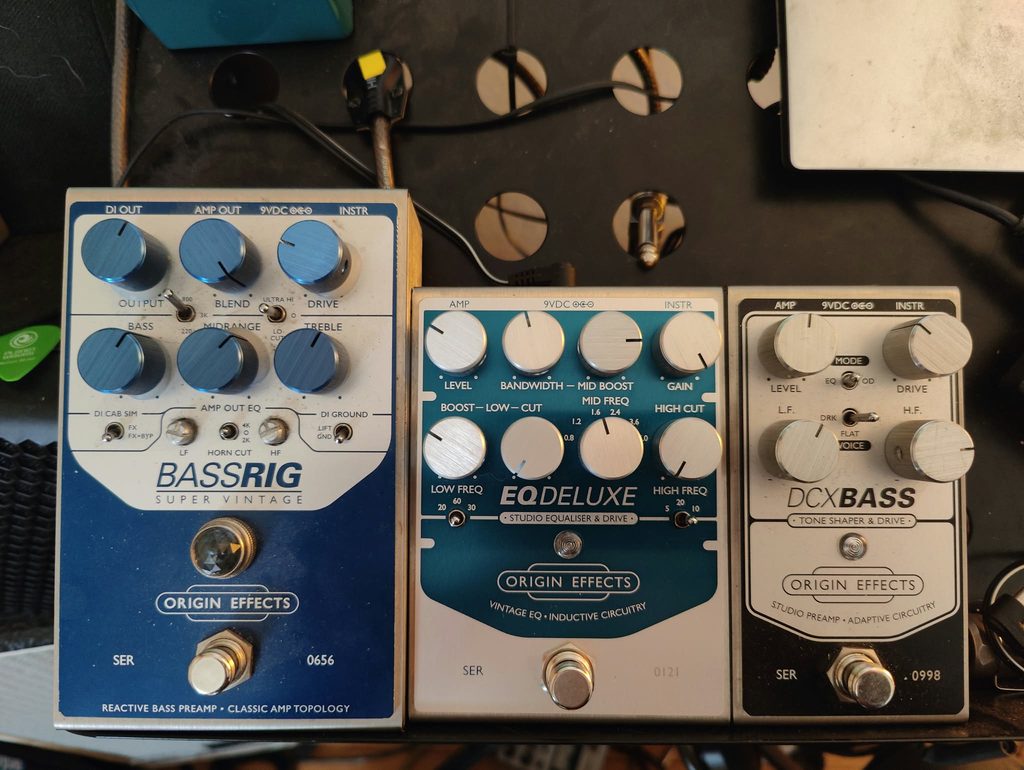
It is, as one might suspect, cooked to Origin’s recipe, featuring a stainless steel enclosure and high quality components, along with impeccable workmanship. The size came as a little surprise to me – I had anticipated that it’s matching the Bassrig enclosures, but it’s much smaller than that. Here’s a size comparison:
Once again, Origin created a more or less faithful reproduction of a piece of audio gear, namely the Pultec EQP-1A Program Equalizer, a massive 19″ rack unit that was originally made from 1956 to 1971. It was reintroduced in 2000 by a successor company and is available to this day. The Pultec is one of these pieces of analog audio gear that got famous for using it in a way the maker never intended. You might know of the 1176 compressor’s “All buttons in”-mode, where you’d push in all ratio buttons and get a result that was never meant to come out of the unit, yet works a treat for mixing drums. The so called Pultec-Trick is much simpler. You get a knob for boosting lows and you get a knob for cutting lows – and a knob for selecting the frequency where those two are centered. The original Pultec manual warns you not to use boost and cut at the same time. Common sense would say so in any case – why boost and cut? If you add bass frequencies and then subtract bass frequencies, you can save yourself the work and do nothing in the first place. The crucial bit, however, is that the boost and cut don’t overlap perfectly, there is an ever so slight gap between the two. This leads to a rather sexy looking tone curve:
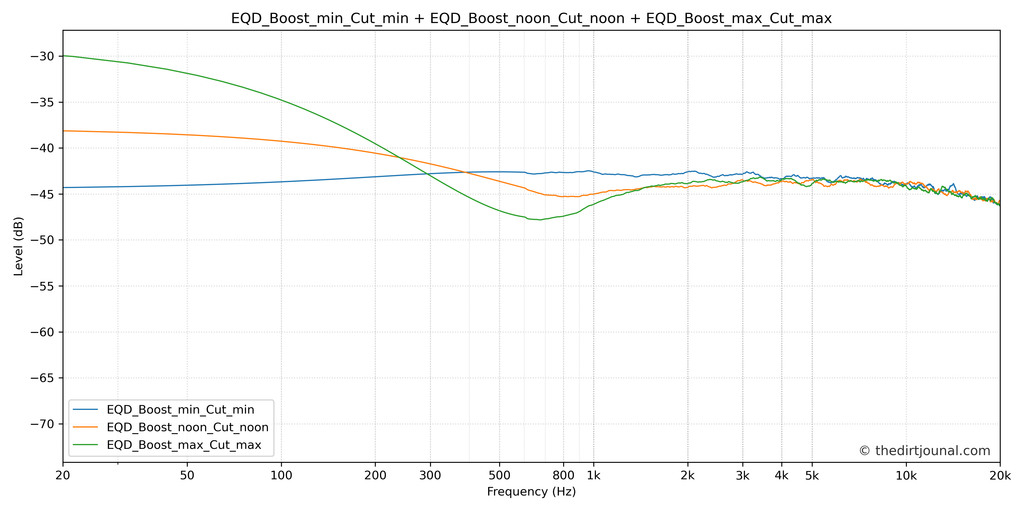
As you can see, the boost is followed by the cut, so when done right, a bassist can use this to boost the foundation of the sound while cutting low mid rumble.
That’s the Pultec-Trick, briefly explained. The EQP-1A, and therefore the Origin EQ Deluxe can do a few things more. There is another band for boost and yet another for cutting, this time both come with their own frequency selection. The cut is 5, 10 or 20kHz, while the boost starts at 3kHz on the original Pultec, but Origin lowered that to 0.8kHz which makes a lot of sense to me.
To my knowledge, the first pedal maker that released a pedal version of the Pultec EQP-1A was Spaceman Effects with their Equinox pedal – and on this one, the frequencies for the treble boost and cut were altered, too – and went down to 1kHz.
Mr. Jounalist! You cry. These are EQ devices you lecture us about. This is the Dirt Jounal! And you’re right, but impatient!
Modern pedals like the Equilux or the ZeroFive Audio LowRider have picked up on the Pultec Trick and they’ve been around for years. Origin, however, does not roll like that. When Origin sets out to capture a device, they don’t go for the one signature sound said device is famous for. They go for the whole nine yards nineteen inches, input jack to output jack. And this might be lesser known around non-studio folk, but people have used the Pultec EQP-1A for its preamp alone, with the EQ section bypassed. Since the Pultec is a passive EQ, you need to create some makeup gain to get the signal back to unity. There is a trio of tubes at work here, a 12AX7 in the input stage, and a 12AU7 at the output, plus a 6X4 in the rectifier position. This is a valid preamp configuration in my book and it has a gain knob that allows to be overdriven. The topology is EQ section first, then gain section – so when you choose to drive the unit, your choice of EQ will affect the nature and timbre of the drive.
While the makers of the Pultec EQ did not anticipate it would achieve legendary status because people would use it in a way it was never intended to use, and Origin probably sought to bring that utility to a pedal board, I will, for my personal testing, put this pedal into the role of a low gain overdrive and judge it for its capabilities to act as such.
Upping the Drive knob yields a wide area of just-before-the-edge, followed by the edge of breakup, followed by actual breakup. It’s interesting that there is so much space between the point where it’s stopped being definitely clean and the point where actual, audible breakup starts. That’s usually the tiny sweet spot you chase with pinched fingers on the knob carefully applying force to shift it by the smallest increments. I quite like how easy that kind of tone is to access on the EQ Deluxe, but let’s turn the knob up a bit further.
The nature of the drive on the EQ Deluxe, I want to categorize as this: When you get to audible fizzle, it’s actually pretty similar to overloading a mixing console, at least in terms how it feels: Like a device that was not constructed to be driven. Since the EQD is imitating a device that runs on tubes, it’s not the nasty sizzle of an angry microchip, though. In terms of sound, there is quite a bit of tube in the mix. When I tried it playing with others, I ran my weak-ish output six string into it, with the gain and boost options dimed. The guitarist commented “that’s a nice fuzz you got there”.
Indeed it yielded that upper harmonic sizzle most vintage fuzz pedals are capable of and famous for. Something that had eluded me in my private chambers, but felt a bit obvious when playing with others. That particular sound is not entirely pleasant when solo playing, but works extremely well in a mix with slightly driven guitars.
That said, I strongly feel that Origin has not constructed the EQ Deluxe as yet another device that’s meant to be used as a drive pedal. It’s meant to be used for the Pultec-Trick, and since the old Pultecs could add that rich and creamy tube goodness, Origin has worked hard to pack that in the pedal, too. The way it’s meant to be used is by adding that subtle compression and saturation that sets in when you approach the red line in the sand, but do not cross it. That is where it feels best. A slight hint of audible grit, along with not going too wild on the EQ will get you a sound that sits better, feels better and has some subtle richness to it. Don’t expect it to polish a turd, though. If you have a bass sound going that is already good, then the EQ Deluxe will nudge it towards a great sound. It’s a lot like a well made and expertly set compressor pedal. It’s not in-your-face. It’s a subtle, but noticeable difference that brings you one step closer to perfection. Note that there is a finite amount of magic tone sweeteners you can have active in your signal chain, though.
I feel like I’m dancing around describing the nature of the drive, and the reason for that is that is a bit elusive. I did start with the EQ off and only using the gain knob, but that felt wrong, since the EQ has a direct effect on how the drive sounds when you use it, so I did mix in some Pultec goodness and also boosted the 1.2kHz band a bit.
The one thing that is something of a constant is when you use enough gain to get solid drive, you will have that fizzle sizzle up top. It’s a sort of drive I don’t particularly enjoy. I remember testing the Origin Deluxe 55 and strongly disliking it for that exact tonal trait.
I must admit that I never took the Deluxe 55 anywhere to play with others, while I did try out the EQ Deluxe in a mix, and it had that P-Bass effect – a sound that will not really squeeze a tear from a bedroom player’s eye will, as it is introduced into a mix, suddenly reveal itself as a social creature. Put it among others, and the shortcomings step into the background, leaving something that really works, nay, even shines when the sonic bandwidth gets crowded.
This is as close as I am able to get with a proper description.
Used purely as a drive pedal, the Origin EQ Deluxe does better than the Origin Cali76, but falls short of the units that were meant to be driven, like the DCX or the Bassrigs. Given the price, I really doubt anyone would use it purely as a drive – the competition is quite fierce when you’re shopping with that kind of budget. But when you have it on your board and need a little drive, it’s really a valid option. However, if I was building a board for a gig and had one spot left for a drive pedal, I’d most likely pick something else. The EQ Deluxe is a magic tone sweetener that adds some unusual, yet attractive curves to your EQ and is capable of that sweet saturation – and it’s great in that role – much too good to take it off that position and make it responsible for your dirt needs. Field promotions excepted, of course.
First try: Capture the pure drive sound. Everything EQ is set to neutral and the gain is set to max. Note that the EQ sits before the drive, so it does shape the drive response, too.
Here’s a subtle one, with the drive just before noon and some EQ deployed to the signal
This example is three passes with the gain at max, treble boost frequency set to 1,2k and the bandwidth set to noon. Bass boost, bass cut and treble boost are at minimum in the first pass, at noon in the second and at max in the third.
This is my Le Fay bass with the gain about three quarters up.
And once again, with the gain at maximum. On the third pass, I increased the plucking strength.
And here’s my P bass, played with a pick.